

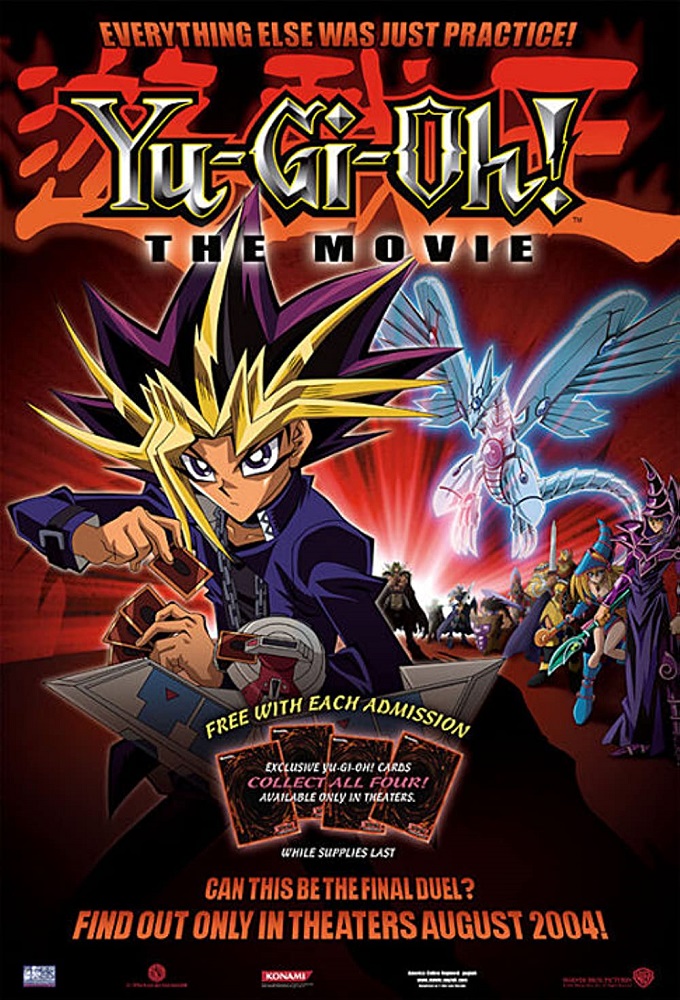
(Yugio: Gekijo-Ban)
Crew
Director – Hatsuki Suji, Screenplay – Matthew Drdek, Lloyd Goldfine, Norman Grossfeld & Michael Pecerlello, Story – Masahiro Hikokubo & Junki Takegami, Based on Characters Created Kazuki Takahashi, Producers – Pecerlello, Grossfeld, Noriko Kobayashi, Katia Milani & Naoko Sasada, Music – Elik Alvarez, John R. Angier, Joel Douek, Wayne Sharpe, Freddy Sheinfeld & Gil Talmi, Animation – Studio Gallop. Production Company – Shonen Jump/4 Kids Entertainment.
Voices
(English language Version)
Dan Green (Yugi Moto/Yami Yugi), Eric Stuart (Seto Kaiba), Darren Dunstan (Maximilian Pegasus), John Campbell (Tristan Taylor), Wayne Grayson (Joey Wheeler), Tara Jayne (Mokuba Kaiba), Maddie Blaustein (Grandfather Moto)
Plot
Young Yugi Moto solves the Millennium Puzzle and in doing so unleashes Ancient Egyptian forces that resume their centuries old Shadow Games. In the Games, combatants duel with playing cards that can summon up various magical entities that have differing strengths and abilities that allow them to combine or affect the way an opponent plays. Yugi becomes the world’s top player due to his possession of three Egyptian God cards that have infinite attack strength. The defeated Seto Kaiba schemes to unseat Yugi’s championship. Kaiba takes on the immortal Pegasus in order to win the two cards that can defeat Yugi. Kaiba then challenges Yugi and in combat succeeds in banishing Yugi’s gods and trapping him inside a powerful pyramid of light. However, this has opened up dangerous forces that threaten the world, while inside the pyramid the god Anubis stirs back to life.
The Yu-Gi-Oh! phenomenon was a children’s fad that hit Western shores in the mid-2000s and went ballistic. It grew out of a manga created by Kazui Takahashi, which first appeared in 1991 in the weekly comic magazine Shonen Jump. Takahashi was reportedly inspired by a love of childhood cardgames and created a shonen strip about a young hero who plays various games. The strip took after the introduction of the cardgame Duel Monsters – Takahashi was inundated by children wanting to learn the rules and was then placed in the position of actually having to create the game. Takahashi came up with an idea that fell halfway between the fad for collecting cards and the premise of gaming cards popularised by series like Magic: The Gathering.
With the expansion of the manga into an animated tv series Yu-Gi-Oh! (2000-6), the game phenomenon became a mass-market institution. Indeed, while featuring relatively little in the original manga and anime episodes, the cardgame now become the central tenet of both. There are few series that are so blatantly designed as outright marketing opportunities – this is one occasion where, akin to the Pokemon phenomenon, the collecting of the cards is actually tied in as a crucial part of the series’ premise.
Yu-Gi-Oh! The Movie – Pyramid of Light is the inevitable movie spinoff of the series. It has many similarities to the first Pokemon movie Pokemon: The First Movie – Mewtwo Strikes Back (1998) – it has been quickly and cheaply made to exploit the phenomenon (in a traditional, limited anime style where characters have eyes that take up nearly three-quarters of their faces); it has been pitched directly to the largely pre-adolescent fans of the series and games; and it makes no concessions (is almost entirely incomprehensible) to anyone who has not seen the series (like this reviewer).
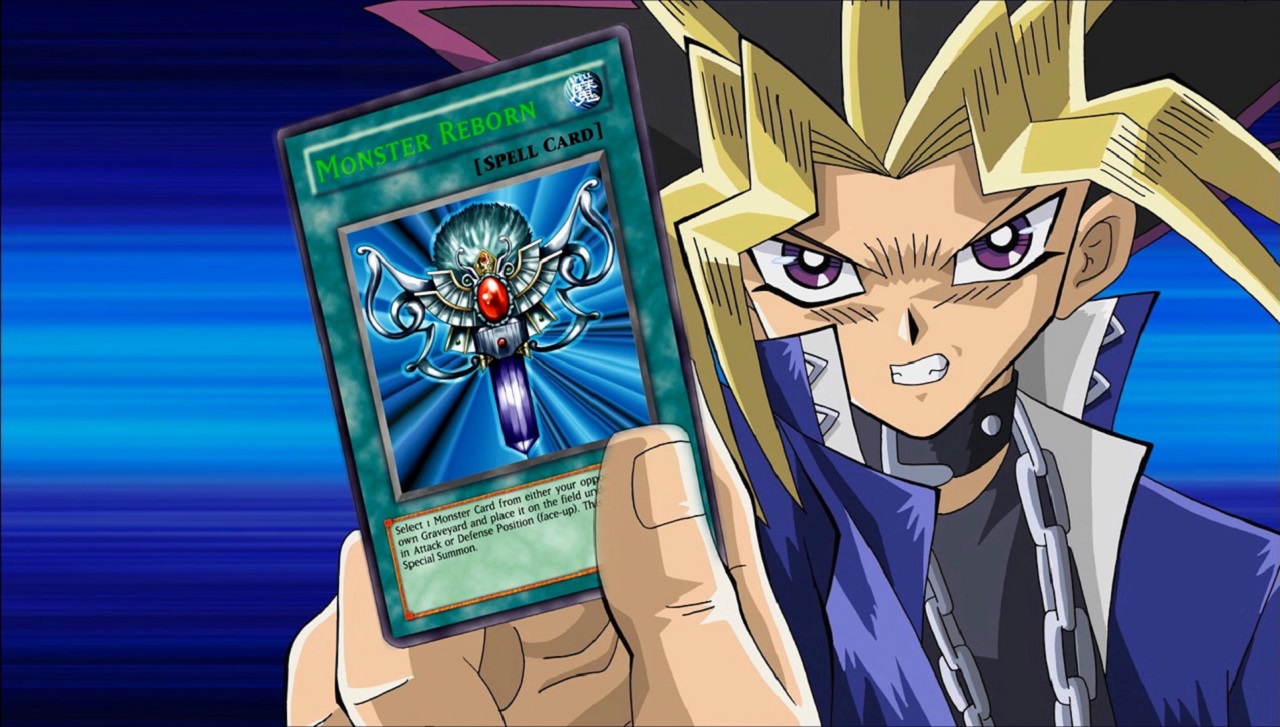
What one was struck by was the incorporation of the card playing as a direct element of the action. There are even little pop-up menus on the screen counting a combatant’s life and attack points. A lot of the action centres around this type of combat – “My Blue Eyes Shining Dragon card beats your ….”, “I play two cards and put two face down,” “I sacrifice 100 lifepoints in order to …”, “I destroy two creatures and play my resurrection card” etc etc. It is not clear what the creatures that appear actually do or where they come from – it eventually becomes apparent that they are only like glorified holograms and have no ontology outside of the game arena and that the lifepoints being lost refer only to the artificial points granted in the game, not a player’s actual life, although in contradiction of this some cards later appear to be in danger of threatening the world.
As a story scenario, this is vague – there is nothing to it beyond the card-playing concept and the set-up seems conceptually stretched trying to make the cardgame into a dramatic scenario. One clearly needs to have absorbed themselves in the animated series in order to understand who half the characters are and the complex backstory of their relationships – it is not particularly clear, for instance, how Yugi became unbeaten world champ and exactly who the doppelganger that takes him over to play the game is.
That said, you have to admire Yu-Gi-Oh! The Movie – Pyramid of Light for its wild profusion of elements. It seems to throw in elements from just about every anime out there – Transformers, Pokemon-like creatures – and just about every other fantasy trope imaginable – dragons, magicians, robots, toons (and this is an animated film), mummies, Ancient Egyptian gods, demons, malevolent clowns and fairies. If nothing else, it is a film that keeps one’s interest with the sheer profusion of fantastic elements. It also proves fascinating in watching the various games in play and trying to work out the rules by which they operate. Not enough to make a good movie but at least a better one than Mewtwo Strikes Back.
Yu-Gi-Oh! The Dark Side of Dimensions (2016) was a further film spinoff from the game.