
USA. 2000.
Crew
Director/Screenplay – Adam Simon, Producers – Paula Jalfon, Colin McCabe & Jonathan Sehring, Photography – Immo Horn, Music – Godspeed You Black Emperor & Karlheinz Stockhausen. Production Company – Minerva Pictures.
Featuring
John Carpenter, Professor Carol J. Clover, David Cronenberg, Wes Craven, Tom Gunning, Tobe Hooper, John Landis, Professor Adam Lowenstein, George A. Romero, Tom Savini
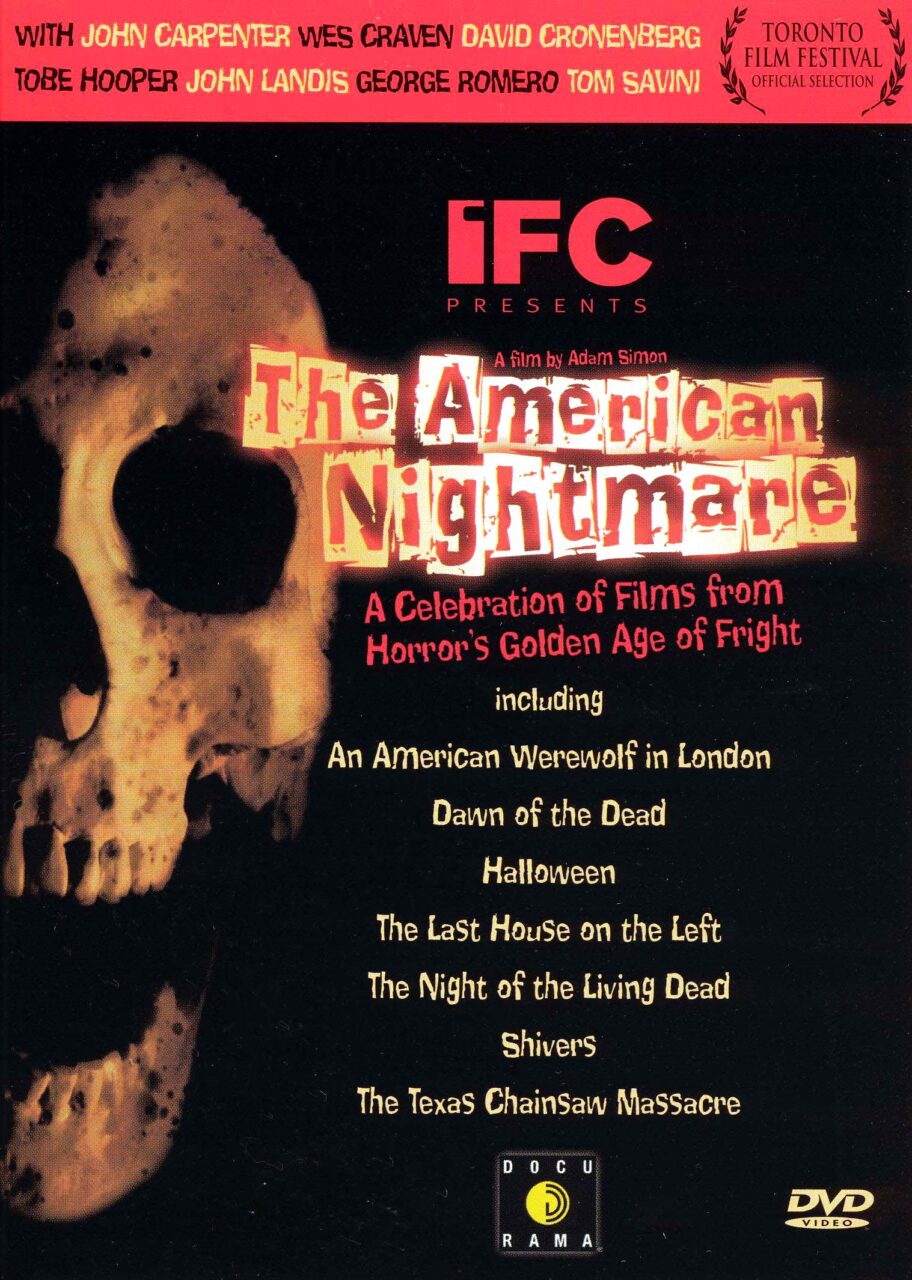
The American Nightmare is a documentary about the horror movie between 1968 and 1979. The film was made by director Adam Simon, operating on funding from the Independent Film Channel. Simon himself made a couple of B horror movies himself – the dazzlingly ingenious Brain Dead/Paranoia (1990) and the cheap Carnosaur (1993), as well as wrote the scripts for Bones (2001), The Haunting in Connecticut (2009) and Books of Blood (2020) and created/produced the tv series Salem (2014-7) and produced the alien invasion film Captive State (2019).
Adam Simon’s approach is a little scattershot. Firstly, you notice that it is not strictly the American horror film he is discussing despite the title – he also focuses on the work of Canadian David Cronenberg. Secondly, we are not entirely sure why Simon discusses only the horror movies of the 1970s – there is slight discussion of earlier films and none at all of later films. The American horror film has been as prevalent in almost every other decade of the 20th Century so focusing only on the 1970s is a somewhat limited discussion of ‘the American nightmare’.
Furthermore, Simon narrows his discussion to only six films from this era – Night of the Living Dead (1968), The Last House on the Left (1972), The Texas Chain Saw Massacre (1974), Shivers/They Came from Within/The Parasite Murders (1975), Halloween (1978) and Dawn of the Dead (1978). All are undisputed classics no denying but there were other highly, if not even more influential, films made during this era – the likes of The Exorcist (1973), Jaws (1975), Carrie (1976) and Alien (1979), for instance. You could perhaps eliminate most of these by arguing that Simon is only covering B-budget indie horror (although there is no indication given in the film that this is his sole focus). However, what about Friday the 13th (1980), which was certainly more influential than the classic but not overwhelmingly widely successful Shivers was? One suspects that what we have is simply a personal selection, that the choice of the era and the selection of the films in question has more to do with the films that Adam Simon enjoyed while in his teens than anything else.
Where Adam Simon’s focus seems less an exhaustive study of the era than a personal profile of his emergent years, you cannot fault The American Nightmare as a documentary. Simon interviews legendary genre directors such as John Carpenter, David Cronenberg, Wes Craven, Tobe Hooper, George Romero, as well as makeup effects man Tom Savini, director John Landis (who doesn’t represent any particular film) and three academics who all offer intriguing insights into the films and their reflection of the times.
Simon manages some potent social analogy tying The Last House on the Left to Vietnam, Shivers to the Sexual Revolution and Dawn of the Dead to disco and the Me Generation and so on. He powerfully merges the images of bodies being burned and thrown into the garbage from films such as The Crazies (1973) and Rabid (1977) with Vietnam massacres, and intercuts disco dancers with Dawn of the Dead‘s stumbling zombies. There is a mesmerising piece where Tom Savini describes basing his gore effects on things he saw in Vietnam. All of which demonstrates that anything the real world has to offer is infinitely more horrifying than any fiction.
Sometimes Simon’s juxtapositions are clumsy – when people talk about things washing over, he cuts to someone washing a screen; a reference to doors being opened cuts to … a door opening. Other times he is clever – like cutting from Tom Savini saying “You don’t know what it is like” [in reference to a Vietcong running at him with a gun] to a scene from Maniac (1980) where the maniac runs at a victim (played by Savini) in a car and blows his head off with a shotgun. Although he never does this more cleverly than cutting from a discussion on the sexual metaphors in Shivers to John Carpenter saying (of Halloween): “I didn’t mean to put an end to the Sexual Revolution. And for that I deeply apologise.”