

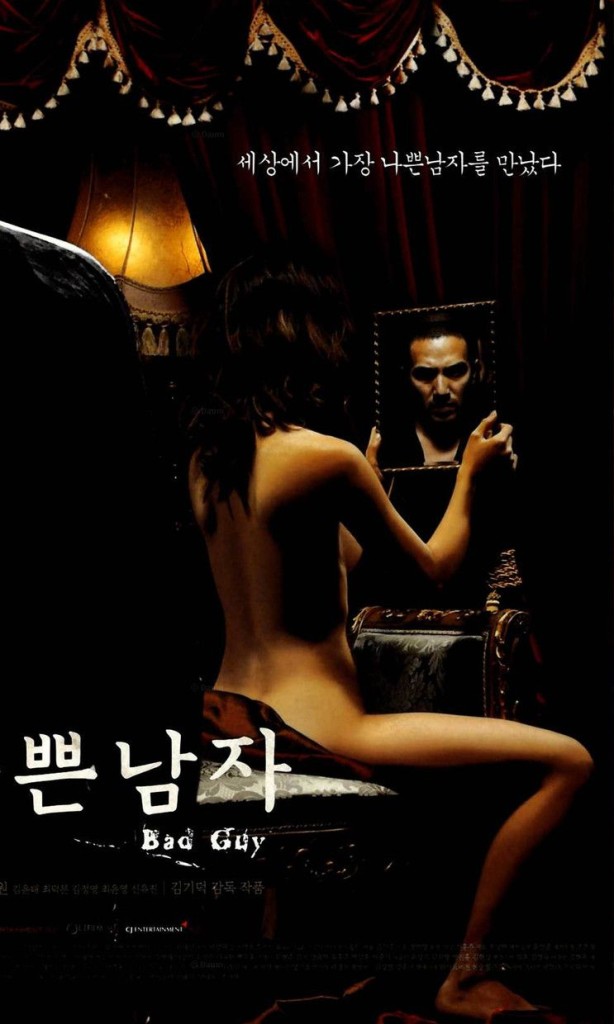
(Nabbeun Namja)
South Korea. 2001.
Crew
Director/Screenplay – Kim Ki-Duk, Producer – Lee Seung-Jai, Photography – Hwang Choi-Hyun, Music – Park Ho-Jun, Art Direction – Kim Sun-Ju. Production Company – E Tube Entertainment/CJ Entertainment/Light&Joy Film.
Cast
Cho Je-Hyun (Han-gi), Seo Won (Kim Sun-hwa), Kim Yoon-Tae (Jung-tae), Choi Duk-Moon (Myung-su), Kim Jung-Young (Eun-he), Nam Gung-Min (Hyung-su)
Plot
Han-gi, a petty hood who never speaks, suddenly grabs and forcibly kisses the pretty art student Sun-hwa in the middle of the street, before being dragged off by her boyfriend and police. Humiliated, he contrives to have a man drop a wallet beside Sun-hwa in a bookstore. When she is tempted and takes the money, the man demands its repayment to the tune of $10,000 and forces her to take out a loan. The only way for her to repay the loan is to sell her body. She is placed in a street-front brothel in the midst of the red light district. There Han-gi secretly watches her every humiliation from behind a one-way mirror. However, as he watches her and she becomes aware of him, a peculiar relationship grows between the two of them.
South Korean cinema is a phenomenon that has blossomed in a big way since the 1990s. It has managed to successfully adopt a number of other Asian genres – the Hong Kong gangster film, the Japanese ghost story and the wu xia flying swordsman genre. The country has also produced a number of extraordinary taboo-defying works with the remarkable likes of Lies (1999) and Oldboy (2003).
Bad Guy comes from Kim Ki-Duk who has come to the forefront of contemporary Korean cinema with acclaimed works like The Isle (2000), which verges on being a horror film, and the international arthouse successes of the contemplative Buddhist work Spring, Summer, Autumn, Winter … and Spring (2003), the quirky romance 3-Iron (2004), Pieta (2012) about the relationship between a petty hood and his mother, and the brutal Moebius (2013). Kim Ki-Duk’s films circle around often recurrent themes. His films often feature characters who do not or cannot speak, while some of the films take place almost entirely without words. Many of these feature women who are prostitutes – The Birdcage Inn (1998), The Isle and Samaritan Girl (2004). His prostitutes and other isolated outcasts seem to be trying to find love across social divides or where they are drawn in different directions – the single prostitute forced to service a whole community in The Birdcage Inn but wanting to leave; the mute woman in a remote village falling for a suicidal man in The Isle; the young postulant drawn between religious devotion and sexual desire in Spring, Summer; the prostitute trying to reconnect with all her former tricks in Samaritan Girl; the peculiar romance between the mysterious housebreaker and the discontented wife in 3-Iron; and the thuggish, cold-hearted hoodlum thawed after meeting the woman claiming to be his mother in Pieta.
Bad Guy created quite a degree of controversy when it came out with its story of a woman degraded and forced into a life of prostitution and how she eventually comes to love the man who placed here there. The story is really a variant on the Roman legend of The Rape of the Sabine Women about a group of women who in the end came to love the men that forcibly abducted them. Kim seems to have also drawn a degree of inspiration from The Collector (1965) – both films concern a girl who is an art student and a man who comes from a different (lower) socio-economic background who becomes obsessed with and then abducts and imprisons her in an effort to make her love him.
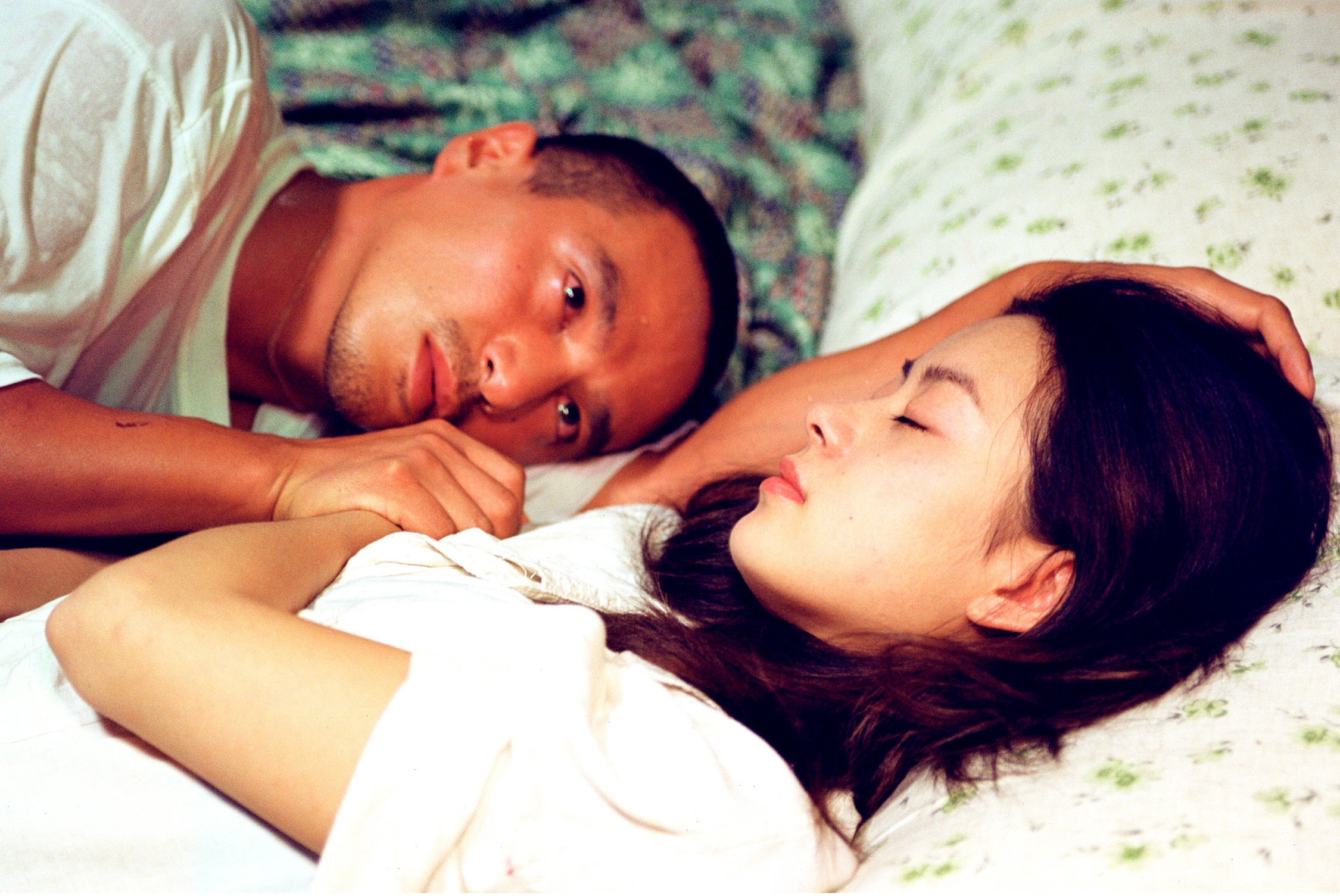
Kim begins the film with a captivating scene that starkly pinpoints the sense of two characters on diametrically opposed sides of the social fence. He makes the sharp contrast between the lovely Seo Won sitting on a public bench, staring into space, looking the embodiment of sunny innocence, and Cho Je-Hyun’s harsh face blankly staring at her. This contrast abruptly explodes into action as he forcibly tries to kiss her and has to be held off by cops, and even as he is held off continues to stand there saying nothing, staring at her like a wild animal.
Cho Je-Hyun never speaks throughout the entire film (up until one line at the end where we learn exactly why he doesn’t speak) and his performance is a remarkable one that is given entirely through wild, intensive stares, or through explosions of violence (his frustration is never better communicated than in the very next scene after the above where we see him punch his fist through a glass window in mute frustration). Kim puts the contrasts in the opening scene through even further twists as we see Cho stalking Seo Won around the city, and then the set-up where she picks up the wallet and is forced by the businessman to pay it back and is sold into prostitution.
This is about the point where Bad Guy could have become a truly sordid film. Someone like Takashi Miike, to whom Kim Ki-Duk is sometimes compared, would have had a veritable field day with the material. Kim does show a number of scenes with Seo Won being raped and abused but largely the film does not dwell on her degradation. Kim seems not so much interested in rubbing the faces of audiences in it, as Miike might do, but to the contrary creates a film that is often extraordinarily tender. The initial brutalities that we see are soon contrasted with remarkably gentle images like Cho Je-Hyun coming into the room to touch Seo Won’s face as she sleeps or stopping to fix a faulty hook on the wall, of their two faces placed against one another through the one-way mirror.
Kim fills the film with strikingly poetic moments that captivate without words. There seems no more hopeless a reinforcement of Seo’s realisation that she is property than when she does manage to escape and as she walks along the street an anonymous woman comes and casually places a jacket around her shoulders and just as quickly disappears, and no more stark a view of the hopelessness of her situation than when Cho takes her to the beach and they sit and watch a wordless vignette as a woman in a red dress gets up and walks out into the ocean. There is perhaps a little too much drama involving the rival gang and Cho’s imprisonment in the latter half but the relationship that grows is heartfelt and beautifully played by the two actors.
This does bring one to the ending, which is both haunting and head-scratchingly peculiar. [PLOT SPOILERS]. Here Cho Je-Hyun finally lets Seo Won go and she departs with tears in her eyes. He is then seemingly stabbed by one of his own gang and left bleeding to death on the riverbank but then gets up apparently unharmed. She meanwhile is picked up along the highway by a truck driver and services him. In a puzzling twist, she then buys a red dress identical to the one worn by the woman we saw earlier, puts it on and returns to the beach where she digs up the remaining pieces of the torn photos that were buried in the sand to find that the faces of the man and woman in the photos are herself and Cho.
Quite what this surreal piece of synchronicity means is a puzzle – are we meant to regard it or the earlier scene or indeed the whole of this epilogue as a dream? That said, the peculiarity of it – and particularly seeing such a surreal effect in a film that is otherwise mundane – is haunting. Even more so is the final scenes where she and Cho are reunited, he outfits a truck with a mattress in the back and they travel around the countryside, stopping at the seaside so that he can rent her out to fishermen and then in the final fadeout continue on. Kim Ki-Duk’s ending the film on such an off-centre note is both remarkable and disturbing.
Director Kim Ki-Duk should not be confused with the other South Korean director named Kim Ki-Duk who worked during the 1960s and 70s and is most known here for the Korean Godzilla copy Yongary, Monster from the Deep (1967)
Trailer here