
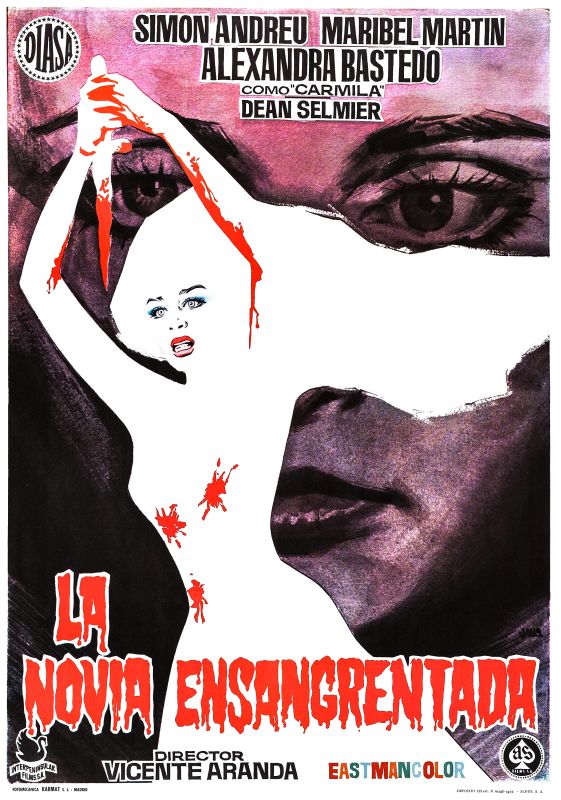
aka The Blood Castle; The Bloody Fiancee; Till Death Do Us Part
(La Novia Ensangrentada)
Spain. 1972.
Crew
Director/Screenplay – Vicente Aranda, Based on the Short Story Carmilla (1872) by J. Sheridan Le Fanu, Photography – Fernando Arribas, Music – Antonio Perez Olea, Special Effects – Antonio Vidal Molina. Production Company – Morgana Films.
Cast
Simon Andreu (The Husband), Maribel Martin (Susan), Alexandra Bastedo (Carmilla/Mircalla Karnstein), Dean Selmier (The Doctor), Rosa M. Rodriguez (Carol)
Plot
A newlywed couple return from their honeymoon to his family estate. However, the wife is repulsed by the husband’s sexual appetite. In the wife’s dreams, a beautiful woman appears, handing her a dagger and urging her to kill the husband. She repeatedly wakes up clutching the dagger and continues to do so despite her husband’s attempts to hide the dagger from her. The husband then finds Carmilla, the woman from the dreams, naked on the beach and brings her home. Carmilla proceeds to seduce the wife and drink her blood. The husband comes to realise that Carmilla is his ancestor Mircalla Karnstein and that she is a vampire.
J. Sheridan Le Fanu’s Carmilla (1872) is a classic tale of lesbian vampirism. However, when it comes to adapting Carmilla to the screen, most film versions have fatally misunderstood the story. The problem is that most films insist on an overtly sexual interpretation, throwing in naked breasts and lesbian sexual encounters, where Le Fanu’s tale is one of classical understatement and the eroticism lies in subtle suggestion. Furthermore, all film adaptations have ended up bumping the title antagonist’s age up into the mid-twenties and usually cast the role with statuesque blondes, whereas in the story Carmilla appears as a teenage girl.
The Blood Spattered Bride is no different to any of these. At least Alexandra Bastedo, formerly a British tv star with the superhero series The Champions (1968), while blonde and statuesque, plays with a cool icy aloofness, unlike the bovinely blank Yutte Stensgaard’s Carmilla in Hammer’s Lust for a Vampire (1971) or the ridiculously unyouthful Ingrid Pitt in Hammer’s The Vampire Lovers (1970). More interestingly, the film adds its own backstory to Le Fanu – it puts the seduced woman’s age up a good ten years, makes her a newlywed and gives her a story about her cooling to her husband’s frequent sexual appetite.
In so doing, the story takes on a considerable misogynistic undertow, one that pits hot-blooded Euro male sexuality against man-hating predatory lesbianism. The point is made overt in one dream scene where Carmilla encourages the wife to castrate her husband with a knife. The final image of the two women dead in their coffin holds an additional frisson, the sense that masculine sexuality has been restored. Despite the overtones of masculine supremacy, The Blood Spattered Bride holds a much more confident and liberal sexuality that the giggly adolescence that permeated Hammer’s Karnstein trilogy.
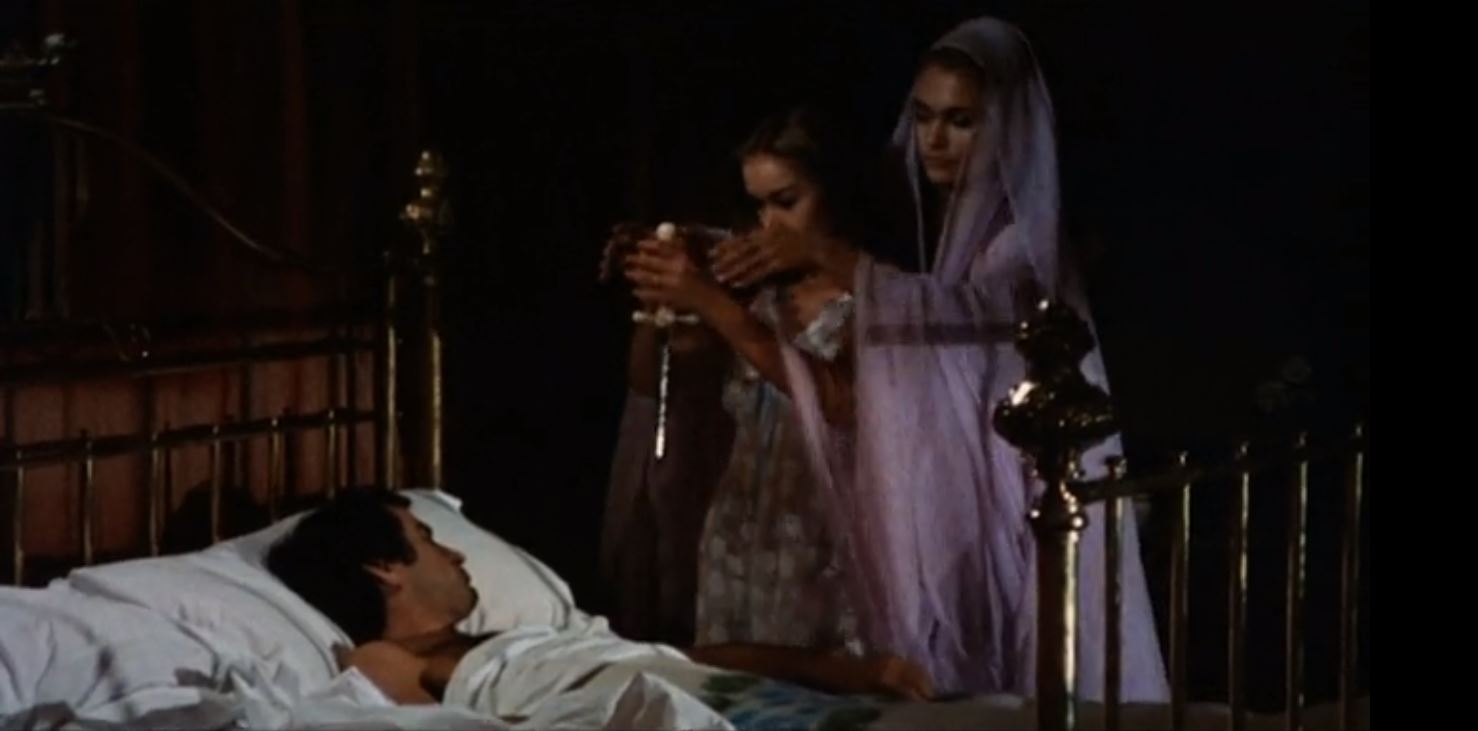
On a directorial level, The Blood Spattered Bride is perfunctorily made. Everything is straightforward – there is little subtlety or anything that works on any other level. However, the film is not entirely without occasional moments of interest. Director Vicente Aranda throws in intermittent images of surrealistic appeal (something that brings him close to France’s Jean Rollin who also blended eroticism, vampirism and surrealism) – someone poking their face through a portrait with the face cut out, momentarily resulting in the image of a portrait with a living face; love-making in a cage filled with pigeons; and some intriguing scenes flipping back and forth between dream with Maribel Martin waking up to find herself holding a dagger that had been previously hidden.
The film’s one moment of surrealistic grandeur is the scene where Simon Andreu discovers Alexandra Bastedo buried in the sand, uncovering first her face wearing a scuba mask and then her ample naked chest. It is a scene that makes no rational sense whatsoever – ie. to ask why she should so bury herself – but amid the film’s relative crudeness does hold an outre wildness.
Other screen adaptations of Carmilla are:– extremely loose influence on the classic Vampyr (1932); Roger Vadim’s Blood and Roses (1960) starring Annette Vadim as Carmilla; the Italian-Spanish Terror in the Crypt (1963); Hammer’s trilogy consisting of The Vampire Lovers (1970) starring Ingrid Pitt as Carmilla, Lust for a Vampire (1971) with Yutte Stensgaard and Twins of Evil (1971) with twin sisters coming under the Karnstein influence; an episode of the tv series Nightmare Classics (1989) starring Meg Tilly; the modernised Styria (2014) starring Julia Pietrucha; the modernised The Unwanted (2014) starring Christen Orr; and Carmilla (2019) starring Devrim Lingau.
Trailer here