

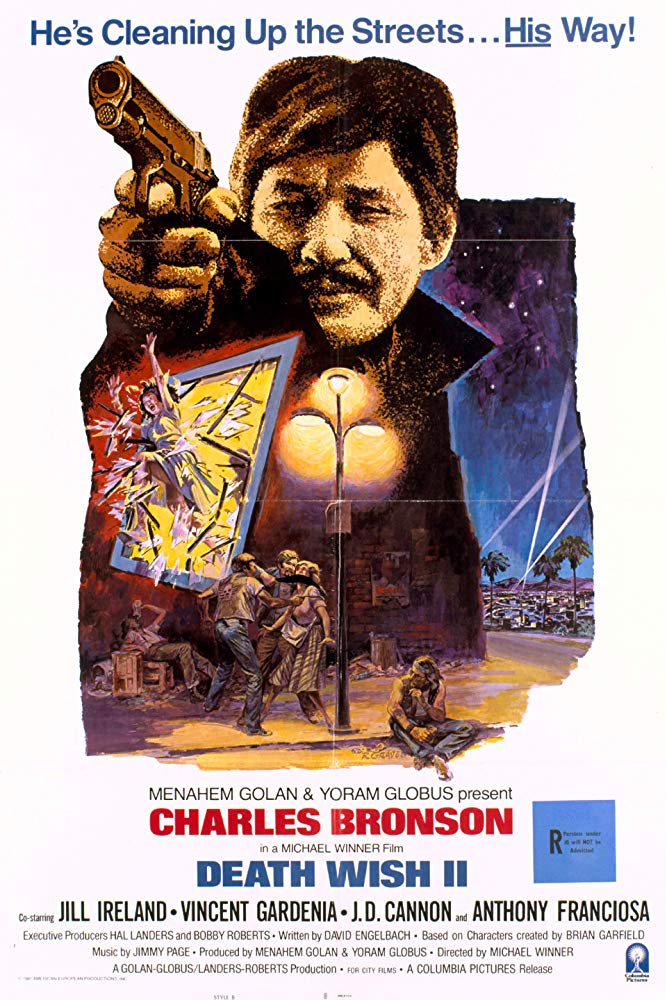
USA. 1981.
Crew
Director – Michael Winner, Screenplay – David Engelbach, Producers – Yoram Globus & Menahem Golan, Photography – Tom Del Ruth & Richard H. Kline, Music – Jimmy Page, Special Effects Supervisor – Kenneth Pepiot, Production Design – William Hiney. Production Company – Golan-Globus/Landers-Roberts/City Films/American European Productions, Inc.
Cast
Charles Bronson (Paul Kersey), Jill Ireland (Geri Nichols), Vincent Gardenia (Lieutenant Frank Ochoa), Robin Sherwood (Carol Kersey), Ben Frank (Lieutenant Mankiewicz), Thomas Duffy (Nirvana), Kevin Major Howard (Stomper), Stuart K. Robinson (Jiver), Laurence Fishburne III (Cutter), E. Lamont Johnson (Punkcut), Silvana Gallardo (Rosaria), Anthony Franciosca (Police Commissioner)
Plot
Paul Kersey is now living in Los Angeles and involved with radio journalist Geri Nichols. His daughter Carol has remained mute since her rape back in New York and has had to be institutionalised. Kersey takes her out from the hospital for the afternoon but while they are queuing for ice cream, a group of street punks snatch Kersey’s wallet. The hoods look up the address in the wallet and then break into the house, where they rape and brutalise the maid. They wait for Kersey to return whereupon they knock him out, kill Geri and abduct Carol. After being raped again, Carol commits suicide by jumping out a window. Upon learning what has happened, Kersey gets out his handgun and goes hunting the gang.
Death Wish (1974) was a substantial hit in the 1970s. It featured Charles Bronson as an ordinary man who takes up a gun and starts shooting muggers after his wife is killed and daughter raped and the police prove too ineffectual to do anything. Death Wish made Bronson’s name and had him typecast as a tight-lipped, granite-faced vigilante for the rest of his career. It also spawned a number of imitators.
Several years later, Israeli producers Menahem Golan and Yoram Globus purchased the rights to Death Wish from prodicer Dino De Laurentiis. Golan-Globus had considerable success throughout the 1980s churning out numerous Chuck Norris action films, various sword and sorcery efforts and much general hackwork. They mounted several Death Wish sequels – Death Wish II here, Death Wish 3 (1985), Death Wish 4: The Crackdown (1987), as well as Menahem Golan making Death Wish V: The Face of Fear (1994) on his own following the financial collapse of Golan-Globus. Death Wish (2018) was a remake from Eli Roth starring Bruce Willis.
Golan and Globus were successful in inveigling Charles Bronson back to the role and, at Bronson’s insistence, brought director Michael Winner back to helm the first two sequels. Charles Bronson then became one of Golan-Globus’s principal stars, eventually appearing in eight films for them, all of which were variants on the same vigilante role.
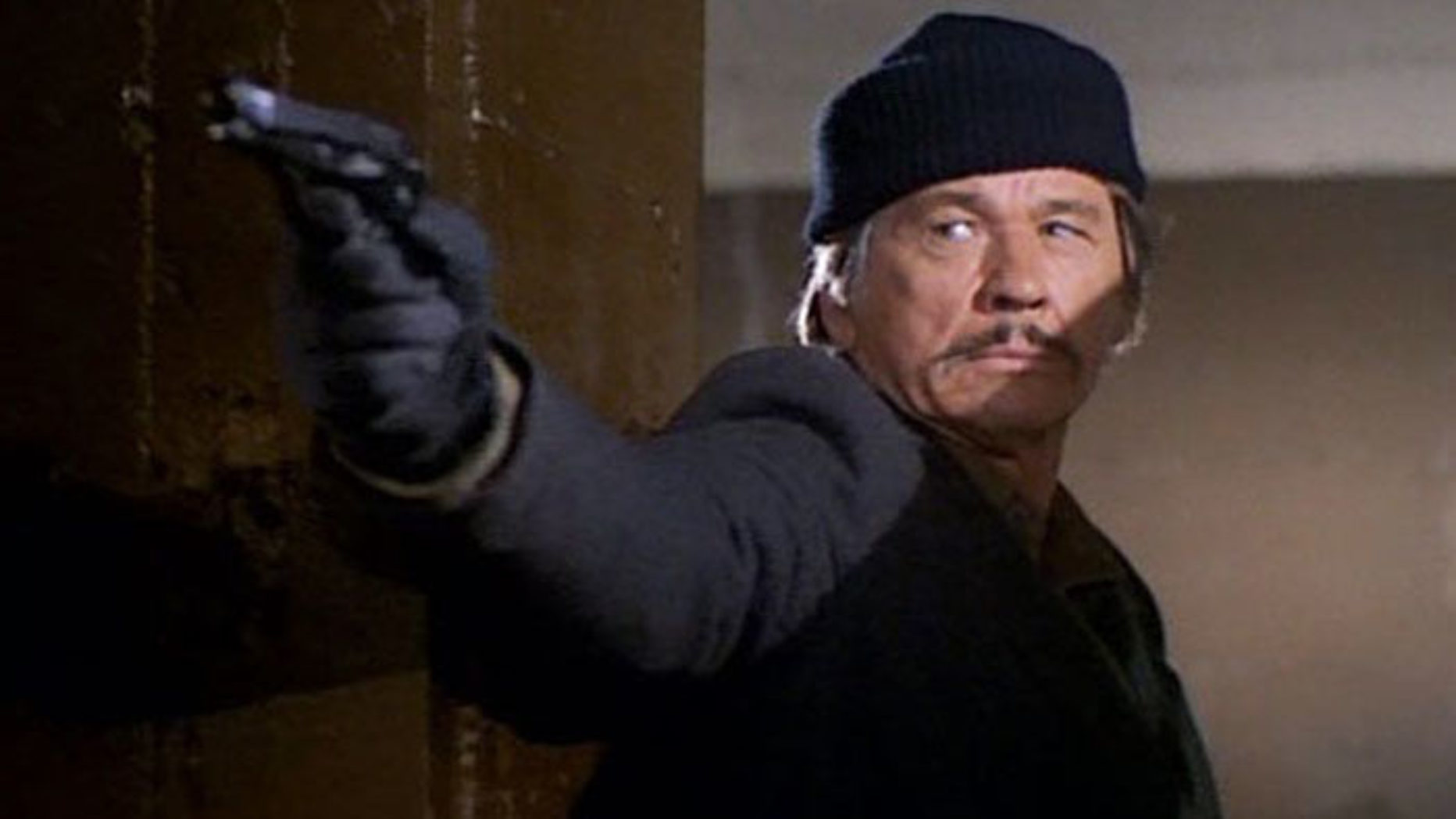
Death Wish was an interesting film. When it was made, the elements of the vigilante fantasy were fresh rather than cliche and the film had a strong subtext about urban lawlessness and the failure of law enforcement agencies to adequately protect citizens. By the time of Death Wish II, the social subtext has gone and all that we are left with is an ugly, rather mechanical revenge film. The script for Death Wish II – which comes from David Engelbach, later the director of Golan-Globus’s bizarre post-holocaust satire America 3000 (1986) – only repeats the basics of Death Wish over again. Rather improbably, Charles Bronson now has a new girlfriend (his real-life wife Jill Ireland) who becomes brutalised and killed after a gang of hoods invade his home just like his wife was in the first film, while the same daughter is brought back to be raped all over again and then commit suicide.
Indeed, while Death Wish was a thriller with some interesting things to say about urban fear, Death Wish II is nastily exploitative. Charles Bronson is such a blank actor that Paul Kersey never seems to have any emotional reaction to the deaths of his girlfriend and daughter (other than to get out his gun again). And Michael Winner is such a crude director that Death Wish II operates not too differently (except perhaps in gore level) from the scenes of serial butchery that appear in the various slasher films being made around the same time.
Often Michael Winner’s films revel in gratuitous offensiveness and Death Wish II is a prime example where he has reduced the vigilante fantasy of Death Wish to a series of gratuitously nasty scenes for our delectation. The daughter’s rape (which has been cut from most versions screening today anyway) and subsequent death by jumping out a window to be impaled on an iron grille is only there as a sensationalistic novelty. The rape of the Latino maid is something that Michael Winner allows to be drawn out for several minutes – well beyond the point that is needed for everyone to understand that this is something shocking and to the point that you wonder if someone is not getting off on such. The Death Wish series is designed to get the red-blooded redneck in all of us worked up and want to see scumbags blown away but with Death Wish II all that Michael Winner does is to reduce everything that happens – from the rapes the hoods conduct to their eventual despatch by Charles Bronson – to the same level of sensationalistic shock effect.
Other than this, Death Wish II plods dully. Some life is provided by Vincent Gardenia in a repeat performance from the first film. Whenever Vincent Gardenia is around, Death Wish II interestingly turns into a battle of wits between he and Bronson in which the moral lines are blurred – alas, Gardenia is abruptly killed in a shootout halfway through. The rest of the film is just a series of killings, which Charles Bronson and the script traipse through as though they were items on a tick list.
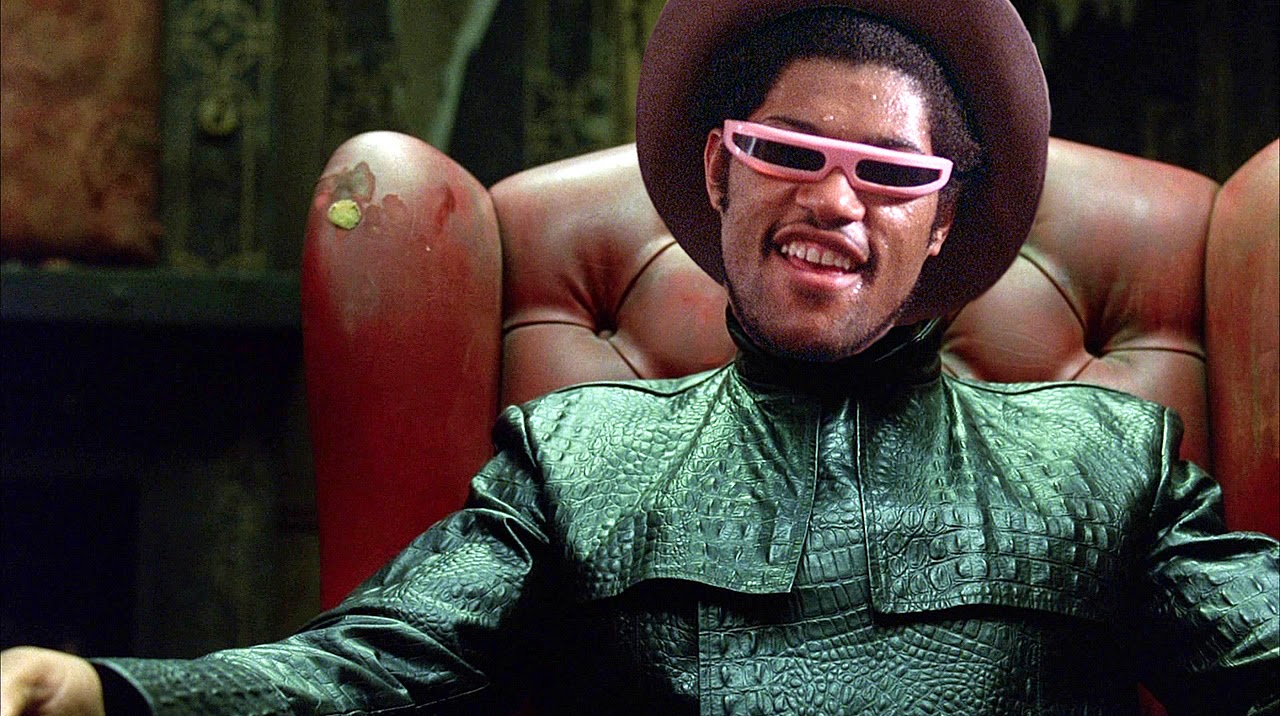
One of the interesting things about the early Death Wish films is the later-to-be-famous faces that turn up in odd roles – Death Wish had a young Jeff Goldblum as a hood, Death Wish 3 had Star Trek: The Next Generation (1987-94)’s Marina Sirtis as a rape victim. Here a young Laurence Fishburne (credited as Laurence Fishburne III) turns up as one of the hoods who rapes the maid and later gets despatched with a bullet fired through his ghetto blaster. Another eyebrow-raising name on the credits is the score that comes from no less than Led Zeppelin guitarist Jimmy Page.