
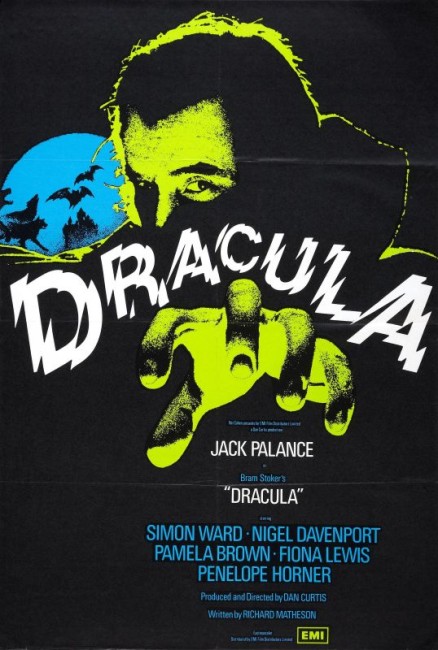
USA. 1974.
Crew
Director/Producer – Dan Curtis, Screenplay – Richard Matheson, Based on the Novel by Bram Stoker, Photography – Oswald Morris, Music – Robert Cobert, Special Effects – Kit West, Production Design – Trevor Williams. Production Company – Dan Curtis Productions/Universal.
Cast
Jack Palance (Count Dracula), Nigel Davenport (Van Helsing), Simon Ward (Arthur Holmwood), Murray Brown (Jonathan Harker), Penelope Horner (Mina Murray), Fiona Lewis (Lucy Westenra)
Plot
May, 1897. British real estate clerk Jonathan Harker travels to Transylvania to conduct the purchase of a property in Whitby for Count Dracula. However, Dracula is a vampire and allows Jonathan to be claimed by his three brides. Five weeks later Dr Van Helsing is called to Whitby to tend Jonathan’s fiancée Mina Murray and then Lucy Westenra as they fall inexplicably ill. Tracing the source of the illness brings Van Helsing up against Dracula. Dracula believes Lucy to be the reincarnation of his love and is determined to make her immortally his.
This was the fifth major attempt to film Bram Stoker’s Dracula (1897). Up to that point there had been the uncredited silent classic Nosferatu (1922); followed by Dracula (1931), the Universal version with Bela Lugosi; Dracula/The Horror of Dracula (1958), the Hammer version with Christopher Lee; and the Jess Franco version Count Dracula (1970) also with Christopher Lee.
This version was made by Dan Curtis who had emerged as producer of the popular tv series Dark Shadows (1966-71) and the cult Night Stalker tv movies. Curtis debuted as director with the Dark Shadows cinematic spinoffs, House of Dark Shadows (1970) and Night of the Dark Shadows (1971). Curtis then embarked upon a series of classic horror stories remade for tv – including Dr Jekyll and Mr Hyde (1968), Frankenstein (1973), The Picture of Dorian Gray (1973), The Turn of the Screw (1974) and this. Dracula was released cinematically outside of America, the only of Dan Curtis’s tv movies to do so.
The script comes from respected genre novelist and screenwriter Richard Matheson, who has been responsible for works like The Incredible Shrinking Man (1957), Duel (1971), What Dreams May Come (1998), most of Roger Corman’s Edgar Allan Poe adaptations and the oft-filmed novel I Am Legend (1954). Richard Matheson treats the Bram Stoker story with the greatest degree of faithfulness that any adaptation had up to that point. The Transylvanian scenes are played almost entirely as Bram Stoker wrote them – all that is missing is the scene of Dracula climbing down the castle wall. The climactic pursuit back to Transylvania tracking Dracula via the hypnotised Lucy is also effectively introduced – the first film to do so. Richard Matheson does trim some aspects of the book – Renfield and the lunatic asylum have been dropped outright. So are the other vampire hunters, excepting for Arthur Holmwood.
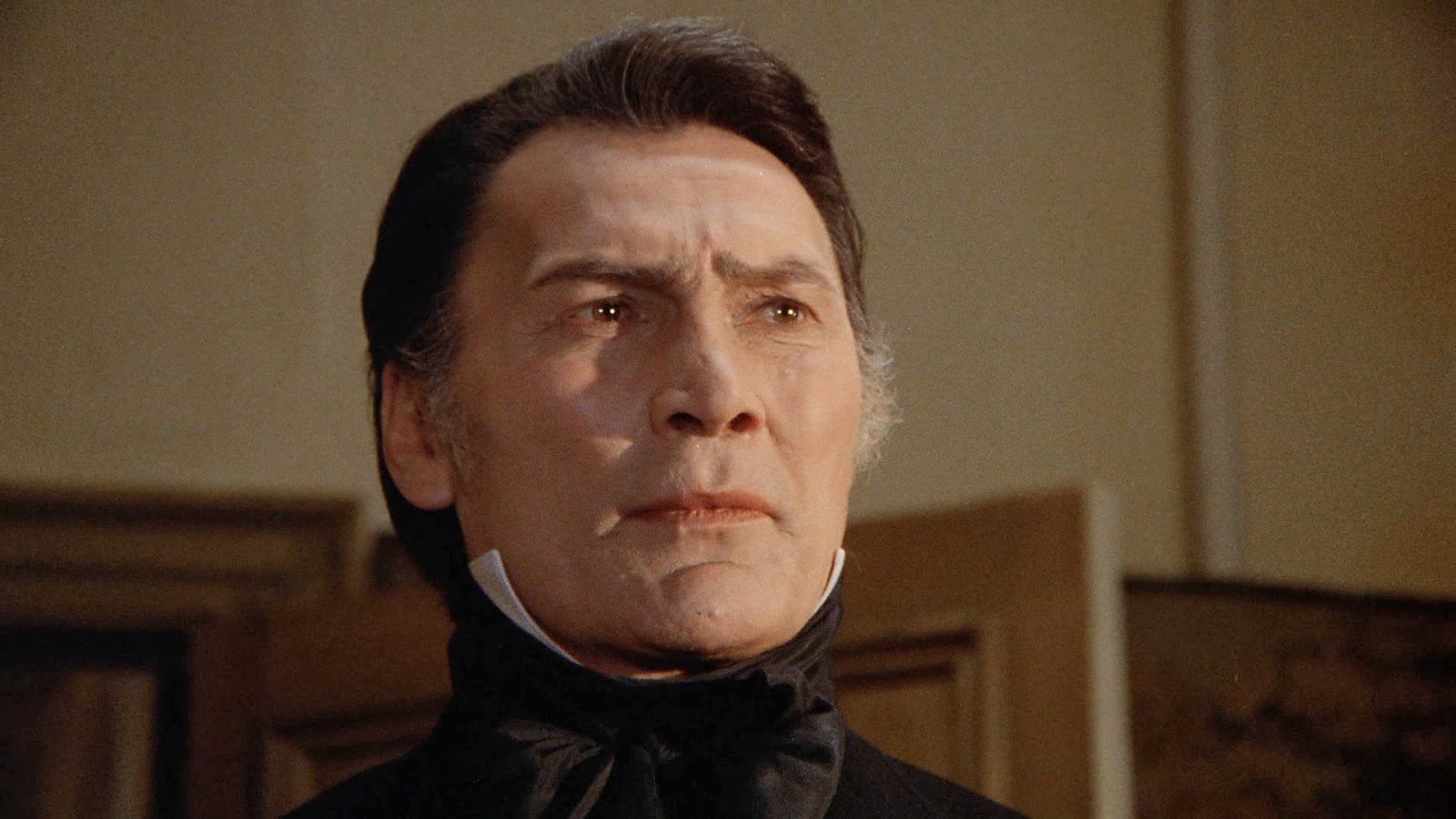
The additions that Matheson makes are intriguing – this was the first adaptation of Stoker to directly equate Dracula with also being Vlad the Impaler, although Dracula had first been equated with Vlad in the previous Count Dracula’s Great Love (1972). (The end note that pops up to inform the audience that Vlad was an alchemist and sorcerer and “… so powerful a man was he that it was claimed he succeeded in overcoming even physical death. To this day it has yet to be disproven” is absolute tosh).
The attempts to create sympathy for Dracula during the flashbacks is also interesting, but these fail to work due to the briefness of the scenes and also because of the casting of Jack Palance. The climactic killing of Dracula, which owes much to the Hammer The Horror of Dracula, with Van Helsing ripping open the blinds of the library to pin Dracula in beams of light before he is impaled against an overturned table by a giant spear, is a highly effective improvement over the book’s climax.
At the same time, the film is also no good. It is certainly a well produced film – the production values seem like those of a feature film rather than a tv movie. What is noticeable is the naturalism of the production. Both the Universal and Hammer adaptations took place in artificial worlds that were almost entirely shot on soundstages. This version has a look of authenticity – its photography is naturalistic, the costumes in period without being ostentatious or florid, and the film appears to have been shot on the grounds of authentic castles and estates. It looks for all the world looks like a BBC costume drama.
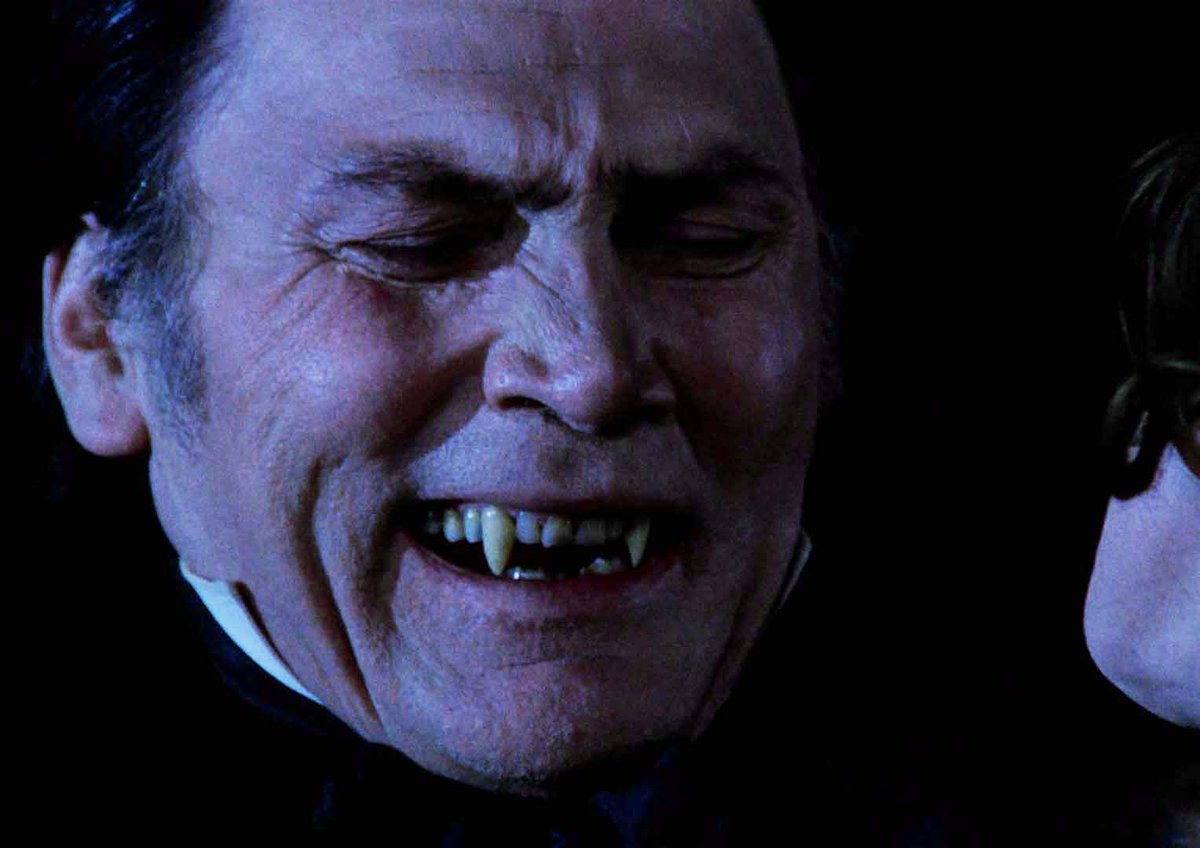
On the other hand, while such an approach adds an enormous amount in the way of a plain straightforward adaptation of the story, it is resolutely un-fantastic in nature. All the supernatural elements have been pared away and those that remain are played as low key and unremarkable as possible. Here Dan Curtis makes the mistake of directing the film in terms of physical action – Dracula is not a supernatural presence, he merely sweeps into rooms and throws people about. Scenes that should have great impact – the attack of the brides, the blood-drinking – and so on are directed without flair or style and are almost nil in impact.
Even worse is the casting. It is certainly difficult to think of an actor less suited to the role of Dracula than Jack Palance – maybe Clint Eastwood or Arnold Schwarzenegger? Jack Palance is unable to shake the image of the old warhorse of countless westerns and makes his way through the role with characteristic asthmatic wheeze. The performance is appalling – the scenes where Palance tries to demonstrate anger by throwing things around in a room are so lacking in threat, so lacking in anything except hammy melodrama, that the entire plausibility of the film collapses.
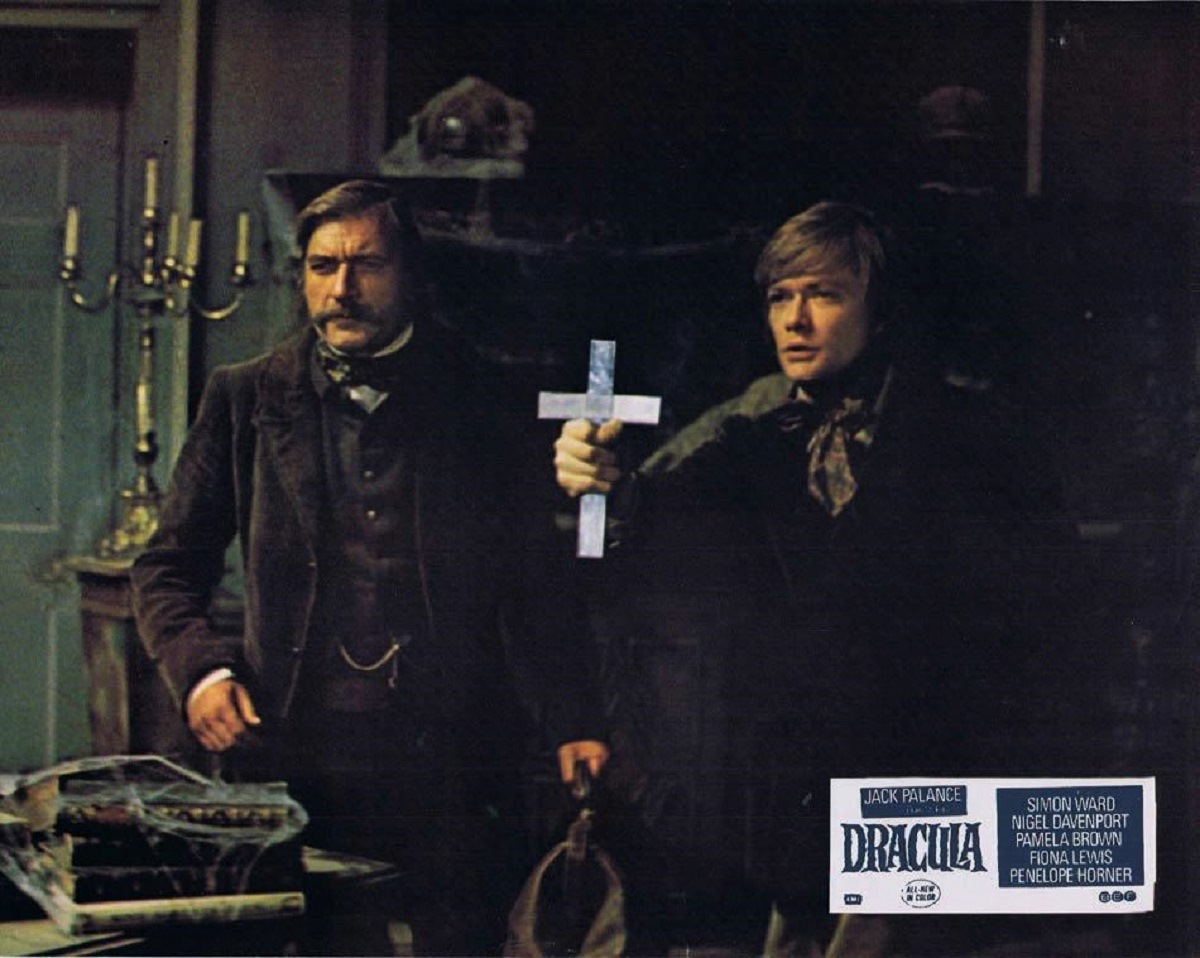
The rest of the casting is not much better. Nigel Davenport’s Van Helsing lacks any sense of intellectual prowess or commanding power. He is no more than a plodding gentleman. There is a laughable scene that demonstrates just how wimpy this Van Helsing characterisation is – Davenport waves a cross at Dracula, who snarls “Throw it away”… whereupon Davenport does with only a slightly peeved “All right.”
Dan Curtis’s other genre productions are:- The Strange Case of Dr Jekyll and Mr Hyde (1968), House of Dark Shadows (1970), Night of the Dark Shadows (1971), The Night Stalker (1972), Frankenstein (1973), The Invasion of Carol Enders (1973), The Night Strangler (1973), The Norliss Tapes (1973), The Picture of Dorian Gray (1973), Scream of the Wolf (1974), The Turn of the Screw (1974), Trilogy of Terror (1975), Burnt Offerings (1976), Curse of the Black Widow (1977), Dead of Night (1977), Intruders (1992) and Trilogy of Terror II (1996).
Other adaptations of Dracula are:– the uncredited classic German silent Nosferatu (1922); Dracula (1931), the classic Universal adaptation starring Bela Lugosi; the Spanish language version Dracula (1931) shot on the same sets as the Lugosi version starring Carlos Villarias; Hammer’s classic Dracula/The Horror of Dracula (1958) with Christopher Lee; Dracula in Pakistan (1967), an uncredited remake of the Hammer film; Count Dracula (1970), a cheap continental production that also featured Lee; Count Dracula (1977), the BBC tv adaptation with Louis Jourdan; Dracula (1979), the lush romantic remake with Frank Langella; Werner Herzog’s remake Nosferatu the Vampyre (1979) with Klaus Kinski; Francis Ford Coppola’s visually ravishing Bram Stoker’s Dracula (1992), featuring Gary Oldman; the modernised Italian-German Dracula (2002) starring Patrick Bergin; Guy Maddin’s silent ballet adaptation Dracula: Pages from a Virgin’s Diary (2002); Dracula (2006), the BBC tv adaptation starring Marc Warren; the low-budget modernised Dracula (2009); and Dario Argento’s Dracula (2012) with Thomas Kretschmann as Dracula; the low-budget Canadian Terror of Dracula (2012) with director Anthony D.P. Mann as Dracula; the tv series Dracula (2013-4) with Jonathan Rhys Meyers; the BBC mini-series Dracula (2020) starring Claes Bang; Bram Stoker’s Van Helsing (2021), which actually features no Dracula; and The Asylum’s Dracula: The Original Living Vampire (2022) with Jake Herbert.
Richard Matheson’s other genre works are:- The Incredible Shrinking Man (1957) based on his own novel, Roger Corman’s Edgar Allan Poe adaptations The House of Usher/The Fall of the House of Usher (1960), Pit and the Pendulum (1961), Tales of Terror (1962) and The Raven (1963), the Jules Verne adaptation Master of the World (1961), the occult film Night of the Eagle/Burn, Witch, Burn (1961), the Corman-produced mortician’s comedy The Comedy of Terrors (1963), The Last Man on Earth (1964) based on his novel I Am Legend concerning a world taken over by vampires, the Hammer psycho-thriller The Fanatic/Die, Die, My Darling (1965), the classic Hammer occult film The Devil Rides Out/The Devil’s Bride (1968), the historical biopic De Sade (1969), Steven Spielberg’s first film Duel (1971), The Night Stalker (1972) and The Night Strangler (1973) tv movies, the ghost story The Legend of Hell House (1973), the tv movies Scream of the Wolf (1974), The Stranger Within (1974), Trilogy of Terror (1975), Dead of Night (1977), The Strange Possession of Mrs. Oliver (1977), the tv adaptation of Ray Bradbury’s The Martian Chronicles (1980), the time travel romance Somewhere in Time (1980) from his own novel, Jaws 3-D (1983) and Twilight Zone – The Movie (1983). Works based on his novels and stories are The Omega Man (1971) from I Am Legend, the afterlife fantasy What Dreams May Come (1998), the fine ghost story Stir of Echoes (1999), I Am Legend (2007), The Box (2009) and Real Steel (2011).
Trailer here