
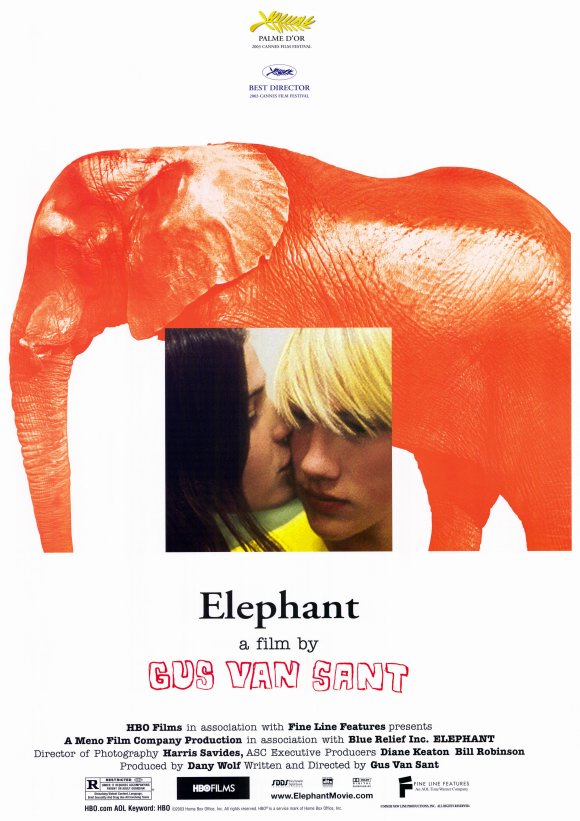
Crew
Director/Screenplay – Gus Van Sant, Producer – Dany Wolf, Photography – Harris Savides, Visual Effects – Illusion Arts, Special Effects Supervisor – Jor Van Kline, Art Direction – Benjamin Hayden. Production Company – Meno Film Company/Blue Relief Inc.
Cast
Alex Frost (Alex), John Robinson (John McFarland), Elias McConnell (Elias), Eric Deulen (Eric), Kristen Hicks (Michelle), Nathan Tyson (Nathan), Carrie Finklea (Carrie), Nicole George (Nicole), Brittany Mountain (Brittany), Jordan Taylor (Jordan), Benny Dixon (Benny), Timothy Bottoms (Mr McFarland), Matt Malloy (Mr Luce), Alicia Miles (Acadia)
Plot
Various kids go about their day at school. John is late to class because his father is drunk; Elias is taking pictures for a photo portfolio; the nerdy Michelle hurries to her duties in the library; three cliquey girls go to have lunch, thinking that Nathan is cute as he passes on his way to meet his girlfriend Carrie. Two guys, Alex and Eric, have ordered guns via the internet and now enter the school and start shooting.
Gus Van Sant is a director who sharply divides people. His films fall between acclaim – works like Drugstore Cowboy (1989), To Die For (1995), Good Will Hunting (1997) and Milk (2008) – and films whose pretensions drive people crazy – My Own Private Idaho (1991), Even Cowgirls Get the Blues (1993) and the remake of Psycho (1998). Predictably, Elephant was greeted with an almost equal amount of acclaim and boredom. It both won the Palme d’Or when it premiered at the 2003 Cannes festival, yet also made several critics worst lists for that year.
Elephant falls into a body of what might be called Teen Apocalypse films – works that see the youth of today in grimly real terms, as having gone out of control and heading for a brink of disaster. The genre fairly much began with the film that most resembles Elephant, River’s Edge (1986). Elsewhere Larry Clark seems to have cornered the market on this type of film with the likes of Kids (1995), Bully (2001) and Ken Park (2002). Clearly, Gus Van Sant has been inspired here by the spate of high school shootings over the last few years, most famously the incident at Columbine High School in Littleton, Colorado in 1999. Some months before this, Uwe Boll had addressed the issue of school shootings in Heart of America: Home Room (2002).
I must admit to being in the camp that liked Elephant (with reservations), although I do find Gus Van Sant a director who bores me more often than he inspires. What I liked about Elephant was not even its portrait of a high-school shooting – as this is something that Van Sant does not do particularly convincingly or shockingly and moreover oddly seems to have almost nothing to say about it – but rather the cool of its approach.
The film could almost be one of Lars von Trier’s Dogme films in many ways. It has the stripped back aesthetic of a Dogme film – Van Sant shoots entirely on location, made the film on a minimal budget and with a cast of non-professionals (the only recognisable name is Timothy Bottoms who appears as John Robinson’s drunken father in the opening scene) whom he often got to improvise their own dialogue; and has been released with many rough edges left in.
What I found particularly mesmerising was Gus Van Sant’s narrative structure. Rather than tell a linear plot, the story unfolds like a mandala – all overlapping pieces of synchronicity with Van Sant flipping back and forward in time between various characters and their interactions from different points-of-view, all drawing one inevitably back to the central event as the shooting erupts. We see many pieces – the arrival of the two gun-toting kids at the school, Elias stopping John for a photo in the hall, a trio of girls thinking the passing Nathan is cute – often from several points-of-view and with Van Sant then going off to show what is happening to characters in the background. What at first glance seems like a casual, shot-rough film soon reveals itself to be an exactingly calculated one.
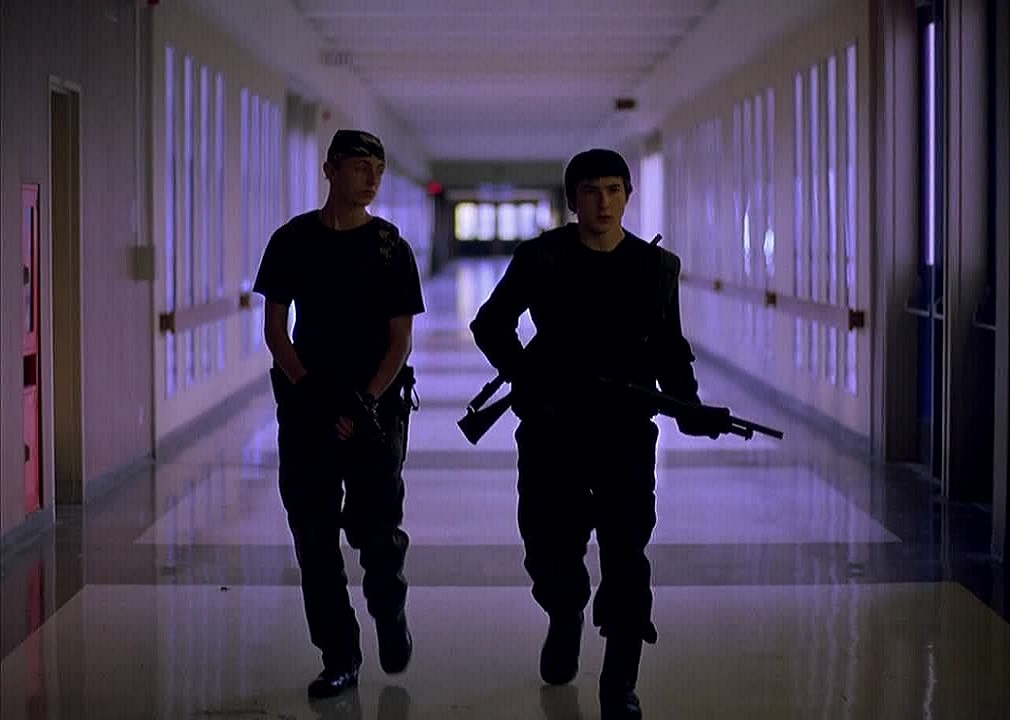
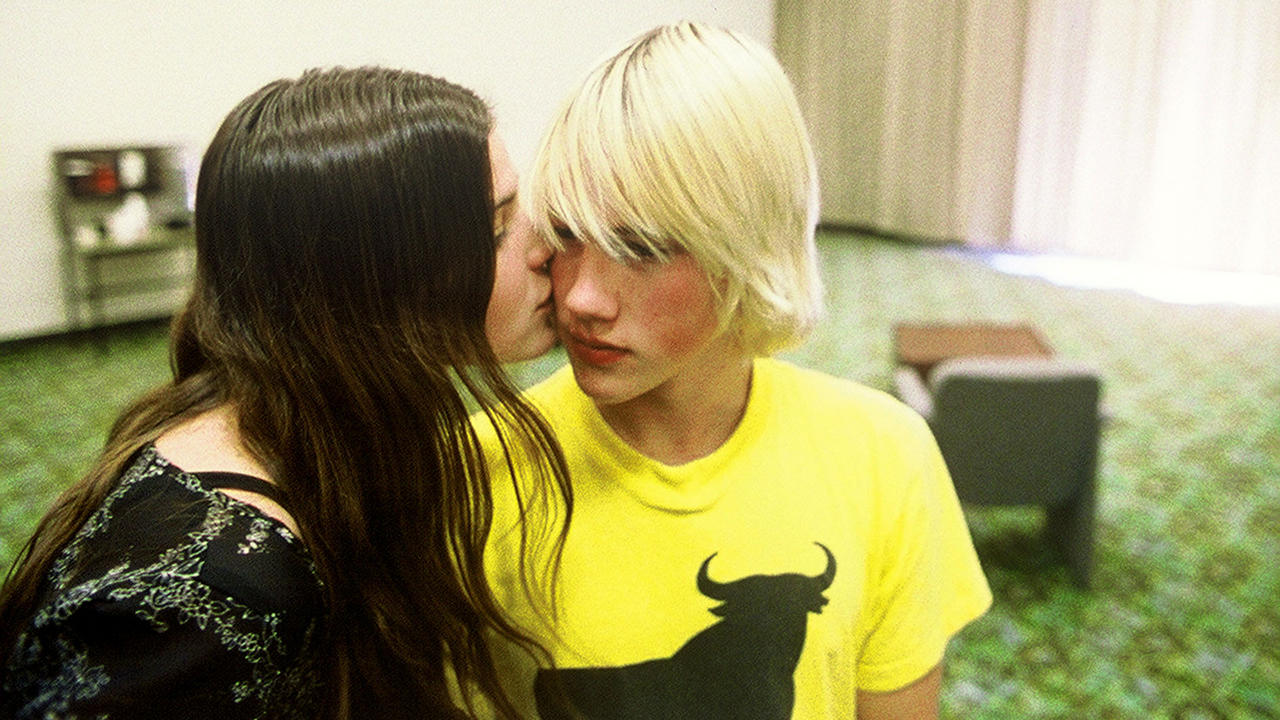
There is a fascination to watching the characters and their interactions. Although, in the end, Elephant is a film where Gus Van Sant tells us surprisingly little about any of them. Particularly noticeably, he tells us very little about the two gun-toting kids. No why, no reason for anything. Van Sant does go against the grain enough in his portrait of the two to show, rather than broodingly angry malcontents, one of them playing Beethoven piano sonatas and that the two of them are also gay lovers. Van Sant does at times seem on the verge of discovering a sense of black humour – the trio of girls who enter the bathroom cubicles in unison to purge their lunch; the images of Eric Deulen and Alex Frost ordering guns over the internet; and the scene at the end where they casually compare their individual shooting tallies. Mostly, Van Sant slips away to a detached distance and the blackly humorous tone seems uncertain.
Equally, the violence when it erupts seems surprisingly unconvincing, often cartoonish and unreal – one would have though that this would have been the most grimly depicted part of the film but disappointingly it isn’t. These sequences also contain some of the least convincing acting of Gus Van Sant’s mostly competent amateurs. Other scenes such as the sudden shooting of Eric Deulen at the end is abrupt and unexplained, with Van Sant leaving one not even knowing where the shot came from. The final scene leaves the film ending abruptly.
Nor does Gus Van Sant ever give us any idea what relevance the entirely cryptic title is – there are most certainly no elephants throughout, nor even reference made to any. (Although apparently, the title was inspired by Elephant (1989), a British tv docudrama about the brutality of sectarian violence in Ireland, which described such as “a large elephant in the room that nobody talks about,” a phrase that Van Sant appropriated with equal validity to talk about high-school shootings).
Gus Van Sant’s other genre films include his remake of Psycho (1998), and Restless (2011), an oddball romance between a girl dying of cancer and a boy with a ghostly kamikaze pilot companion.
Trailer here