

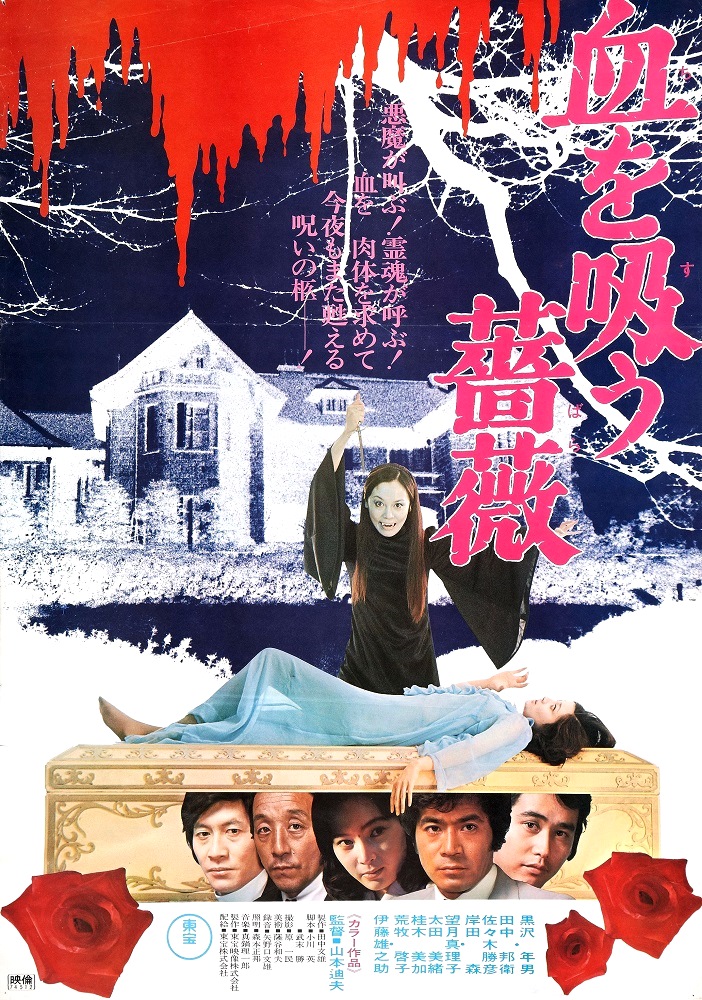
(Chi o Suu Bara)
Crew
Director – Michio Yamamoto, Screenplay – Ei Ogawa & Masaru Takesue, Photography – Kazutami Hara, Music – Riichiro Manabe. Production Company – Toho Eizo.
Cast
Toshio Kurosawa (Shiraki), Moriko Mochizuki (Kumi), Oota Mio (Yukiko), Kunie Tanaka (Dr Shimimura), Mori Kishida (The Principal), Katsuhiko Sasaki (Yoshii), Aramaki Keiko (Kyoko), Mika Katsuragi (The Principal’s Wife), Yunosuke Ito (Detective Takakura)
Plot
The schoolteacher Shirkai travels to the remote north of Japan to take up a position at the Seimi girls’ boarding school. There have been mysterious happenings there, including one girl Keiko having gone missing. Shirkai has a dream in which what he later learns is Keiko appears to him. The school doctor Shimimura tells him about the legend of a vampire in the area, a Christian foreigner who, hundreds of years ago, was forced to forsake his religion and took to drinking blood. Meanwhile, Keiko starts preying on the other girls at the school, turning them into vampires. Shiraki and Shimimura begin a search and realise that the head vampire is the school principal.
Evil of Dracula is the third of Michio Yamamoto’s Bloodthirsty Trilogy of Japanese vampire films for Toho Studios. It was preceded by Legacy of Dracula: The Bloodthirsty Doll/The Bloodsucking Doll/Night of the Vampire/The Vampire Doll (1970) and Lake of Dracula (1971), the latter also starring Mori Kishida as the vampire. All three were retitled as Dracula films by English-language distributors, even though the vampire is never named Dracula throughout.
Michio Yamamoto had clearly been inspired by the Hammer Dracula films and was attempting to replicate the same success for Japanese audiences. Evil of Dracula then is surely Michio Yamamoto’s equivalent of Hammer’s Lust for a Vampire (1971), a lesbian vampire film that was set in a girl’s boarding school. In both films, the lead character is a newly arrived male teacher who falls in love with one of the girls as he fights the menace that he discovers. The film also borrows from Bram Stoker’s Dracula (1897), particularly the opening with the hero travelling with a sinister driver to the vampire’s lair through a land that it becomes increasingly apparent exists almost as another world. The appearance of the vampire down a broad staircase, before anticlimactically being revealed as a courtly host, also mimics the first appearance of Christopher Lee in Hammer’s Dracula/The Horror of Dracula (1958).
In comparison to Lust for a Vampire, Evil of Dracula is much more sedate. Lust was overflowing with busty teenage girls in a ready state of undress but here Yamamoto has excised almost all suggestion of any sexual element. In this sense, Evil of Dracula comes much closer to the original repressions of Stoker’s Dracula, where the chief vampire, like Dracula, serves to turn the female victims into dangerous forces who are occasionally imbued with sensual interest. (Although symptomatic of just how sexually sedate a film this is, at most the vampire women here express enjoyment at having their necks bitten).
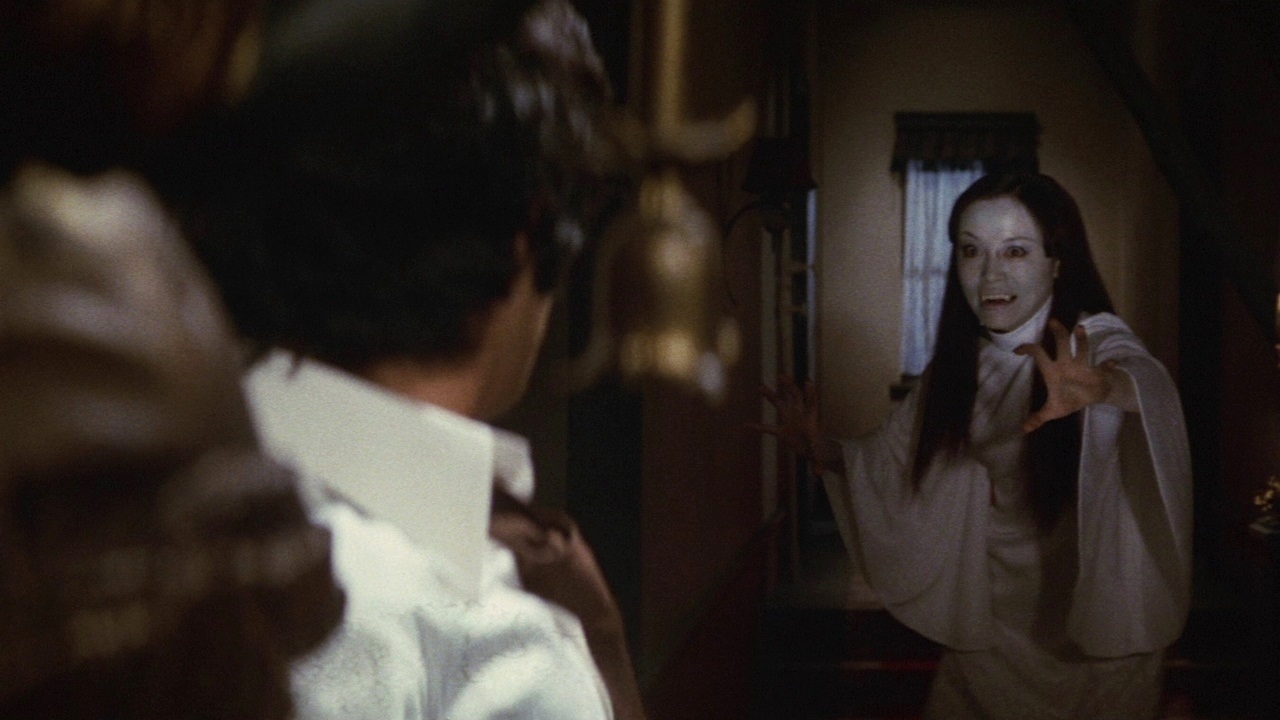
This is a vampire film that very much buys into traditional conservative patrilineage – the other important change between this and Lust is that the vampire is not a lesbian schoolgirl but a predatory headmaster. The female vampires are never their own characters, as much as they are catspaws of the lead male vampire. When one of them is found out, rather than turn and attack, she merely jumps over the stairs to her death; others are in the habit of dying when their master is injured; and the character of the principal’s wife’s only ambition is to steal the face of the girl that the hero loves so as that she can pose as her (quite why, is never explained. Nor for that matter why the principal is so set on the hero becoming his successor. Ei Ogawa’s scripts for Michio Yamamoto’s vampire films were always a little weak on motivation and rationale).
The other interesting theme that runs through Michio Yamamoto’s films is the sense of the vampire as a foreign polluter of Japanese blood. In this case, the vampire is specifically identified as a foreign Christian traveller who was forced to surrender his faith in a foreign land and became cursed as a result. Later we get an additional, slightly incongruous explanation about the vampire having become a demon after drinking his own blood out of thirst in the desert and then taking to attacking other victims. Yamamoto succeeds in generating a fair degree of atmosphere and builds the film toward a reasonable climax.