
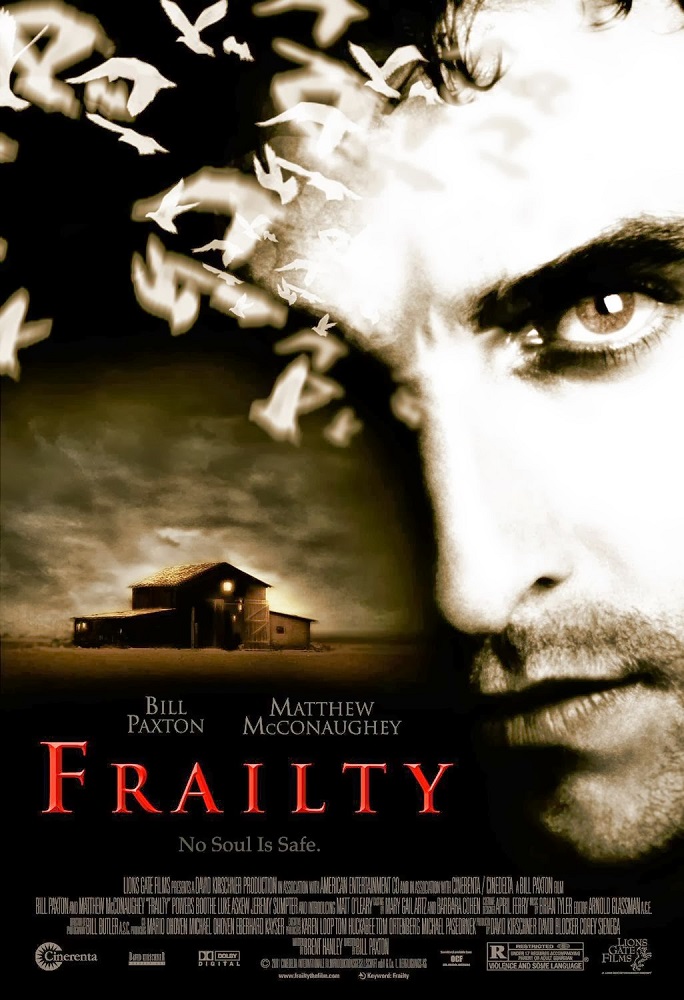
USA/Germany/Italy. 2001.
Crew
Director – Bill Paxton, Screenplay – Brent Hanley, Producers – David Blocker, David Kirschner & Corey Sienega, Photography – Bill Butler, Music – Brian Tyler, Visual Effects Supervisor – Joe Bauer, Visual Effects – Cantina Pictures (3D Animation Supervisor – Doug Beswick) & Digital Dimension (Supervisor – Benoit Girard), Special Effects Supervisor – Larry Fioritto, Art Direction – Nelson Coates & Kevin Cozen. Production Company – David Kirschner Productions/American Entertainment Co/Cinerenta/Cinedelta.
Cast
Bill Paxton (Dad), Matt O’Leary (Young Fenton), Matthew McConaughey (Fenton Meiks/Adam Meiks), Powers Boothe (Agent Wesley Doyle), Jeremy Sumpter (Young Adam), Luke Askew (Sheriff Smalls), Melissa Crider (Becky)
Plot
Fenton Meiks walks into the FBI offices in Dallas, Texas and tells Agent Wesley Doyle an incredible story – that his brother Adam is the wanted God’s Hand Killer. Doyle is sceptical but listens to Fenton’s story. Fenton tells how in 1979 as a boy living in the small town of Thurman, he was shocked when their father came to he and his brother one night and announced that he believed that he had been given a vision from God – that it was their mission to kill demons. In subsequent visions, their father was given a list of names of the people they had to kill. His father then started to abduct the people on the list, bringing them home and making the boys watch as he killed them with an axe and buried the remains in the neighbouring cemetery. While his father claimed he could see all their sins when he touched the people, that the victims were no longer human and that God protected their every move, Fenton could see nothing but his father murdering people. Valiantly, he declared his atheism and tried to stand up against the madness of these acts.
Frailty was a film that emerged as a genuine sleeper. It snuck out in the middle of nowhere, premiering at several minor film festivals in late 2001 and then went into general release in various countries around the world in 2002 and 2003. It did only so-so to modest business but what it failed to do in terms of audience returns it did in terms of word of mouth, picking some of the greatest acclaim of any not-widely-seen film of 2002. Frailty was the directorial debut of Bill Paxton, better known as an actor in solid, reliable and often memorable parts in films such as Aliens (1986), Near Dark (1987), True Lies (1994), Apollo 13 (1995), Twister (1996), Titanic (1997) and A Simple Plan (1998).
Frailty is a striking and original film. It defies any easy description or pigeonholing. Maybe one could consider liken it to a supernatural version of John Huston’s Wise Blood (1979) – a film about crazed religionists in the American Bible Belt. Or perhaps something like an existential take on the avenging angels of The Prophecy (1995), as maybe seen through the tortured religionism of Lars von Trier’s Breaking the Waves (1996) where the miraculous is couched in very ambiguous terms as to whether it is real or delusional (and where the film’s eventual coming down on the side of the reality of it reinforces an insanely crazy religious worldview).
Frailty is a film where all the effect is not carried by Bill Paxton’s direction – which is unexceptional, even at times banal – but through the unique, way-out originality of the screenplay. This comes with a darkly compulsive fascination and a conceptual wildness that is quite unlike any other film out there. Consider the themes the film juggles – a widowed father deciding that he is being guided by God to kill demons that exist in human form; the bulk of the film’s drama centring around a young boy who rejects all concept of God and engages in a titanic battle of wills against his father’s insane vision of God’s will; while the film itself sits on a line of ambiguity as to whether the demons and divine visions are real of delusional.
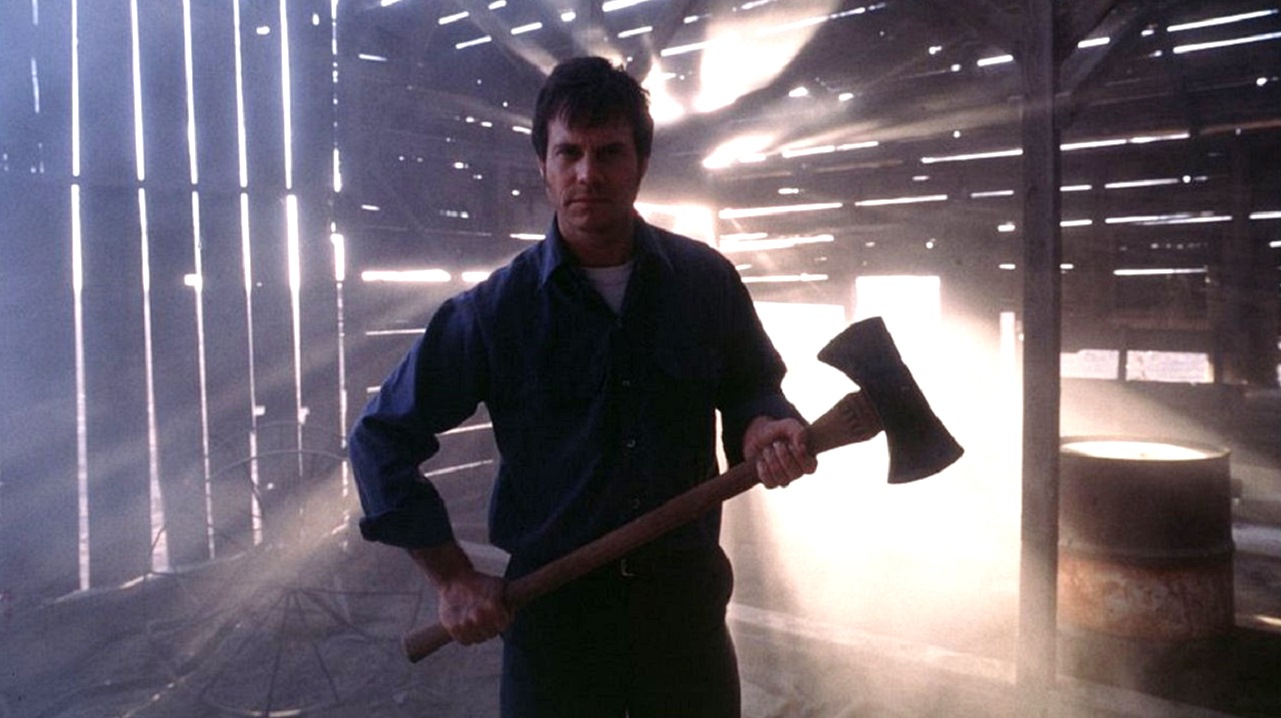
It is a film that inhabits a highly disturbing headspace. It is all the more effective for the understated nature of it – Bill Paxton refuses to indulge in any cliché horror moves, shows little blood, and concentrates not on the killings but in the battle of faith between father and son. The scene that Paxton makes into the dramatic centre of the film where young Matt O’Leary is locked down in the cellar by his father to await a vision from God is highly disconcerting. The film is made all the more disquieting by the alarmingly patient and rational everyday performance given by Paxton himself as the boy’s father.
Where Frailty falters somewhat is when it comes to its ending. [SPOILER ALERT]. It is here that screenwriter Brent Hanley tosses up a grand twist in revealing that the narrator of the flashbacks throughout the film up to this point is not the person we thought he was. It is a twist ending that Hanley has entirely borrowed from The Usual Suspects (1995). It is an effective surprise but one that makes us all too aware of the contrived nature of the charade that has just been pulled on us. Why would someone go to the elaborate extent of telling such a story to the FBI and tell it from the point-of-view of someone else?
It is given a sort of rationalisation as to why but it is only there to jolt us out of what we thought was the case and never makes much in the way of motivational sense. The dramatic intensity that Bill Paxton has placed into the scenes we have just seen also makes this revelation less believable – if this is after all the other brother narrating then it fails to seem plausible that he could put so much emotional conviction into relating his sibling’s vehement opposition and atheism to his own point-of-view.
Bill Paxton subsequently went onto direct one other film with the golf drama The Greatest Game Ever Played (2005).
(Nominee for Best Original Screenplay at this site’s Best of 2001 Awards).
Trailer here