
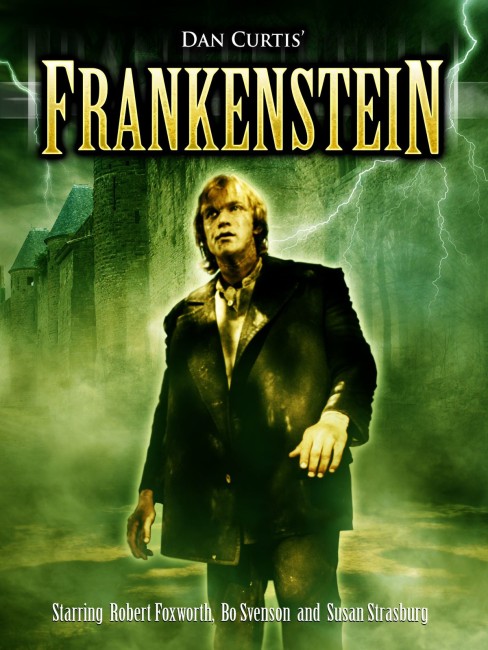
USA. 1973.
Crew
Director – Glenn Jordan, Screenplay – Sam Hall, Adaptation – Dan Curtis & Sam Hall, Based on the Novel by Mary Shelley, Producer – Dan Curtis, Music – Robert Cobert, Special Effects Supervisor – Roger George, Makeup – Mike Westmore, Art Direction – Trevor Williams. Production Company – Dan Curtis Productions.
Cast
Robert Foxworth (Victor Frankenstein), Bo Svenson (The Giant), Susan Strasberg (Elizabeth Clerval), Robert Gentry (Henry Clerval), Philip Bourneuf (Alphonse Frankenstein), Heidi Vaughn (Agatha De Lacey), John Karlen (Otto Roget), Jon Lormer (Charles De Lacey), Brian Avery (Felix De Lacey), Willie Ames (William Frankenstein), George Morgan (Hugo), William Hansen (Professor Waldman), Malila Saint Duval (Safie), Edgar Daniels (Innkeeper)
Plot
Ingolstadt, 1856. Victor Frankenstein is a brilliant student at the university but is scorned because of his unconventional theories about reviving the dead. Determined to prove these, Frankenstein harnesses electricity from a lightning storm to revive a giant creature that he has pieced together from parts of dead bodies. The creature, not knowing what it is doing, kills Frankenstein’s assistant and then flees into the wilderness. Shunned because of its scarred visage, it hides in a woodshed near a cottage in the forest. There it is able to learn to speak by overhearing a family teaching English to the son’s Spanish fiancee. The giant then returns to Ingolstadt and demands that Frankenstein create it a mate. However, Frankenstein is unable to go through with doing so again and destroys the experiment. The giant then promises revenge against him.
Dan Curtis came to attention as a producer with the Gothic tv soap opera Dark Shadows (1966-71). This was a considerable primetime success for several years and was spun off into two movies House of Dark Shadows (1970) and Night of the Dark Shadows (1971). Realising his forte with the genre, Curtis went onto remake a series of classic horror tales as tv movies with The Strange Case of Dr Jekyll and Mr Hyde (1968), The Picture of Dorian Gray (1973), Dracula (1974) with Jack Palance and The Turn of the Screw (1974), as well as original tv movies like The Night Stalker (1972), The Invasion of Carol Enders (1973), The Night Strangler (1973), The Norliss Tapes (1973), Scream of the Wolf (1974), Trilogy of Terror (1975), Curse of the Black Widow (1977), Dead of Night (1977), the cinematically released Burnt Offerings (1976), the tv mini-series Intruders (1992) and Trilogy of Terror II (1996). Curtis also directed a number of these.
Dan Curtis’s Frankenstein was about the fourth major sound version of Mary Shelley’s Frankenstein (1818). (Curtis had previously borrowed from the basics of Frankenstein for the whole Adam storyline that ran though much of 1968 in tv’s Dark Shadows). What one can say is that of all these other adaptations, Curtis’s Frankenstein was the most faithful to Mary Shelley of any version made up to that point (and still was for a number of years). Indeed, this version of Frankenstein adheres to Mary Shelley far more closely than the more high profile tv adaptation Frankenstein: The True Story (1974) that was made the following year. (See the bottom of the page for other screen versions of the Frankenstein story).
The faithfulness of this version is especially notable during the middle third. We get the classic scene with the monster hiding in the woodshed in the forest secretly observing the blind daughter and the old man, learning to speak as she hears the son’s new Spanish wife being taught English, before he emerges to befriend the blind daughter but is driven away when the sighted family return. (The scene is slightly different in the book – it is the old man that is blind, not the daughter, and the wife is Turkish not Spanish – but this conducts an effective replication of the basics). In fact, this was the first time in any Frankenstein film up to that point that we have had a monster that can speak – or at least voice more than a couple of words in Pidgin English.
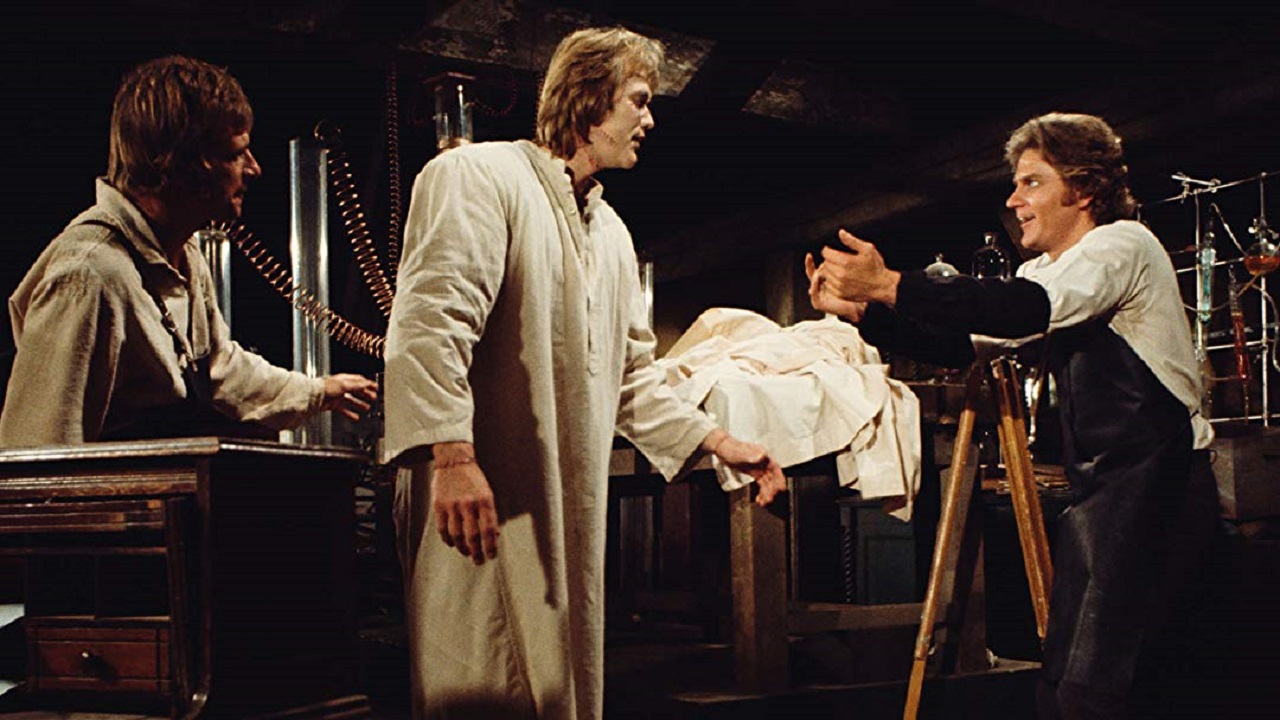
We also have the murder of Frankenstein’s brother William by the monster (although nothing of the framing and hanging of the maid Justine Moritz), as well as the scenes where Frankenstein and the monster meet up, he promises to make it a mate but then finds he cannot go through with such again. The meeting between Frankenstein and monster is given an interesting new spin here that no other version has ever done – that the two meet up again by accident but the monster does not recognise Frankenstein as his creator.
On the minus side, Dan Curtis’s Frankenstein has been undeniably made on the cheap. Frankenstein’s laboratory looks cramped, especially in comparison to the other screen versions (notably the magnificent laboratories in the Universal films) – all that we see of the requisite lightning storm that brings the monster to life are flashes that light up the laboratory from outside the skylight window.
The show is also hampered by Glenn Jordan’s run-of-the-mill tv direction. There is rarely much in Jordan’s direction that attempts to make Frankenstein seem more than say a standard tv soap opera episode and little to pump the story up for atmosphere. This is particularly noticeable at the end of the film, which substitutes Mary Shelley’s moody climax where Frankenstein pursues the monster into the Arctic for a more mundane one where Frankenstein pursues the monster to the ruins of an abandoned mansion and dies after falling on a protruding piece of debris, after which the monster is shot by the authorities and poignantly dies with Frankenstein’s body in his arms weeping “forgive me”.
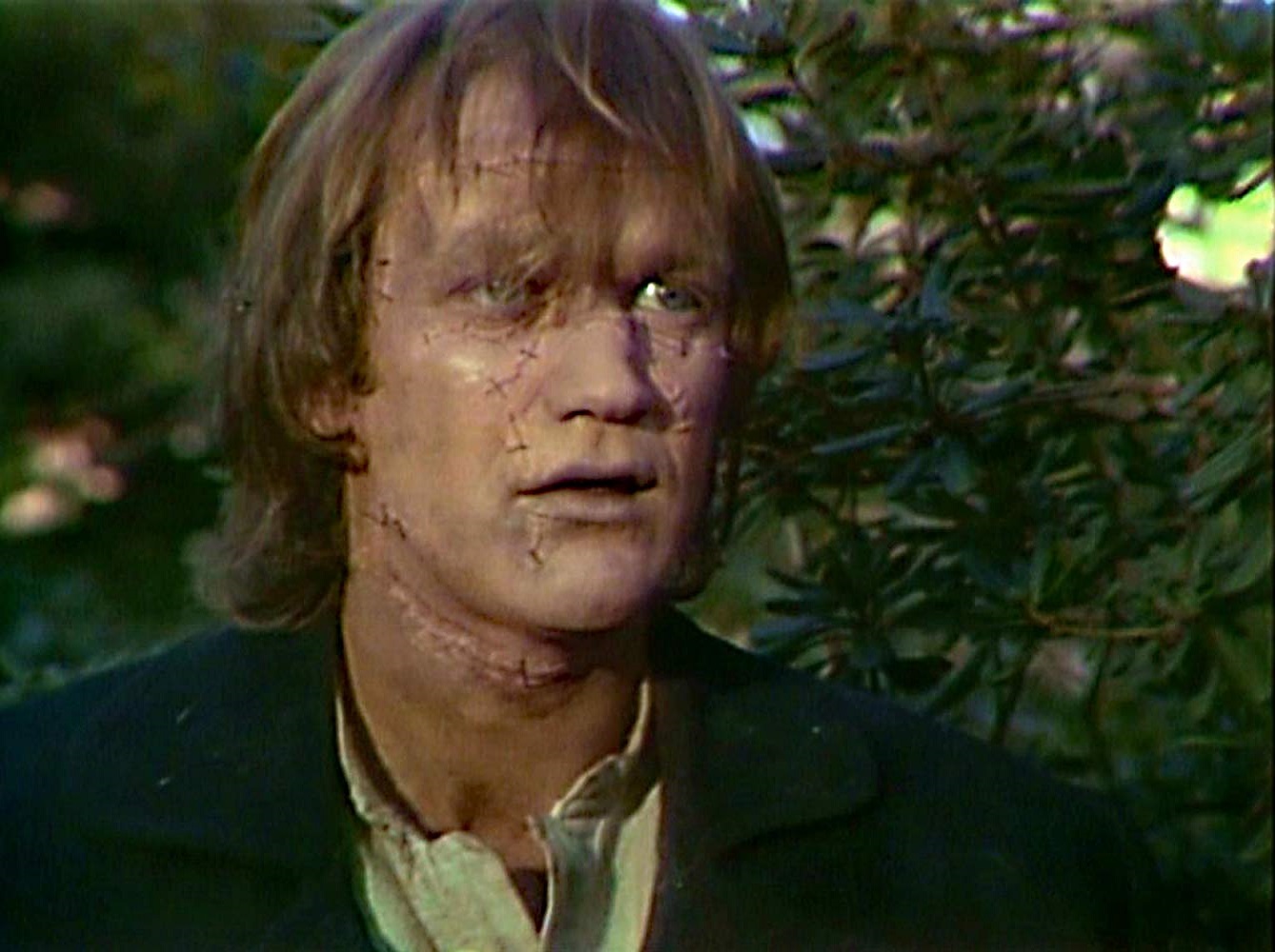
As Frankenstein, Robert Foxworth, later of Falcon Crest (1981-90) fame, seems too much the handsome leading man type to seem right as the brooding, guilt-ridden Frankenstein. As the monster, Bo Svenson has some of the innocent, hulking lugubriousness that Boris Karloff did in his classic essayal of the role. His monster seems more of a good-natured simpleton. (The casting of Bo Svenson does give us the odd novelty of the screen’s first (only???) blonde Frankenstein monster). Another interesting twist is Susan Strasberg’s Elizabeth. Here Elizabeth, who now also becomes Henry Clerval’s sister, is played as much more of a modern woman rather than the dutiful fiancee who is merely there to be abducted – she even decides to leave Frankenstein because he has been neglecting her. This is probably the strongest characterisation that Elizabeth has had in any screen version so far.
Other adaptations of Frankenstein are:- the famous Thomas A. Edison Frankenstein (1910), the lost Life Without Soul (1915) and the lost Italian The Monster of Frankenstein (1920); the classic Universal adaptation Frankenstein (1931) with Colin Clive as the Baron and Boris Karloff as the monster; Hammer’s excellent The Curse of Frankenstein (1957) with Peter Cushing as the Baron and Christopher Lee as the monster, a film that spun out its own series of sequels (see for which); a 1968 Thames tv production with Ian Holm as both the Baron and the monster; Hammer’s unfunny comic remake The Horror of Frankenstein (1970) with Ralph Bates as the Baron and Dave Prowse as the monster; the tv mini-series Frankenstein: The True Story (1974), which returned much more to the book, and featured Leonard Whiting as the Baron and Michael Sarrazin as the monster; the Swedish-Irish production Victor Frankenstein (1977) starring Leon Vitali as the Baron as Per Oscarsson as the monster; the tv movie Frankenstein (1984), with Robert Powell as the Baron and David Warner as the monster; the little-seen tv movie Frankenstein (1986) with Carl Beck as Frankenstein and Chris Sarandon as the monster; David Wickes’s dull tv movie Frankenstein (1992) with Patrick Bergin as the Baron and Randy Quaid as the monster; Kenneth Branagh’s quite faithful, big-budget Mary Shelley’s Frankenstein (1994) with Branagh as the Baron and Robert De Niro as the monster; the tv mini-series Frankenstein (2004) with Alec Newman as Frankenstein and Luke Goss as the monster; Danny Boyle’s stage version of Frankenstein (2011) with Benedict Cumberbatch and Jonny Lee Miller alternating the role of Frankenstein and creation; the low-budget Frankenstein: Day of the Beast (2011) with Adam Stephenson as Frankenstein and Tim Krueger as the monster; and Victor Frankenstein (2015) with James McAvoy as Frankenstein.