
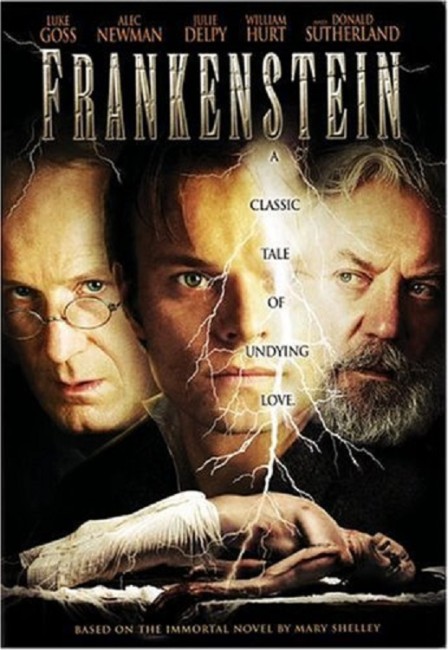
USA. 2004.
Crew
Director – Kevin Connor, Teleplay – Mark Kruger, Based on the Novel by Mary Shelley, Producer – James Wilberger, Photography – Alan Caso, Music – Roger Bellon, Special Effects Supervisor – Tissi Brandhofer, Makeup Effects – Almost Human (Supervisor – Robert Hall), Production Design – Jonathan Carlson. Production Company – Hallmark Entertainment/Silverstar Limited/Larry Levinson Productions.
Cast
Alec Newman (Viktor Frankenstein), Luke Goss (The Creature), Nicole Lewis (Elizabeth Frankenstein), Donald Sutherland (Captain Robert Walton), William Hurt (Professor Waldman), Mark Jax (Alphonse Frankenstein), Dan Stevens (Henry Clerval), Julie Delpy (Caroline Frankenstein), Jean Rochefort (Old Blind Man), Monika Hilmerova (Justine Moritz), Daniel Williams (William Frankenstein), Oliver La Sueur (Felix), Edita Borsova (Agatha), Hannah Van Der Westhuysen (Eva)
Plot
The 1820s. A sailing ship captained by Robert Walton is iced in in the Arctic. The crew suddenly see two men pursuing each other across the ice on dog sleds. One of the men collapses and is brought aboard the ship. This proves to be Viktor Frankenstein who proceeds to tell Captain Walton his incredible story. From a young age, Viktor was obsessed with life and death. He went to Ingolstadt to study where his tutor Professor Waldman encouraged him to think beyond convention. Viktor then stole dead bodies from graves and pieced them together. He harnessed lightning from a storm to bring his creation to life. However, upon seeing what he had created, Viktor was horrified. The creature ran away but was shunned by everybody it came across because of its hideous appearance. Hiding in the woods, it learned to speak and read from spying in on a family in a cottage. It then returned to Geneva to find its creator. In its bumbling attempts to do so, it accidentally killed Frankenstein’s younger brother William and left evidence that had the maid hung for the murder. Frankenstein confronted his creation who promised to stop its reign of terror if he created a mate for it. However, after starting, Frankenstein found that he could not go through with doing so again and burned his notes. The creature then promised to take revenge on Frankenstein on his wedding night.
This tv mini-series is by this author’s estimation the thirteenth screen adaptation of Mary Shelley’s Frankenstein (1818). (See below for the other film and tv adaptations of the story). This version comes from Hallmark Entertainment, a production arm of the US Hallmark tv cable channel. Hallmark have made a number of family oriented tv works, as well as adapted numerous classic stories. (A list of Hallmark’s other genre productions is also at the bottom of the page).
In sitting down to watch Hallmark’s Frankenstein, one wonders, after numerous adaptations of the story, sequels, modernizations, parodies and comedic variations, not to mention various pornographic, Blaxploitation and children’s movie interpretations, what yet another version of the story might have to say anew on the subject. The answer appears to be that Hallmark are attempting to conduct a rigorously faithful adaptation of Mary Shelley’s book. Surprisingly enough, Hallmark end up succeeding – at least more so than any other version to date, even Kenneth Branagh’s Mary Shelley’s Frankenstein (1994), which was previously considered the most faithful of all screen adaptations.
There are some minor changes – the mini-series extends the narrated backstory to take us through Frankenstein’s childhood; and gives both Professor Waldman and Captain Walton much more on-screen time than any other film version to date (most notably in returning to the wraparound narrative framework several times throughout, whereas Shelley only has Captain Walton there at the beginning and end. William Hurt’s Waldman also keeps returning to voice horror and disapproval at Frankenstein’s experiments).
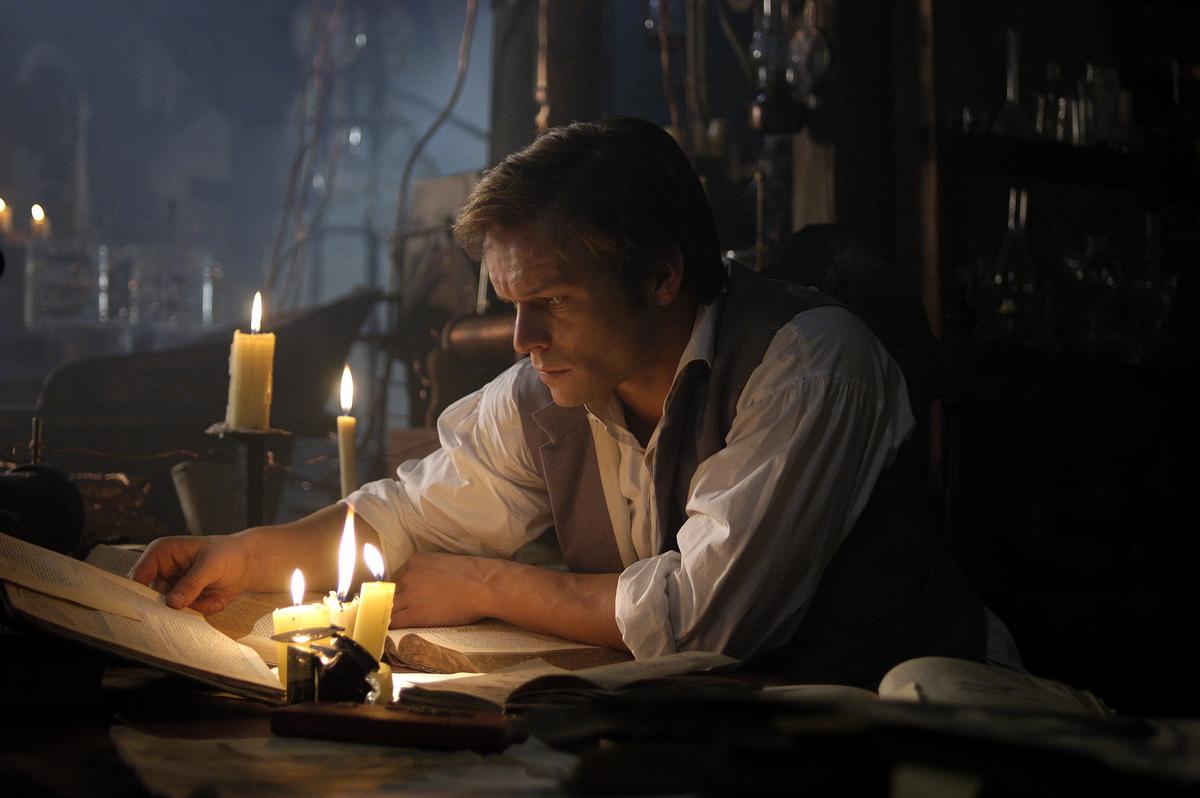
The mini-series also concertedly stays clear of association with all foregoing film versions – excepting to stage its own version of the encounter with the blind man from Bride of Frankenstein (1935) and an equivalent of the classic scene where the creature and little girl meet in Frankenstein (1931), although here the creature does not kill her. On the minus side, this version takes its time in the telling of the story – the pursuit of the creature up into the Arctic takes up nearly the entire second half of the second part of the mini-series (about an hour’s worth of screen time).
One notable difference is that in telling a straight version of the story, the mini-series comes minus the social indignation of previous versions. In the 1931 Boris Karloff version, the film’s subtext was outrage at someone challenging the provenance of divine law, while in Hammer’s version The Curse of Frankenstein (1957), Frankenstein was seen as someone who defied the domain of polite upper-class society and good taste. Here the story is simply about a creature that is a social outcast – all its problems result from loneliness, not from criminal brains or its creator’s crossing of social taboo lines.
Unfortunately, the mini-series comes with a bland affect that cripples the story. There is not much to it as a horror story. At least until the latter parts of the story, the creature seems merely gauche and ungainly but well meaning at heart – it doesn’t murder William, only accidentally kills him in an overenthusiastic embrace (which admittedly reasonably replicates the equivalent scene from the book). Certainly, the idea of a gentle, simple-minded creature worked in the 1931 film. If there had been a Boris Karloff in the role here, the mini-series could have worked well – alas, Luke Goss evokes none of the innocent pathos that Karloff managed to in his performance. Although, to its credit, the mini-series does pick up more of a head of steam during its second half once the creature swears its vengeance.
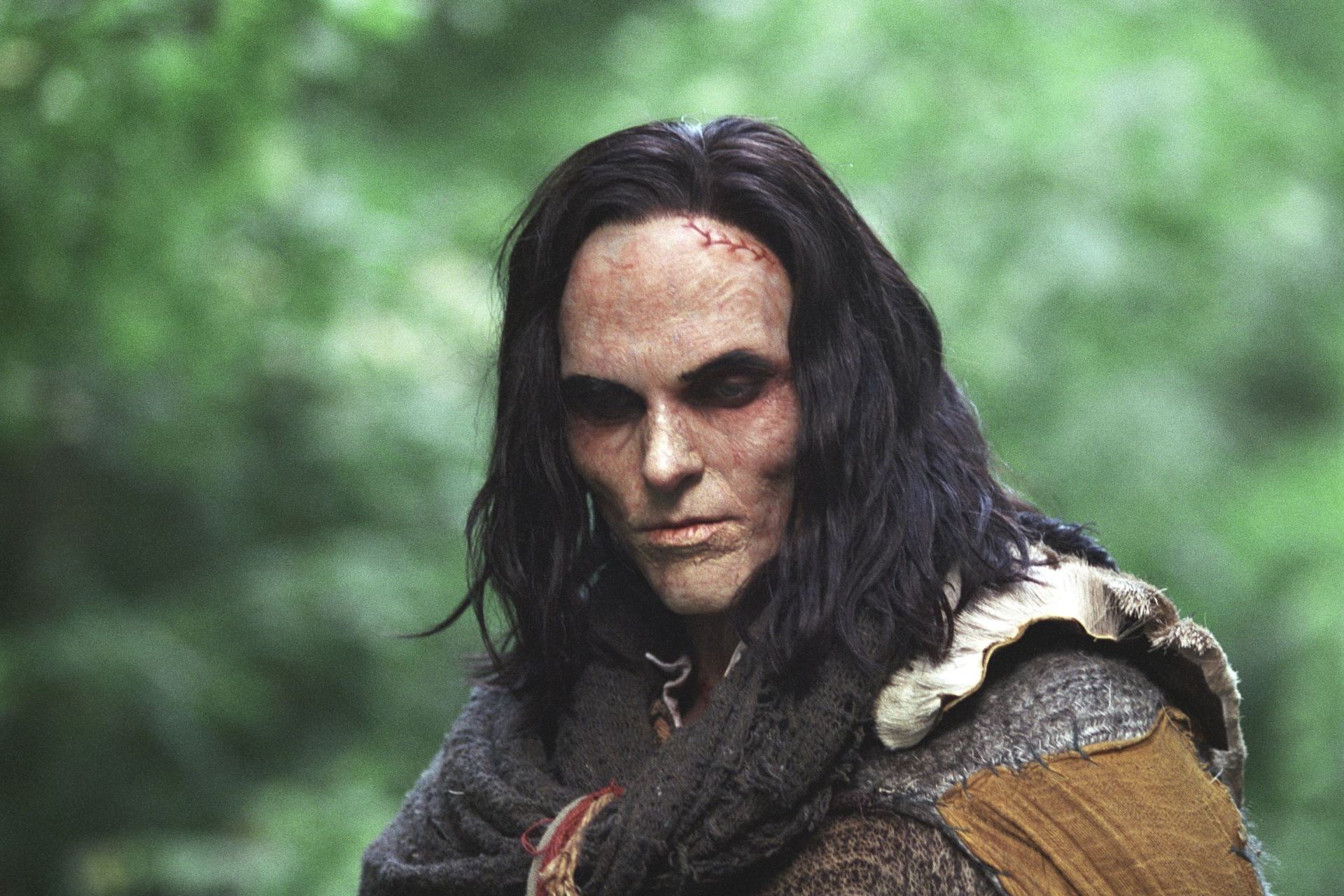
Some of Hallmark’s genre productions have been amazingly lavish works for television. Not the same can be said for Frankenstein alas. While a reasonable effort is made to root the story in the historical period it was written, there is no colour or texture to the mini-series’ evocation of period – the cast and extras only look like they are filling out the parts in costumes from the nearest rental costume warehouse, while the period trappings seem to extend no further than the camera’s eye. Certainly, there are some very nice location work in Slovakia, especially the ruined castle where Alec Newman and the creature meet, and in Norway during the moody extended climax where Frankenstein pursues the creature across the snowy wastes.
Scottish actor Alec Newman plays the title role with an intent seriousness. I was impressed with Alec Newman in the lead role in the tv mini-series version of Dune (2000), but here he is stodgy. Newman seems to strain to do the angst-wracked Colin Clive thing convincingly but fails to achieve any emotional conviction. William Hurt makes an unwise choice to play his part through a Germanic accent, which seems out of place as no-one else in the cast does so. Nicole Lewis makes for a bland and drippy Elizabeth. Disappointingly, some of the name cast barely even appear – Julie Delpy gets third billing on the credits but only appears in about two scenes, while Ian McNeice only ever appears in the background.
Other adaptations of Frankenstein are:- the famous Thomas A. Edison Frankenstein (1910); the lost Life Without Soul (1915) and the lost Italian The Monster of Frankenstein (1920); the classic Universal adaptation Frankenstein (1931) with Colin Clive as Frankenstein and Boris Karloff as the monster, which spawned a number of sequels; Hammer’s excellent The Curse of Frankenstein (1957) with Peter Cushing as Frankenstein and Christopher Lee as the monster, a film that spun out its own series of sequels; a 1968 Thames tv production with Ian Holm as both the Baron and the monster; Hammer’s unfunny comic remake The Horror of Frankenstein (1970) with Ralph Bates as Frankenstein and Dave Prowse as the monster; Dan Curtis’s tv movie adaptation Frankenstein (1973) with Robert Foxworth as Frankenstein and Bo Svenson as the monster; the tv mini-series Frankenstein: The True Story (1974), which featured Leonard Whiting as Frankenstein and Michael Sarrazin as the monster; the Swedish-Irish production Victor Frankenstein (1977) starring Leon Vitali as Frankenstein as Per Oscarsson as the monster; the tv movie Frankenstein (1984) with Robert Powell as Frankenstein and David Warner as the monster; the little-seen tv movie Frankenstein (1986) with Carl Beck as Frankenstein and Chris Sarandon as the monster; David Wickes’s dull tv movie Frankenstein (1992) with Patrick Bergin as Frankenstein and Randy Quaid as the monster; Kenneth Branagh’s big-budget Mary Shelley’s Frankenstein (1994) with Branagh as Frankenstein and Robert De Niro as the monster; Danny Boyle’s stage version of Frankenstein (2011) with Benedict Cumberbatch and Jonny Lee Miller alternating the role of Frankenstein and creation; the low-budget Frankenstein: Day of the Beast (2011) with Adam Stephenson as Frankenstein and Tim Krueger as the monster; and Victor Frankenstein (2015) with James McAvoy as Frankenstein.
Kevin Connor originally began directing back in the days of the original English horror fad created by Hammer. There Connor made the Amicus horror anthology From Beyond the Grave (1974); Amicus’s trilogy of Edgar Rice Burroughs lost world films, The Land That Time Forgot (1974), At the Earth’s Core (1976) and The People That Time Forgot (1977), and one original lost world film Warlords of Atlantis (1978), all starring Doug McClure; the Arabian Nights fantasy Arabian Adventure (1979); the Backwoods Brutality black comedy Motel Hell (1980); and the Japanese ghost story The House Where Evil Dwells (1982). These days Connor directs for tv. Among Connor’s genre tv fare is:- Goliath Awaits (1981), an interesting tv mini-series about a society that has survived in a sunken ship; The Return of Sherlock Holmes (1987), which brought the famous sleuth into the present-day; the Indian adventure The Mysteries of the Dark Jungle (1991); the stalker thriller Shadow of Obsession (1994); the Egyptian archaeology adventure The Seventh Scroll (1999); and the Christmas fantasies Santa, Jr. (2002), A Boyfriend for Christmas (2004), Farewell Mr Kringle (2010) and Annie Claus is Coming to Town (2011); and Chasing Leprechauns (2012).
Hallmark’s other productions are:– the sf mini-series White Dwarf (1995), The Canterville Ghost (1996), Gulliver’s Travels (1996), Harvey (1996), the Christmas musical Mrs Santa Claus (1996), Murders in the Rue Morgue (1996), the children’s horror Shadow Zone: The Undead Express (1996), the medical thriller Terminal (1996), The Odyssey (1997), the cloning thriller The Third Twin (1997), 20,000 Leagues Under the Sea (1997), the monster movie Creature (1998), Merlin (1998), the sf film Virtual Obsession (1998), Aftershock: Earthquake in New York (1999), Alice in Wonderland (1999), Animal Farm (1999), A Christmas Carol (1999), the tv series Farscape (1999-2003), Journey to the Center of the Earth (1999), The Legend of Sleepy Hollow (1999), The Magical Land of the Leprechauns (1999), the modernised Hamlet (2000), Arabian Nights (2000), Jason and the Argonauts (2000), Prince Charming (2000), the mini-series The 10th Kingdom (2000) set in an alternate world where fairy-tales are true, the medical thriller Acceptable Risk (2001), The Infinite Worlds of H.G. Wells (2001), Jack and the Beanstalk: The Real Story (2001), The Monkey King/The Lost Empire (2001), My Life as a Fairytale: Hans Christian Andersen (2001), Snow White (2001), the series Tales from the Neverending Story (2001), the fantasy adventure Voyage of the Unicorn (2001), the Sherlock Holmes film The Case of the Whitechapel Vampire (2002), Dinotopia (2002), The Hound of the Baskervilles (2002), the Christmas film Mr St. Nick (2002), the Christmas film Santa Jr (2002), Snow Queen (2002), the modernised A Carol Christmas (2003), Children of Dune (2003), the American Indian legends mini-series Dreamkeeper (2003), the children’s monster film Monster Makers (2003), Angel in the Family (2004), A Christmas Carol (2004), Earthsea (2004), 5ive Days to Midnight (2004) about forewarning of the future, King Solomon’s Mines (2004), the Christmas film Single Santa Seeks Mrs. Claus (2004), Dinotopia: Quest for the Ruby Sunstone (2005), Hercules (2005), the thriller Icon (2005), Meet the Santas (2005), Mysterious Island (2005), the disaster mini-series Supernova (2005), The Curse of King Tut’s Tomb (2006), the alien invasion mini-series Final Days of Planet Earth (2006), Merlin’s Apprentice (2006), the bird flu disaster mini-series Pandemic (2006), the disaster mini-series 10:15 Apocalypse (2006), the psychic drama Carolina Moon (2007), the psychic drama Claire (2007) and the ghost story Something Beneath (2007).
Trailer here