
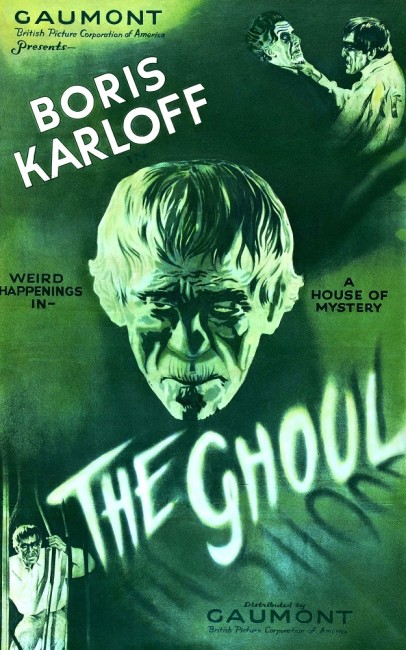
UK. 1933.
Crew
Director – T. Hayes Hunter, Screenplay – Roland Pertwee & John Hastings Turner, Based on the Novel & Play by Leonard J. Hines & Dr Frank King, Photography (b&w) – Gunther Krampf, Music – Louis Levy, Music Adaptation – Rupert Downing, Art Direction – A. Junge. Production Company – Gaumont British.
Cast
Boris Karloff (Professor Morlant), Anthony Bushell (Ralph Morlant), Dorothy Hyson (Betty Harlow), Ernest Thesiger (Laing), Cedric Hardwicke (Broughton), Kathleen Harrison (Kaney), Harold Huth (Aga Ben Dragore), Ralph Richardson (Nigel Hartley), A. Clarke-Smith (Mahmoud)
Plot
Professor Morlant dies. As per his instructions, an Egyptian jewel known as The Eternal Light is bandaged to his hand and his body placed in a crypt that is locked from the inside. The local parson condemns this as highly un-Christian. His designated heirs, Ralph Morlant and Betty Harlow, arrive at the country estate, along with several other parties of interest, including Egyptians who insist that the Eternal Light belongs to them. It is then discovered that someone has stolen the jewel from the tomb. Professor Morlant next rises from the crypt and staggers through the house, killing those in his way as he tries to get the jewel back.
The Ghoul is an obscure genre film. It was believed lost for many years until a print was found in 1969, although even since its rediscovery – up until its 2002 DVD release – it has remained difficult to get hold of. This lack of availability has tended to lead to the inevitable hyping of its reputation – its inclusion by William K. Everson in his genre study Classics of the Horror Film (1974), for instance, a position it didn’t deserve.
The Ghoul is certainly a fascinating film to finally see after reading about it. Invariably its reputation is far more than what the film stands up to. It is has not dated well. This print seen here is not the best quality – it is grainy and one strains to hear the sound. The direction is rather slow. A good deal of the film given over to the cosy drawing room banter between Anthony Bushell’s hero and Dorothy Hyson’s heroine, as well as Kathleen Harrison as Hyson’s comic relief flatmate who spends most of the film batting her eyelids as Harold Huth’s mysterious Egyptian stranger.
Despite the film’s creakiness, an undeniable atmosphere does come through. There is a captivating opening with the dying and cadaverous Boris Karloff begging his manservant to bind the jewel to his hand amid suggestions of arcane rituals. Director T. Hayes Hunter does manage to create a certain atmosphere out of gloomy contrasts of light and shadow, with the whole mansion seeming one of angular staircases, narrow passages, big bay windows with ominous shadows moving beyond the glass, sinister prowlers and the like.
When Boris Karloff does finally rise from the tomb and start stalking through the house, the film gains an undeniable degree of effectiveness. Karloff has been outfitted with a makeup job that makes him look particularly unearthly and decaying. Moreover, Karloff has almost no dialogue and delivers the entire performance as a mime of leering cadaverous threat. With his almost cartoonishly exaggerated pinched face, wild hair and a theatrical Scottish accent, Ernest Thesiger also proves to be a scene-stealer.
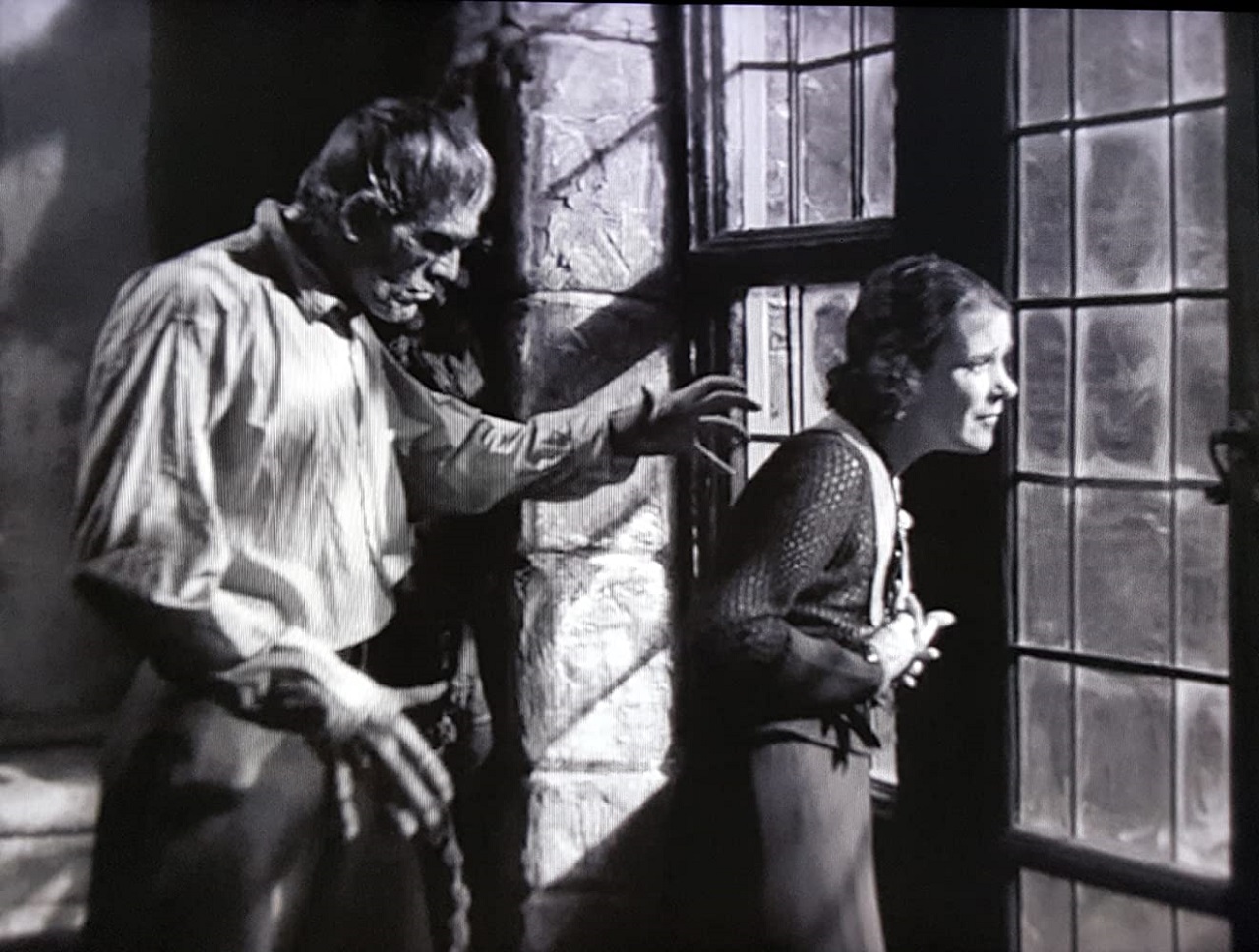
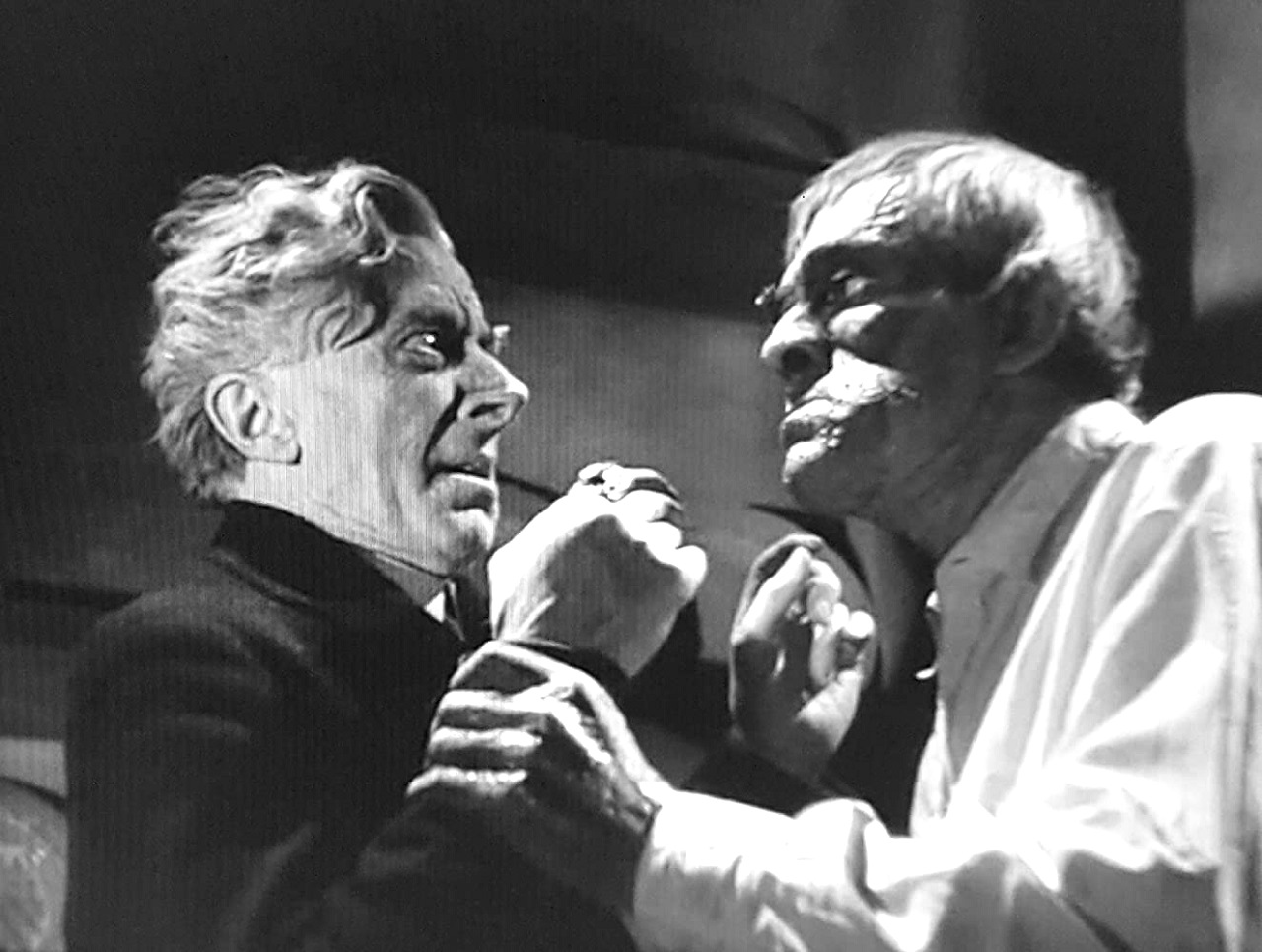
There are many similarities between The Ghoul and the various Old Dark House Thrillers of the same era – the likes of The Cat and the Canary (1927), The Bat Whispers (1930) and The Old Dark House (1932), which notedly also paired Boris Karloff and Ernest Thesiger. All of these Old Dark House films (as indeed did almost all horror films from Hollywood during this decade) rigidly eschewed the supernatural, eventually revealing the causes of such to be mundane in origin. The Ghoul, being British made, does not (quite). It certainly gives the impression that Boris Karloff has been resurrected from the dead and is a corpse stumbling about. Although one is not entirely sure how he did this without having possession of the Eternal Light. Moreover, there is a line at the end that tries to suggest that this might be of mundane explanation after all and have been due to his premature burial because of catalepsy.
The Ghoul certainly arrays many plot elements of the Old Dark House genre – the relatives come to claim an inheritance, the assorted incidental characters, skulking menaces in the shadows, people posing in different identities and a thriller plot of sorts concerning who stole the jewel. However, the film does have a vagueness when it comes to explaining what is going on – it is never made clear whether Boris Karloff died or not, or even why the Eternal Light is so valuable and how Karloff came into its possession.
The Ghoul creaks and is a minor effort – certainly in comparison to the polish that the aforementioned Old Dark House Hollywood counterparts from the same era are made with, it does seem dated today – although is not entirely without a certain modest effectiveness.
(Review copy provided of Kathy Tipping)
Trailer here
Full film available online here:-