
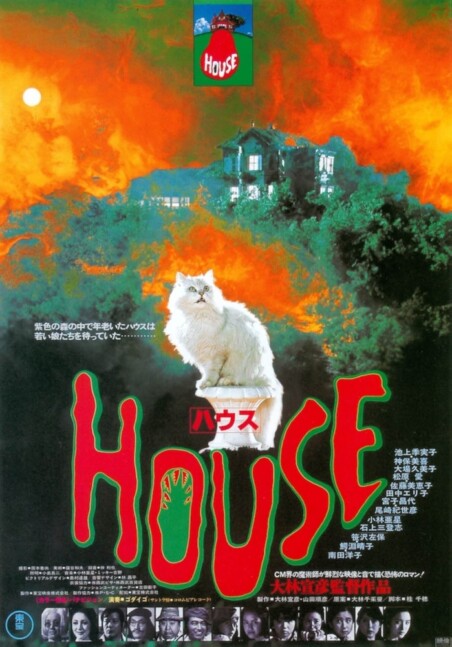
(Hausu)
Crew
Director/Director of Special Effects – Nobuhiko Obayashi, Screenplay – Chiho Katsura, Concept – Chigumi Obayashi, Producers – Nobuhiko Obayashi & Yorihiko Yamada, Photography – Yoshitaka Sakamoto, Music – Asei Kobayashi & Mickie Yoshino, Songs – Godiego, Production Design – Kazuo Satsuya. Production Company – Toho.
Cast
Kimiko Ikegami (Gorgeous), Kimiko Ohba (Fantasy), Yoko Minamida (Auntie), Miki Jinbo (Kung Fu), Eriko Tanaka (Melody), Ai Matsubara (Prof), Mieko Satoh (Mac), Masayo Miyako (Sweet), Haruko Wanibuchi (Ryoko Ema), Saho Sasazawa (Father), Kiyohiko Ozaki (Keisuke Togo), Asei Kobayashi (Watermelon Seller)
Plot
As school breaks for the holidays, Gorgeous prepares to go to Karuizawa with her father. When she returns home, her father introduces her to Ryoko Ema and announces that he is going to marry her. Shocked at the thought of having to regard Ryoko as her mother, Gorgeous refuses to join them. She instead writes to her Auntie to ask if she can go stay with her and instantly receives a welcoming response. When Gorgeous’s five schoolfriends have their vacation plans cancelled, Gorgeous invites them to join her. They travel to Auntie’s house in the countryside as Gorgeous tells them how the man Auntie was going to marry was shot down during World War II but how Auntie steadfastly refused to give up on his vow to return to her. Arriving at the house, they are invited in by the strange Auntie. They soon discover however that the house is haunted.
House – no relation to the Steve Miner-Sean S. Cunningham horror film House (1986) and its sequels or to the contemporary hit tv medical drama House M.D. (2004-12) – is a very strange Japanese horror film. Not widely seen outside of Japan when it was originally made – I am unable to ascertain if it even had an English-language release anywhere beyond a handful of fantastic film festivals – it was suddenly rediscovered in 2009 and underwent a theatrical arthouse re-release after proving a trippy hit with film festival audiences and has started to develop a cult reputation.
From the moment the film opens, you sit wondering what on earth is going on. It is peopled with teenage girls seemingly out of a juvenile shoujo drama who have names like Gorgeous, Fantasy, Sweet and Kung Fu and spend so much time giggling in unison you wonder if it were not mandatory that everyone in the cast had to inhale laughing gas. Director Nobuhiko Obayashi experiments with every cinematic technique in his arsenal – random freeze-frames, spiral effects, colour tints, cuts to black-and-white stock, the screen forming into gauzed-out hearts and circles or irising down to a small dot.
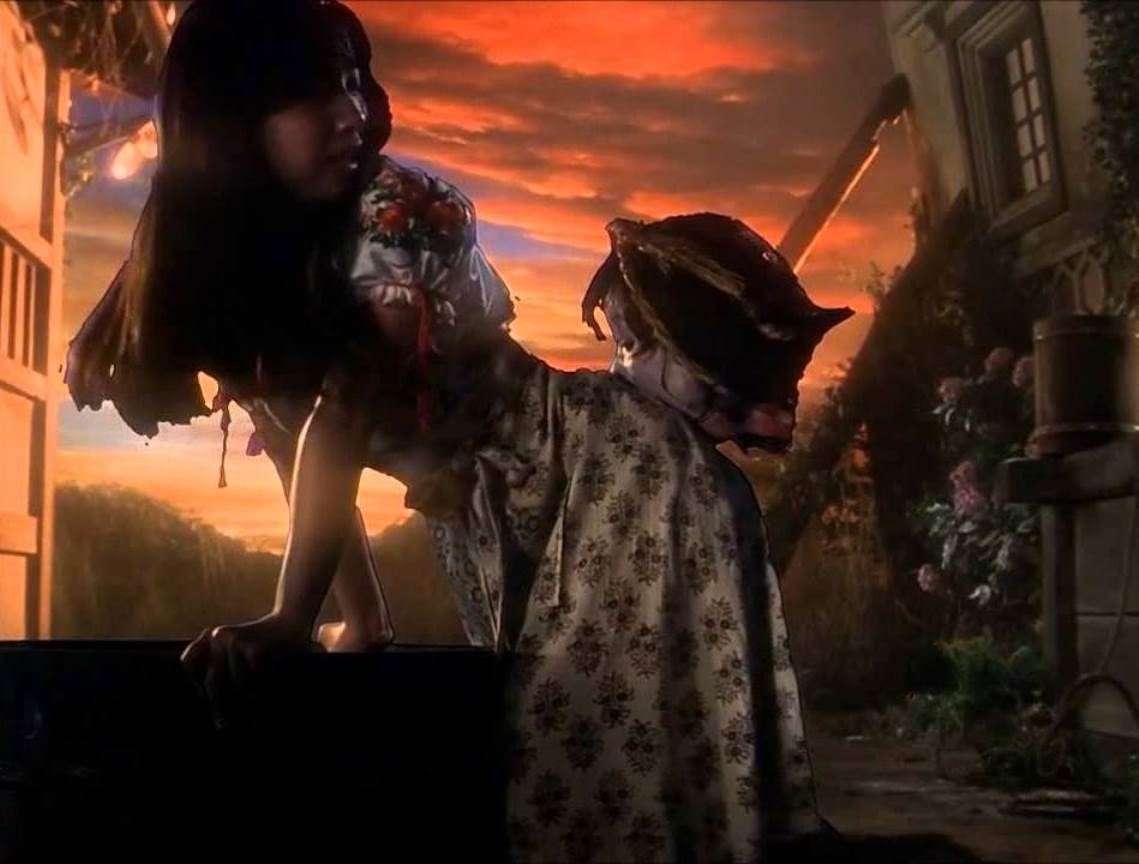
The colours seem hyper-real – the sunset sky beyond the heroine’s home is clearly a painted backdrop that comes in impossibly beautiful oranges and pinks. There are sappy slapstick scenes with a guy who falls down the stairs and impales his ass in a bucket, while characters nod along like a seated chorus line as a pop song plays on the soundtrack. The train journey to Auntie’s house is represented by animation and obviously painted backdrops passing by outside the window.
Director Nobuhiko Obayashi seems to have set out to make a kaidan eiga (or Japanese ghost story film) that is wacky and way-out as he possibly can. In fact, the initial third seems more like something made for adolescent girls than anything that approaches a ghost story. The effect is less of a film in the tradition of other kaidan eiga around that time such as Ugetsu Monogatari (1954), Ghost Story of Yotsuya (1959), Oni Baba (1964), Illusion of Blood (1965) or Kwaidan (1964) than it is a psychedelic 1970s children’s story like Pufnstuf (1970) or Willy Wonka and the Chocolate Factory (1971) having been reconceptualised as a haunted house tale.
Once the film arrives at the house and the hauntings begin proper, things become even more bizarre. The moment the girls enter the house, the chandelier comes to life, flashing animated lights and firing its drops out, levitating some of the group and causing a hat to appear on one of the other girls. Kimiko Ikegami is attacked by Mieko Satoh’s head come out of a well, whereupon it flies around and bites her on the butt. Auntie (Yoko Minamida) joins the girls in eating a melon but then an eyeball peers out her mouth. Miki Jinbo is attacked by flying logs and kung fu’s them away while, for no particular reason, she loses most of her outer clothes in the process. Eriko Tanaka plays the piano where the ticking metronome is joined by a skeleton clapping to keep the time. Later, in one of the more demented scenes, the keyboard lid of the piano chops her fingers off and then she is devoured by the body of the piano. (The makeup and optical effects are decidedly shoddy but do not take away from the outre wildness of the scene). The film arrives at a madcap climax with walls and cupboards spraying blood until the survivors are afloat on a river of blood inside of the house and Kimiko Ohba is attacked by a light fitting that attaches itself to her head and swings her around the room.
Is House an undiscovered cult classic? Who knows, cult audiences often seem completely random in their tastes. Certainly, it has the perfect mix of hallucinatory trippiness, bad filmmaking and WTF moments that makes it perfect for midnight screenings. For me, it seemed just a little too much in the way of edible silliness, like eating so much sweet, syrupy candyfloss that you start to feel nauseous. That is the sum of the film ultimately – strip the wacky visuals and effects out and play everything straight and what would emerge would be a fairly ordinary juvenile haunted house story. Not to say that House does not prove a wackily pleasurable morsel while it lasts.