

USA. 2005.
Crew
Director – Andrew van den Houten, Screenplay – Steve Klausner, Story – Troy McCombs, Producers – William M. Miller & Andrew van den Houten, Photography – William M. Miller, Music – Ryan Shore, Makeup Effects – Jamie Kelman, Production Design – Krista Gall & Jeff Subik. Production Company – Modern Ciné/Modern Headspace Productions, LLC.
Cast
Christopher Denham (Alex Borden), Erick Kastel (Harry Jelinek), Olivia Hussey (Dr Karen Murphy), Paul Sparks (Jason), William Atherton (Dr Ira Gold), Dee Wallace Stone (Dr Denise Bell), Udo Kier (Reverend Karl Hartman), Mark Margolis (Boris Pavlovsky), Patrick Wang (Sammy Chung), Larry Fessenden (Father), Sean Young (Mother), Pollyanna McIntosh (Stacy), James Spruill (Lloyd)
Plot
Alex Borden begins to experience headaches, before he collapses and is rushed to hospital. Doctors determine that he is using untapped parts of the human brain. Soon Alex is demonstrating massive mental skills – he able to absorb the contents of books merely by looking through them, becomes a chess expert simply by reading about it and is uncannily able to know people’s secrets. At the same time, monsters starts killing everybody that Alex comes into contact with and then come after him too.
Headspace is a low-budgeted and independently made debut feature from Andrew van den Houten. van der Houten was previously a child actor who appeared in various commercials and a Nickelodeon pilot. In his college year, van der Houten formed the Modern Ciné production company and directed the short Inherent Light and Darkness (2002). Headscape was van der Houten’s first feature film.
For an independent production, Andrew van den Houten has managed to array an impressive line-up of name actors including Olivia Hussey, William Atherton, Sean Young, Dee Wallace Stone and cult German actor Udo Kier, even fellow low-budget horror director Larry Fessenden, of Habit (1996) and Wendigo (2001) fame, who plays the boy’s father. William Atherton was clearly impressed enough with Headspace to take an associate producer role.
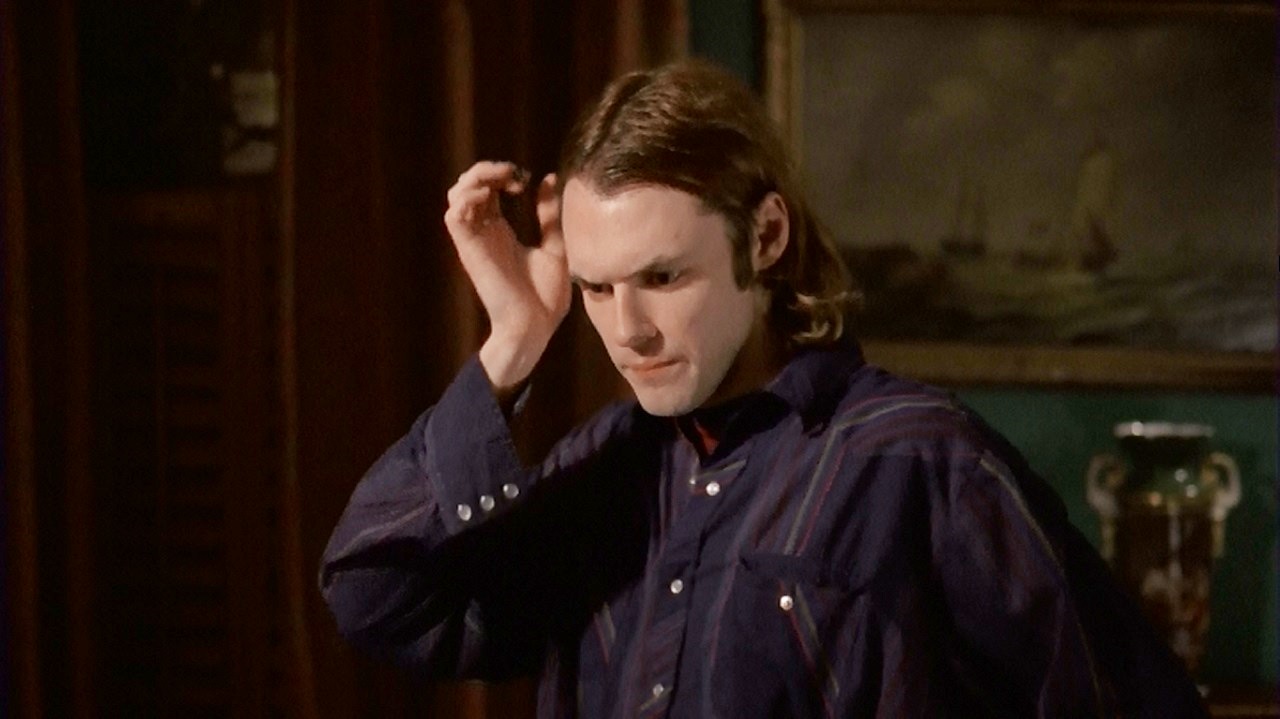
Though it is pitched as a gore-drenched horror movie and the dvd cover comes with quotes from splatter director Stuart Gordon, Headspace is (if you will pardon the pun) a much more intellectual film than one might expect. It for the most part eschews gratuitous upfront shock effects to work on a level of ideas. The film starts slowly – time is spent on things such as a chessgame and the introduction of Christopher Denham’s friends. In these scenes, Headspace is a mannered, even quietly muted film. This means that when the sudden eruptions of sexuality, monsters and gore do come it is often with a sudden jolt. Andrew van den Houten’s reality blurrings are conducted with an adept cleverness and some of the shocks genuinely do make you jump – particularly one entirely unexpected moment where Christopher Denham is grabbed by a demon from out of a darkened hallway.
In terms of its ideas, Headspace feels like a film like Powder (1995) or Phenomenon (1996), which both concerned individuals who demonstrated expanded mental abilities, including vast intelligence and seeming psychic powers. A few years later, the theme was taken up in high-profile films like Limitless (2011) and Lucy (2014). Where Powder and Phenomenon play their ideas as respectively a parable about prejudice towards the gifted and an inspirational positive thinking drama, Andrew van den Houten plays the idea as a horror film where the arrival of mental gifts also serves to unleash something horrific.
For the most part, Headspace could have been a standard teen horror film – look to similar works of recent like They (2002) and Darkness Falls (2003) or the A Nightmare on Elm Street sequels of the 1980s, which are construed as no more than a conveyor belt of scares provided up at intervals with little-to-nothing in the way of explanatory rationale. For a time, Headspace seems to be heading along a similar path in offering up a good many reality flips and a number of gory killings, but with not much to tie it all together conceptually. That is until the film throws in Mark Margolis’s expatriate Russian scientist and his explanation about Links. It is an idea that proves positively ingenious in tying together what up to that point seemed like no more than a standard reality bender film with a predictable victimisation spread. This is followed by a highly effective twist revelation about identities of people that serves to bring the entire film together with a clever ingenuity.
Certainly, when it does come to providing the gore, Andrew van den Houten does not stint in this regard – there is a good jolt in the first few minutes when we see Sean Young having a hole blasted through her head. On the minus side, when we finally do get to see them in the light, the demons do seem rather rubbery. Andrew van den Houten also welcomely throws a dash or two of gratuitous sexuality into the mix, something that has been bled out of the ultra-conservative mainstream-released teen horror films of the 00s. On the basis of Headspace, one is certainly interested to see what Andrew van den Houten does next.
One should also complement van den Houten’s cast, both the recognisable names and the newcomers, who all give able and highly professional performances. Particularly good is Erick Castel as the enigmatic chessplayer who plays with a mix of wry humour and cocky individuality – one predicts that Castel is an actor who is heading places and we are likely to hear from again soon. In his film debut, Christopher Denham manages to stand out with some understated effect.
Andrew van den Houten has directed one other horror film with Offspring (2009) about a savage feral family who exist by preying on others. Subsequently however, van den Houten has become prolific as a horror producer with medium-budget works such as The Girl Next Door (2007), Home Movie (2008), Lucky McKee’s The Woman (2011), Ghoul (2012), All Cheerleaders Die (2013), Jug Face (2013), Malignant (2013), Ascent to Hell (2014), Slumlord (2015), Central Park (2017), Camera Obscura (2017), No Way to Live (2017), The Night Sitter (2018), The Ranger (2018), Sadistic Intentions (2019), Darlin’ (2019), The Honeymoon Phase (2019), Sadistic Intentions (2019), The Block Island Sound (2020) and Good Samaritan/Don’t Look Back (2020).
Trailer here