
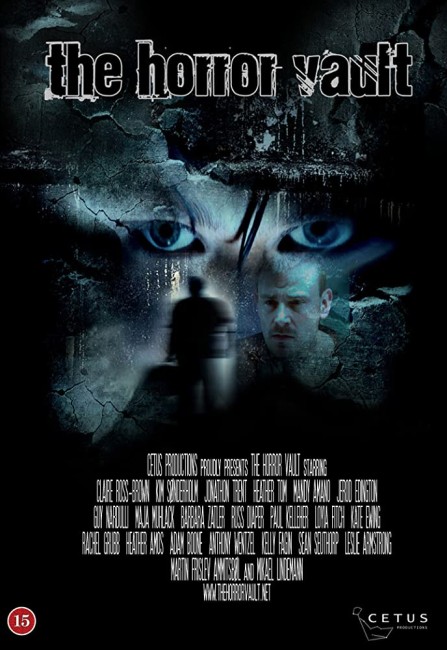
Producer/CGI Animation – Kim Sønderholm. Production Company – Cetus Productions.
When John Met Julia
Claire-Ross Brown (Julia), Kim Sønderholm (John)
Delusion
Director – Mark Marchillo, Producer – Michael Heard, Photography (b&w) – Graham Futerfas, Music – Donnie Janofsky, Production Design – Brian Ollman.
Jonathan Trent (Flynn Bentwood), Heather Tom (Veronica Farrow), Elisa Richardson (June Bentwood), Sally Wells Cook (Gertrude Follier), James Terry (Inspector Garren)
Alone
Director/Screenplay – Kenny Selko, Producer – Lyrica Glory, Photography – Christopher Gosch.
Mandy Amano (Ellen), Jerod Edington (Taylor Halliwell), Guy Nardulli (Detective Wiley)
Dead to the World: A True Story About a Killer
Director/Screenplay – Russ Diaper, Photography – Simon Black & Russ Diaper, Music – Russ Diaper and the Pumpkin Philharmonic.
Russ Diaper (Ted), Paul Kelleher (The Detective), Joyia Fitch (Suzanne), Kate Ewing (Second Victim)
Mental Distortion
Director/Screenplay – Kim Sønderholm, Photography – Mads Lund, Music – Russ Diaper.
Kim Sønderholm (Pete), Maja Muhlack (Maria), Barbara Zatler (Sarah)
Disconnected
Directors/Screenplay/Producers/Photography (b&w) – Adam Boone & Josh Card.
Adam Boone (Adam Blakes), Anthony Wentzel (Villain)
The Demon
Director/Screenplay/Special Effects Supervisor – Thomas Steen Sørensen.
Martin Frislev Ammitsbøl (The Man), Sofie Tanashka Ranji Olsen (The Girl), Mikael Lindemann (The Demon)
Echoes
Director – Gabriel Dowrick, Screenplay/Photography (b&w) – Drew English.
Sean Southorp (The Man), Leslie Armstrong (The Nurse)
Retina
Director/Producer/Digital Effects – J.P. Werner, Screenplay – Nicolai Ketelsen, Zach Rasmussen & J.P. Werner, Photography (b&w) – Zach Rasmussen, Special Effects – Alex West.
Plot
When Julia Met John:- John comes upon Julia standing by the roadside and offers her a ride. She claims to have been dumped by a boyfriend. However, she quickly turns on John, accusing him of wanting to exploit her, despite his protests of being a family man. Delusion:- Flynn Bentwood attends a society party, his first social function after the death of his mother. However, the police suspect that Flynn pushed her down the stairs and the trauma is still near to the surface for him. Alone:- Ellen is left in the sorority house after all her fraternity sisters have gone away for the weekend. A detective comes knocking at the door, warning her to stay inside because a maniac killer is on the loose. However, one of the girls’ boyfriends comes, asking to be let in and warning of the killer who is posing as a detective. Dead to the World: A True Story About a Killer:- Serial killer Ted Bundy is interviewed by a detective about a string of crimes where he raped and murdered women. Mental Distortion:- Pete finds the dead body of a girl in the bathtub. He continues to be haunted by her as he becomes involved with an old friend Maria. Disconnected: Adam is dragged out of his apartment and brutally tortured by a man. The Demon:- A very religious man picks up a girl hitchhiker and then signs into a hotel with her. He soon finds himself pursued by a demon. Echoes:- A man finds himself handcuffed to a bed and visited by nightmarish figures. Retina:- A group of people sit in a house terrified.
The Horror Vault is the first in a series of short film compilations from Denmark. The Horror Vault concept comes from Kim Sønderholm, an actor who has appeared in a number of Danish films and tv productions, including episodes of international hits such as The Killing (2007-12) and Bron/Broen (2011-8). Sønderholm began directing with the short Mental Distortion seen here and has since made his feature-length film debut with the serial killer film Craig (2008) and subsequently went onto make the action film Tour de Force (2010) and the horror film Little Big Boy (2012). Two further films were made with The Horror Vault 2 (2009) and The Horror Vault 3 (2010).
As with any compilation of shorts, The Horror Vault is a mixed bag. Kim Sønderholm directs and stars in the first and fourth segments, When John Met Julia and Mental Distortion. When John Met Julia is reminiscent of the The Hitch-Hiker segment in Creepshow II (1987). While well played, Sønderholm’s direction is a little too methodical and never holds enough of the sharp surprises that an anthology segment like this needs. It could have worked well if the psychological games between John and Julia had been drawn out more, while the twist ending seems perfunctory. Mental Distortion is a lot more assured. Again it hangs around someone (Sønderholm himself) being haunted in their apartment. We never find out who the dead girl in the bath and Sønderholm’s nightmares is and the episode falters at its payoff, but is put together and played with a considerable professional assurance. The two actors seem at home in the roles and craft credible characters.
The second segment, Delusion, is one of the strongest segments in The Horror Vault. Director Mark Machillo and photographer Graham Futerfas do a superb job of capturing the mood and lighting effects of 1940s film noir melodrama. The story in the segment is slight but the mood captured is top notch.
Alone feels like could easily be the last 15 minutes of a 1980s slasher film. The entire segment hangs on the heroine (Mandy Amano) alone in the sorority house, unsure whether the detective at the door or the guy she has just let in are the killer or not. These are familiar doubt and suspicion set-ups for a slasher film but are well delivered and not too badly performed with director Kenny Selko riding the rollercoaster of the heroine’s suspicions in all the right places.
Dead to the World is a segment based on true-life serial killer Ted Bundy. The film’s five minutes are far too brief to do Bundy justice – see the feature-length Ted Bundy (2002) for a far better treatment. The episode makes the case that Bundy was driven by rape as much as he was murder but the peculiarly named lead actor (and segment director) Russ Diaper does not in any way resemble the real Bundy – Bundy was described as charming, calculating and highly intelligent; Diaper comes across as short, stocky and nervously hesitant. The other complaint one might have about Dead to the World and with The Horror Vault is that some of the segments come in different screen formats – even after trying to adjust my screen, I wasn’t able to view Dead to the World is anything other than an ugly stretch format that looked like it was shot through a distorting mirror.
Disconnected is a brief and effective piece that hangs on a sardonic twist ending. We go through a series of torture scenes – a man having nails hammered into his fingers, fingers snipped off, legs broken, attacked with a power drill – that become increasingly over-the-top before arriving at the twist ending, which is not unreminiscent of the Quitters, Inc segment of Cat’s Eye (1985). The segment is a single joke and comes with just the right length to be amusing and not outstay its welcome.
While the segments so far have held up to a reasonable quality, The Demon is an amateurish piece. Thomas Steen Sørensen is constantly straining for atmosphere and in doing so only ever discovers horror cliches. The segment consists of a man being pursued a figure that is wearing obvious contact lenses, before the hackneyed end twist that shows that the demon figure was only in his head.
Echoes is another episode in mixed screen format. The segment is brief and only really hangs around various trompe l’oeil imagery – the man handcuffed in a bed revealed as being a mental patient in a hospital, the dead soldier and zombies being other patients, the woman with a handful of worms being a nurse with a handful of pills and so on. Brief enough to make the point but one felt the segment could have been developed more than that.
When it comes to Retina, I must confess to having no idea what the segment was about. A group of people gather in a house anticipating the return of a friend. In some scenes they are blind, in others sighted but it is not at all clear why. The segment is shot in some amazing grainy black-and-white camerawork that captures an incredibly deranged, fractured mindspace – but as to what is going on, it could be anybody’s guess.
Trailer here