
USA. 1994.
Crew
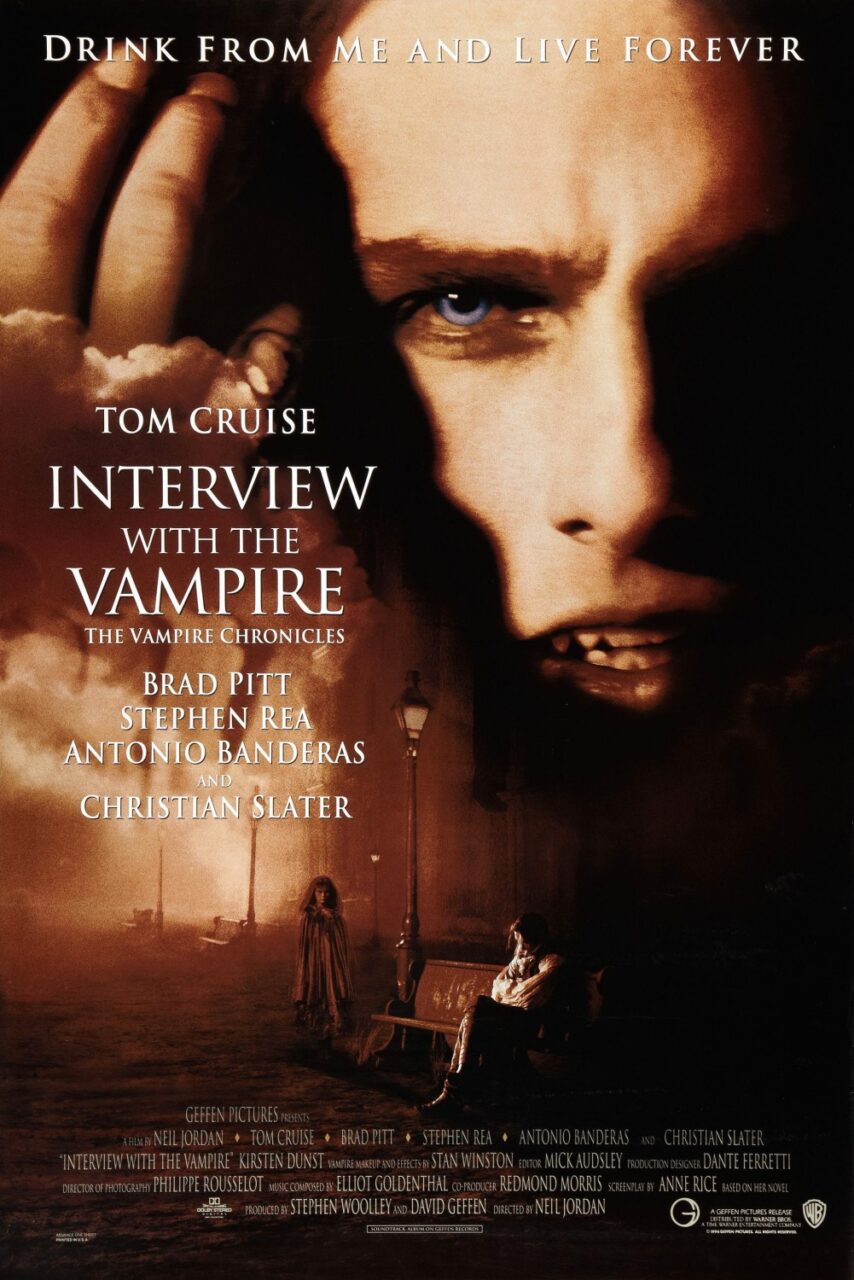
Director – Neil Jordan, Screenplay/Based on the Novel by Interview with the Vampire (1976) by Anne Rice, Producers – David Geffen & Steven Woolley, Photography – Philippe Rousselot, Music – Elliott Goldenthal, Visual Effects Supervisor – Rob Legato, Digital Effects – Digital Domain, Makeup Effects – Stan Winston, Production Design – Dante Feretti. Production Company – Geffen Films.
Cast
Brad Pitt (Louis), Tom Cruise (Lestat), Kirsten Dunst (Claudia), Antonio Banderas (Armand), Christian Slater (Daniel Molloy), Stephen Rea (Santiago)
Plot
In present-day San Francisco, journalist Daniel Molloy follows the mysterious Louis. Louis allows Daniel to interview him and record his life story. Louis reveals that he is a vampire. He explains how in 1794, following the death of his wife and daughter, he grew tired of life and welcomed death. He then met the blonde-haired Lestat who drank Louis’s blood and turned him into a vampire. Together they plundered Louis’s estate and were eventually forced to relocate to New Orleans. Louis steadfastly refused to drink human blood. He did turn Claudia, a young child dying of the plague, into a vampire and together the three of them became a perverse family. Driven by a need to know the reason for their condition, Louis travelled to Europe in search of answers.
Anne Rice became a best-selling author with the publication of Interview with the Vampire (1976). Rice later published thirteen further vampire books, expanding the saga of the various characters introduced throughout this story. What made Interview with the Vampire and Anne Rice a success was less anything to do with it being a vampire story than the fact that at heart Rice is a slash writer – the peculiar sub-genus of fandom written by and for women that features romantic stories of male (usually media) characters in torrid embrace with one another. All of Anne Rice’s novels, including her various other sagas set around the modern adventures of a revived mummy and a family of witches, feature extraordinarily handsome male characters and their blatant or thinly disguised mutual attraction. Interview with the Vampire and its various antecedents were certainly popular – indeed, Interview with the Vampire is the demarcation point where the vampire made the move from ravening monster to dark, sexually magnetic romantic anti-hero. The book was kicked about as a film project since the late 1970s – it was once to have been a tv movie starring John Travolta.
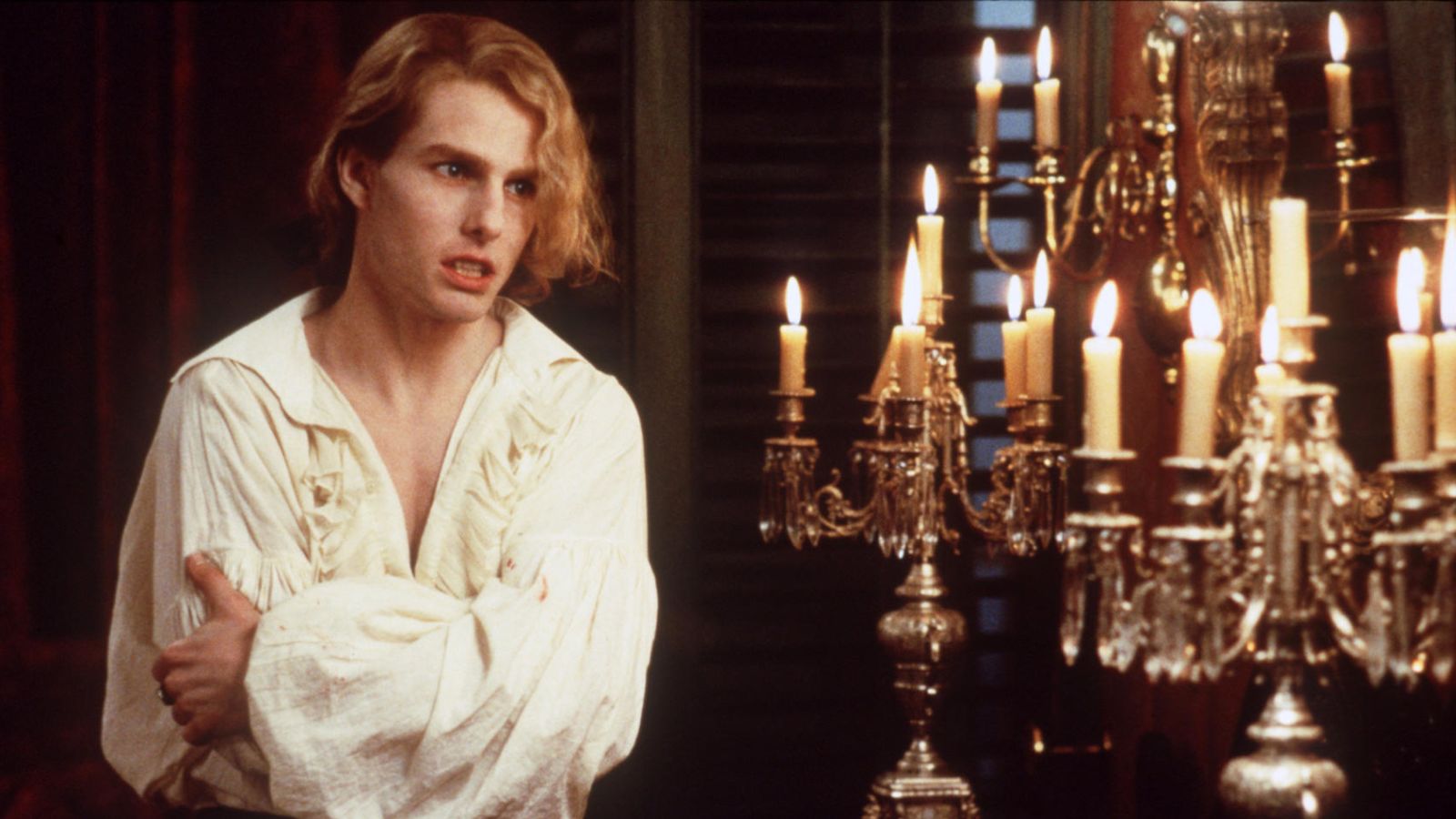
Every review, indeed every punter’s opinion of Interview with the Vampire: The Vampire Chronicles, tends to concern itself with the controversy that surrounds the film. Namely that Anne Rice made a very loud and public denunciation to anyone who would listen of the casting of Tom Cruise as Lestat and then surprisingly ate her own words shortly before the release of the film after seeing Cruise’s performance. When it comes to the casting decision surrounding Tom Cruise, one can see both sides of the coin. At the time, Tom Cruise was still fairly much a teen heartthrob whose brow furrowed with his (not very successful) attempts to establish himself as a serious actor. He was short, dark-haired and did not remotely resemble a Lestat.
On the other hand, one has to argue that playing a different person is what an actor is meant to do. All of this would not have been an issue if Interview with the Vampire were made in Britain where actors tend to wholly submerse themselves in roles. In America, actors tend to be perceived as stars who adopt certain personas and rarely engage in the chameleon shifts British actors customarily do. Anne Rice’s condemnation of Tom Cruise seems based in this type of Americano-centric view of actors as being certain types of unvarying personas. What is unusual in all of this was the studio’s decision to go with Tom Cruise in the face of such vehement and vocal opposition – clearly it was seen that more people would be drawn to the film through the Cruise name than that of Anne Rice.
There do seem some oddly hypocritical attitudes on Anne Rice’s part. Despite protesting the casting of the film, she did sue to get screen credit while a large part of the script was purportedly adapted by Neil Jordan. Although she kicked up about the casting of Lestat here, the film otherwise remains surprisingly faithful to her book, yet she said nothing whatsoever about Exit to Eden (1994), the film that was made the same year of her BDSM romance, which turned the book into a slapstick comedy and added a plot about diamond thieves.
However, there is one difference between the two films that is glaringly obvious. Anne Rice is a slash writer and her vampire books are Gothic sexual fantasies. Lestat was her creation – in the first book, he was a bad boy, but in the subsequent books, she fell in love with his vitality and danger. Throughout the years, Rice was vocal about who she wanted playing her Lestat, variously naming the likes of Rutger Hauer, Julian Sands, Jeremy Irons and Daniel Day-Lewis for the role. (The perfect person for Lestat would actually have been Sting – in The Vampire Lestat (1985), you can see that he was the clear inspiration for what Lestat became). Nobody wants the person of their dreams to emerge as someone completely different in reality. (Although in 2004, Rice converted to Catholicism and publicly denounced the vampire books, saying she would never write any of them again, and then in 2010 publicly quite Christianity and returned to her vampire novels).
What the controversy tended to eclipse is how surprisingly good Interview with the Vampire: The Vampire Chronicles is. The script is extraordinarily faithful to the book – it could be counted as one of the handful of successful genre literary adaptations. It does change the book at the end, bringing Lestat back to life in a not entirely successful attempt to set things up for The Vampire Lestat, and one or two other minor details. However, Neil Jordan taps exactly the essence of Louis’s existential nightmare – Why are the vampires there? Are they cursed by God? The film never provides an answer to this great existential question – although that was also Anne Rice’s problem in the book, not one native to the film.
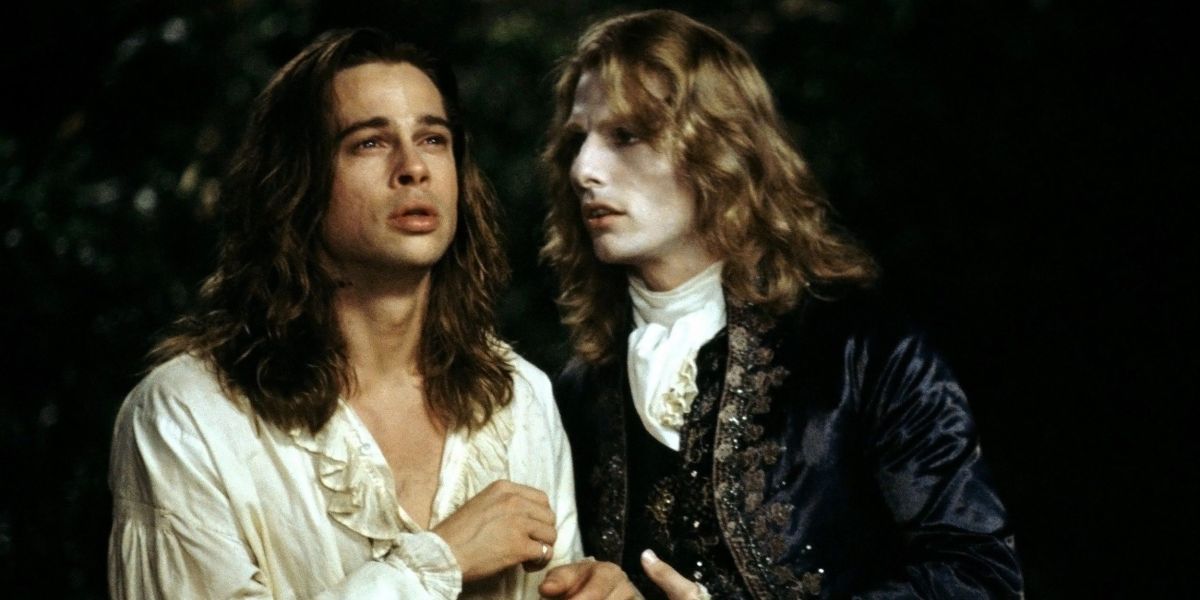
Neil Jordan even brings out some incredibly subtle pieces from the book – the perverse family metaphor that exists with Louis as mother, Lestat as father and Claudia as daughter. Jordan seems drawn to these themes of sexual and gender role confusion – look at his body of work, which consists of Mona Lisa (1986) with its crucial failing hinging on someone’s inability to understand someone’s sexual orientation, the transsexual romance of The Crying Game (1992) and the drag performer biopic of Breakfast on Pluto (2005). Although here, rumouredly at Tom Cruise’s instigation, the gay subtext of the book was considerably watered down.
The big surprise of the film is that Tom Cruise gives a good performance. We get the full breadth of the character’s decadent cruelty and arrogance. Most surprisingly, Cruise succeeds in bringing out the element of black humour in the book. The scenes he appears in have a high fire to them, filled with elegant taunts – one scene where he comes across Louis feasting on an old dowager’s poodles is mercilessly funny.
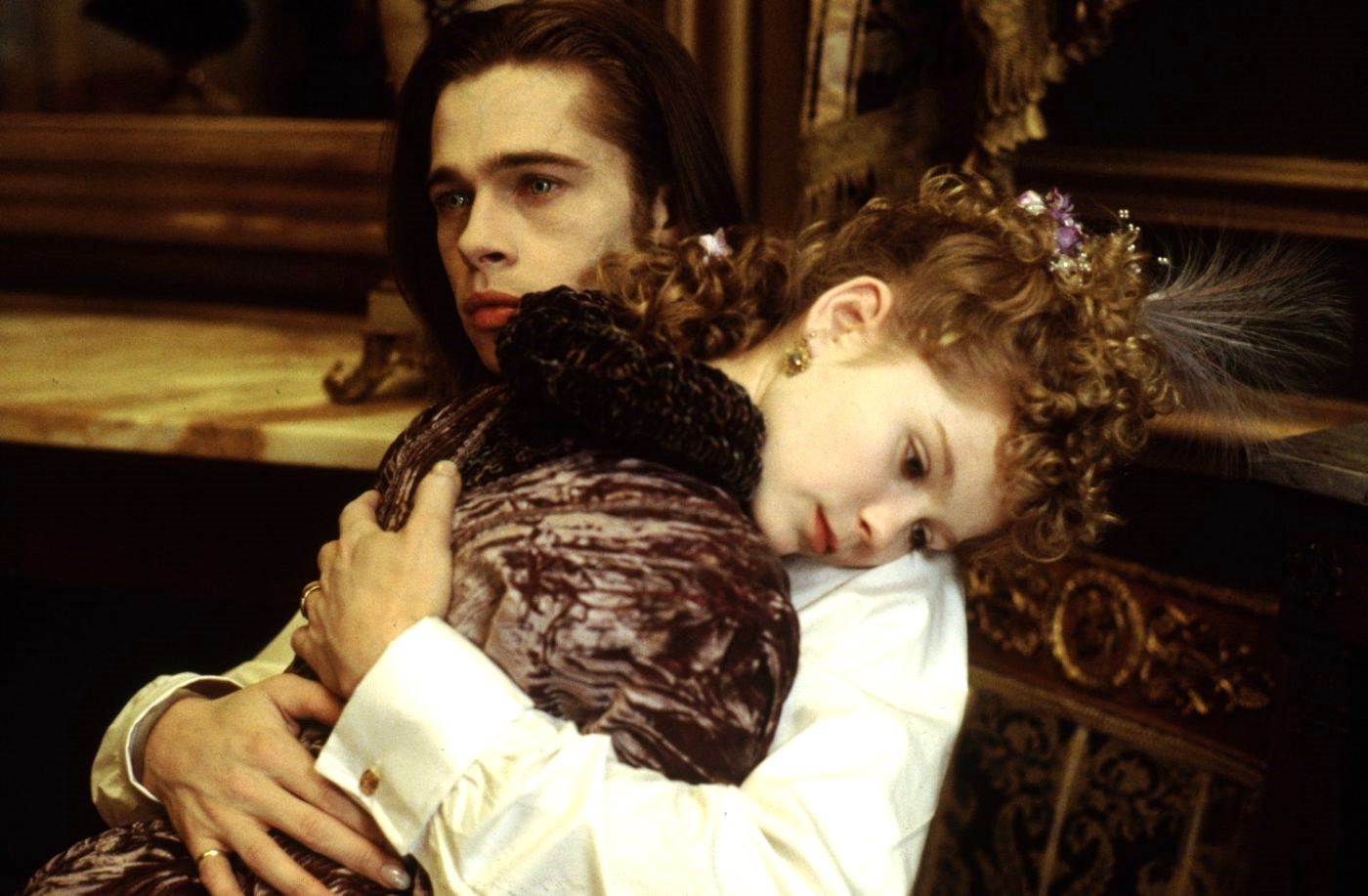
On the other hand, Brad Pitt, who is capable of being a fine actor, comes across surprisingly bland. If anything, one suspects the film might have worked better if Brad Pitt and Tom Cruise had reversed roles – Louis would have been fine as one of Cruise’s moody, petulant pretty boys and Lestat would have been great with the fired-up energy that Pitt brought to roles like Kalifornia (1993) and Fight Club (1999). The best performance comes from young Kirsten Dunst. It is an amazing performance that Neil Jordan elicits from her – both child-like, yet also adult and filled with a cold cruelty.
Neil Jordan is a frequent dabbler in genre films. His other genre films include – The Company of Wolves (1984), an adaptation of one of Angela Carter’s stories that deconstructs Little Red Riding Hood with werewolves; the haunted house comedy High Spirits (1988); The Butcher Boy (1997) about a disturbed Irish Catholic childhood; the clairvoyance thriller In Dreams (1999); the female vigilante drama The Brave One (2007); Ondine (2009) about a possible sea nymph; the vampire film Byzantium (2012); and the psycho-thriller Greta (2018).
The book was later remade as a tv series Interview with the Vampire (2022- ) with Jacob Anderson as Louis and Sam Reid as Lestat. The Vampire Lestat (1985), Anne Rice’s direct sequel to Interview with the Vampire, was promised as a sequel with Tom Cruise, although has yet to emerge. In the meantime, the third of Rice’s Vampire Chronicles was filmed as the wimpy Queen of the Damned (2002) featuring Stuart Townsend as Lestat.
Other Anne Rice adaptations include the crime thriller/ghost story Rag and Bone (1997); the non-genre tv mini-series Feast of All Saints (2001), an historic story set during the racial melange of historic New Orleans; The Young Messiah (2016) based on the series of books about the life of Christ that Rice wrote following her conversion to Christianity; and the tv series Mayfair Witches (2023- ) based on her book series.
(Winner for Best Film in this site’s Top 10 Films of 1994 list. Winner for Best Adapted Screenplay and Best Supporting Actress (Kirsten Dunst), Nominee for Best Director (Neil Jordan), Best Supporting Actor (Tom Cruise) and Best Musical Score at this site’s Best of 1994 Awards).
Trailer here