

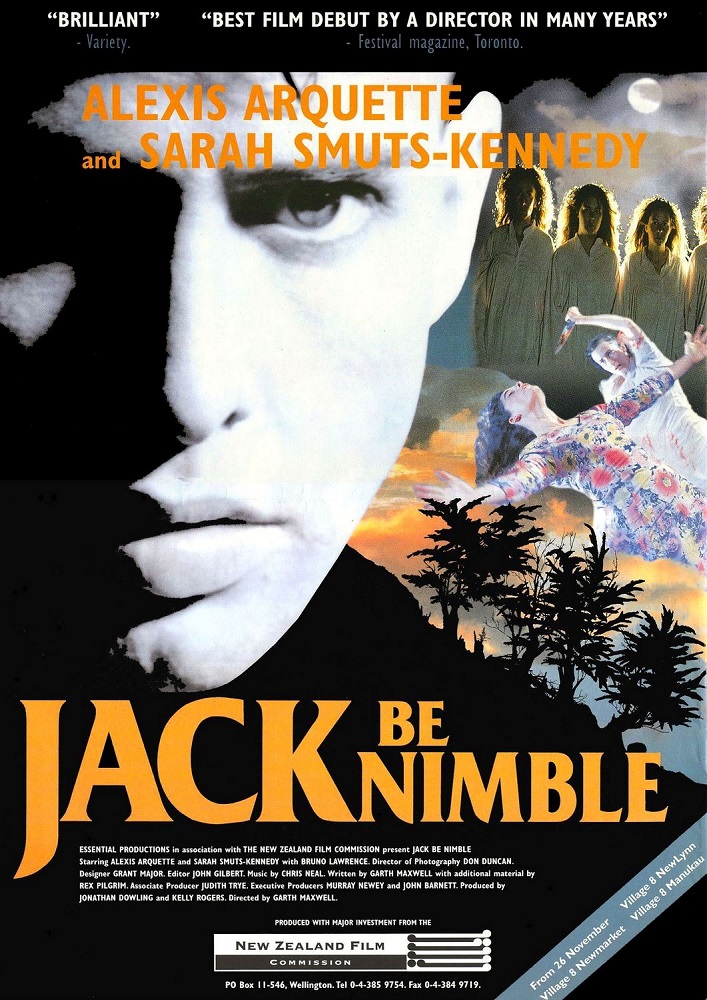
New Zealand. 1993.
Crew
Director/Screenplay – Garth Maxwell, Additional Material Written by Rex Pilgrim, Producers – Jonathan Dowling & Kelly Rogers, Photography – Donald Duncan, Music – Chris Neal, Special Effects Supervisor – Kevin Chisnall, Production Design – Grant Major. Production Company – Essential Productions/New Zealand Film Commission.
Cast
Sarah Smuts-Kennedy (Dora Sharp/Birch), Alexis Arquette (Jack Sharp/Gough), Bruno Lawrence (Teddy), Tony Barry (Clarry Gough), Elizabeth Hawthorne (Clarry’s wife), Tricia Phillips (Anne Sharp), Paul Minifie (Kevin Sharp), Brenda Simmons (Mrs Birch)
Plot
As children, Jack and Dora Sharp are abandoned to an orphanage by their mother. Dora is adopted by the caring Birches, while Jack is adopted by the abusive Gough family. As a teenager, Jack builds a dynamo-powered hypnotism device, which he then uses to kill off the tormenting Goughs. He then sets out in search of Dora. Dora, meanwhile, is learning to understand the clairvoyant abilities she has. Finding her, Jack drags her on a quest to find their parents, killing everybody who gets in their way. Behind them come the three sinister Gough sisters seeking revenge.
Jack Be Nimble was the feature-length debut of New Zealander Garth Maxwell. Maxwell was a promising young talent who debuted with the Cannes Award-winning gay love short Beyond Gravity (1989) and went onto the modestly acclaimed polysexual love story When Love Comes (1998). Everything he has done since then alas has been work in New Zealand television.
Jack Be Nimble gained modest genre acclaim when it came out but leaves much to be desired. As a film, it is so incomprehensible in its random plotting, frequent shifts of tone and jumbled melting pots of incongruous genre elements as to be downright weird. Garth Maxwell never seems to have any idea where the film is meant to be going from one moment to the next – at first, it appears to be a straight drama about a psychic link between separated children then develops a stew of other ideas involving telepathic powers and Sarah Smuts-Kennedy with no apparent explanation being able to pick up the voices of the dead.

The scene where Alexis Arquette produces his high-school metal-work project, a candle-operated dynamo lantern that hypnotises his foster family and drives them to humiliating suicides, seems to have strayed in from a totally different film altogether – it is like something out of a Gothic farce. A scene where Bruno Lawrence introduces Sarah Smuts-Kennedy to marigolds under the pillow as a handy source of psychic amplification verges on the laughable.
Garth Maxwell compensates somewhat with an occasionally ambitious visual style in the early scenes – a toy clown placed on young Jack’s cot with its lips sewn up, the dishevelled Gough daughters moving in unison like some ominous chorus of Greek harpies – but eventually he and Jack Be Nimble get lost amid the plot incomprehensibilities.
Trailer here