
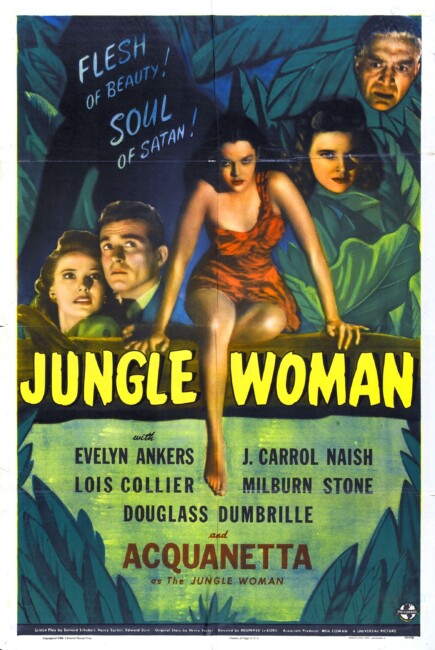
USA. 1944.
Crew
Director – Reginald LeBorg, Screenplay – Edward Dein, Bernard Schubert & Henry Sucher, Story – Sucher, Photography (b&w) – Jack MacKenzie, Music Supervisor – Paul Sawtell, Art Direction – John B. Goodman & Abraham Grossman. Production Company – Universal.
Cast
Acquanetta (Paula), J. Carrol Naish (Dr Fletcher), Richard Davis (Bob Whitney), Lois Collier (Joan Fletcher), Milburn Stone (Fred Mason), Evelyn Ankers (Beth Mason), Edward M. Hyans Jr (Willie), Samuel S. Hinds (Coroner), Nan Bryant (Miss Gray)
Plot
Dr Fletcher is placed on trial for murdering a woman. He explains his incredible story. He obtained the body of a gorilla that was shot during an escape from a circus and revived it, only for it to escape from his laboratory. At the same time, the mysterious Paula turned up. She became obsessively fixated on Fletcher’s daughter’s e Bob Whitney. However, those who angered Paula or stood between her and Bob ended up being threatened by the gorilla. Fletcher then began to realise that the gorilla and Paula might be one and the same and that Paula has the ability to transform into an animal.
Jungle Woman was the second in a trilogy of ape woman films begun with Captive Wild Woman (1943) and subsequently concluded in Jungle Captive (1945). The first two of these starred the exotically beautiful Acquanetta as a woman who had the ability to transform into an ape when aroused (she was replaced by Vicky Lane in the third film). The series was a belated attempt by Universal to add another famous monster to their ongoing line-up, which already included the Frankenstein, Dracula, Mummy, Invisible Man and Wolf Man series, all of which had started to team-up and meet one another in films around this point.
However, the Jungle Woman series never became as popular as the others or would meet any of the other monsters. The series was made in a clear attempt to emulate the success of RKO’s Cat People (1942), which had Simone Simon turning into a were-feline when aroused, with the Jungle Woman series merely substituting an ape for a panther. (For this era, an ape represented the untamed animal side of human nature – in this case female sexuality, which was always regarded as an exotic, primal and unknown quality).
Jungle Woman is slightly above the routine. Director Reginald LeBorg was a genre regular who made numerous B movies during this era (see below). Le Borg creates some occasional atmosphere. There is one fair scene with Richard Davis and Lois Collier in a canoe being attacked from underneath by an ape in the water (the credibility of the scene being slightly beset by the fact that apes don’t swim).
Acquanetta has a charged, piercingly intense presence whenever she appears. Her mysterious foreign beauty and accent (she was in fact an American Indian but publicists invented an entire mystery background for her and claimed that she was from Venezuela) gives the film an eerily exotic appeal. Alas, Reginald LeBorg never gives her much to do except wander around in a trance whenever she is on screen.
The film comes in at just over an hour long. Of this, some fifteen minutes consists of flashbacks to the first film.
Director Reginald Le Borg was an Austrian immigrant who worked as a B-budget director in Hollywood between the 1920s to the 1970s, mostly being known for a number of the entries in the Joe Palooka series. His other genre films include:- the Inner Sanctum thrillers Calling Dr Death (1944) and Dead Man’s Eyes (1944); the clairvoyance film Destiny (1944); The Mummy’s Ghost (1944), the fourth of Universal’s Mummy series; Weird Woman (1944) about witchcraft in academic circles; the mad scientist film The Black Sleep (1956); Voodoo Island (1957); The Flight That Disappeared (1961), an anti-nuclear film about a planeload of people being abducted in mid-flight; the possession film Diary of a Madman (1963); the psychic thriller The Eyes of Annie Jones (1964); and the psycho-thriller So Evil, My Sister (1974).
Full film available here