

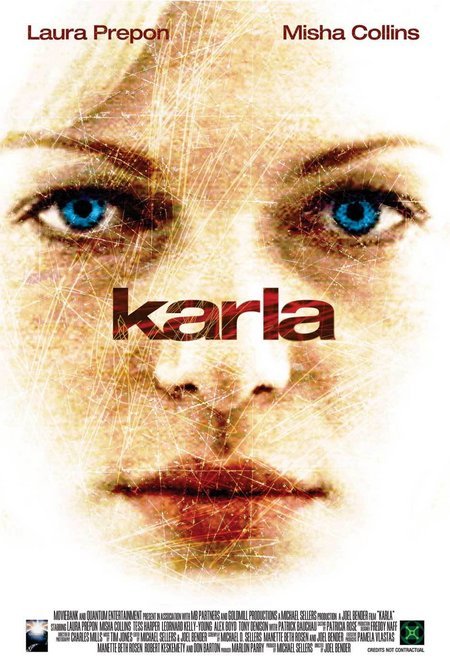
USA. 2006.
Crew
Director – Joel Bender, Screenplay – Joel Bender, Manette Beth Rosen & Michael D. Sellers, Producers – Marlon Parry & Michael D. Sellers, Photography – Charles Mills, Music – Tim Jones, Production Design – Freddie Naff. Production Company – Moviebank/Quantum Entertainment/MB Partners/Goldmill Productions/True Crime Investments LLC.
Cast
Laura Prepon (Karla Homolka), Misha Collins (Paul Bernardo), Patrick Bauchau (Dr Arnold), Alex Boyd (Nick), Sarah Foret (Kaitlyn Ross), Kristen Swieconek (Tina McCarthy), Cherilyn Hayres (Tammy Homolka), Tess Harper (Molly Czehowicz), Leonard Kelly-Young (Dan Czehowicz), Emile Jacobs (Peggy)
Plot
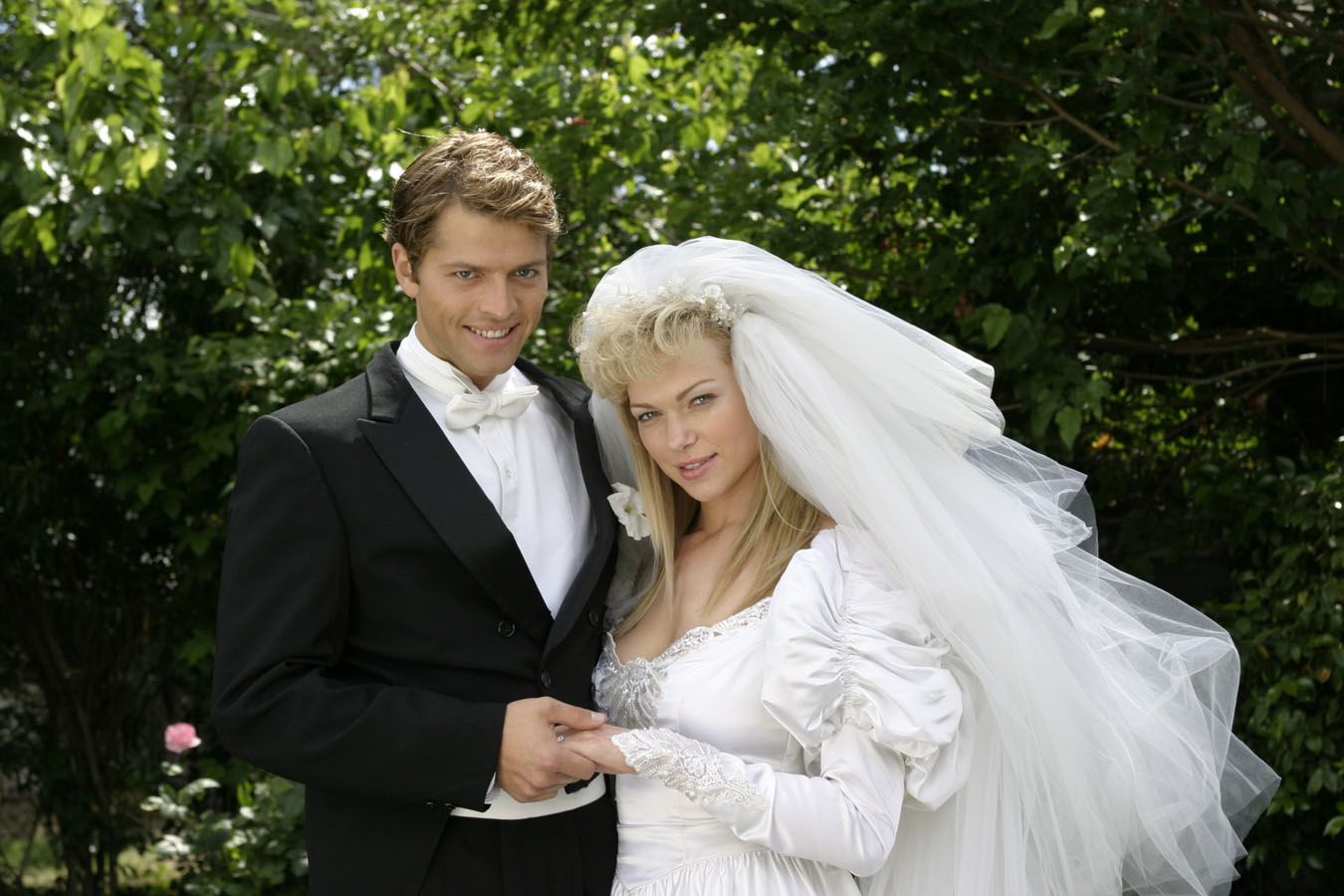
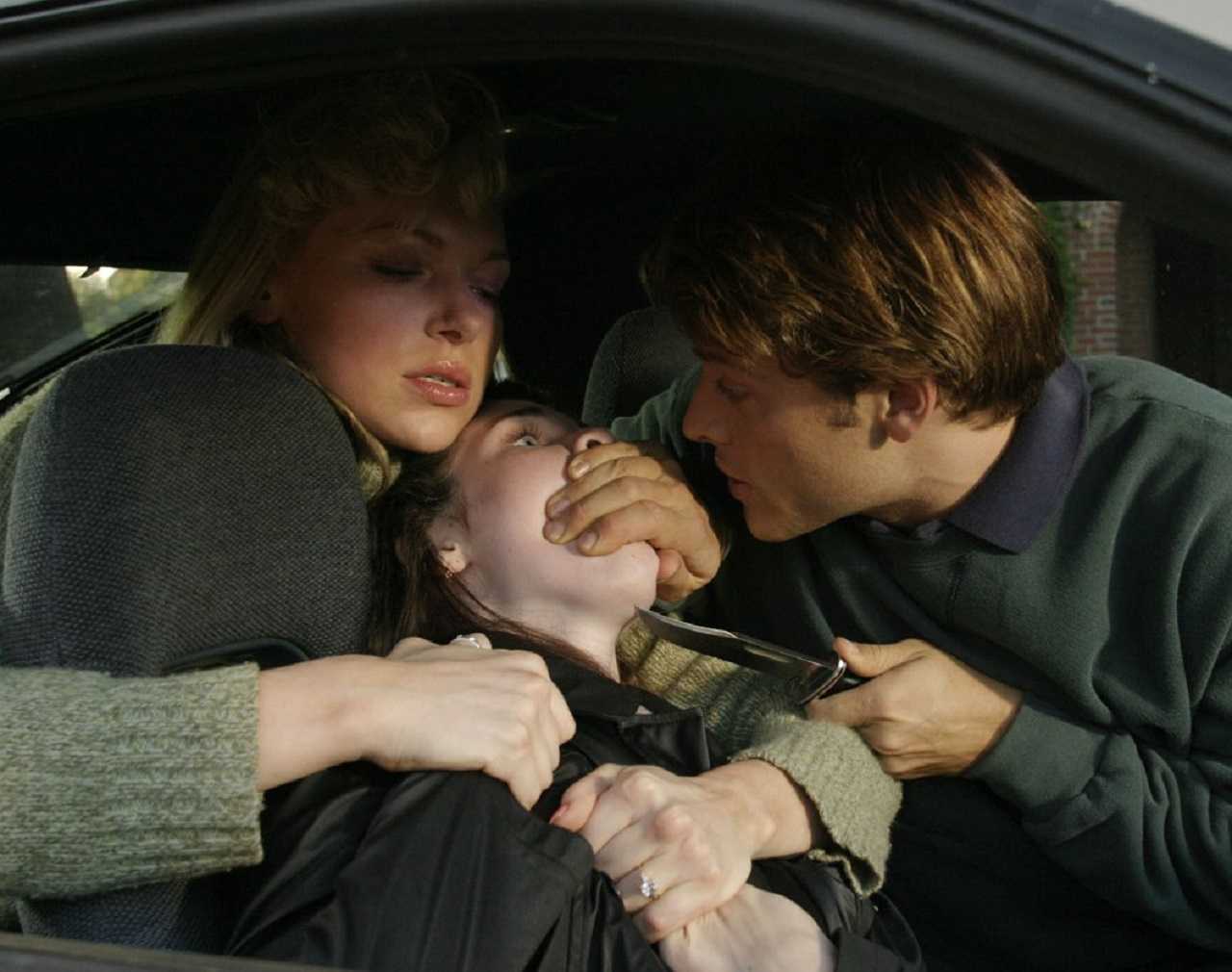
Saskatoon, Canada in 2000. Prisoner Karla Homolka is brought before psychiatrist Dr Arnold to be assessed for parole. He presses her to confront the events that led to her conviction. She recounts how she met Paul Bernardo while at a veterinary convention. This quickly led to the two moving in together in St Catherine’s, Ontario and later marrying, where Paul made a comfortable living by smuggling cigarettes across the US border. Karla discovered that Paul had an enjoyment for sadomasochistic sex and that he was in fact a wanted rapist who had been terrorising the nearby Scarborough area. Paul became obsessed with taking the virginity of Karla’s fifteeen year-old sister Tammy. Karla tried to arrange this for him by drugging Tammy with drinks laced with halothane tranquiliser stolen from the veterinary clinic where she worked. However, they used too much of the tranquiliser and caused Tammy to choke to death – although the police dismissed this as an accidental death. Fearful both of Paul leaving her and his frequent beatings, Karla was forced to take part in a series of perverse acts where Paul abducted various teenage girls. Making the girls’ prisoners in the house, Paul would brutalise and rape them, before killing them, all the while videotaping the incidents.
The series of killings conducted by Paul Bernardo and Karla Homolka are regarded as the most infamous in Canadian criminal history. To all apparent eyes, Homolka and Bernardo led a perfect marriage in Ontario. The two met in 1987 when Homolka was seventeen and Bernardo twenty-three, while Homolka was attending a convention. They moved in not long after, marrying in 1991 (the same day that the body of their second victim was found). Homolka soon discovered Paul Bernardo’s taste for sadomasochistic sex and later claimed that he had made her his unwilling slave. Bernardo also had a secret life as the wanted Scarborough Rapist.
In 1991, Bernardo developed a fixation with claiming the virginity of Homolka’s fifteen year-old sister Tammy – to the extent that he would even secretly peep in on Tammy undressing and have Karla dress up as her during sex. Homolka arranged to fulfil Paul’s fantasy by drugging Tammy with a tranquiliser stolen from her veterinary practice so that Paul could have his way with her in the basement of the Homolka family home. This went wrong and Tammy suffocated, although this was officially listed as an accidental death. Bernardo’s activities began to accelerate from there. In 1991, he abducted fourteen year-old Leslie Mahaffy, brutalised her for twenty-four hours, before strangling her with electrical cord, cutting the body up with a circular saw and dumping it in a lake encased in concrete. In 1992, the two of them abducted fifteen year-old Kirsten French from a church parking lot after pretending to ask directions, raped and abused her and then left her dead body in a ditch.
The truth came to light in 1993 after Bernardo beat Karla so badly that she was hospitalised and subsequently ended up leaving him. During the police investigation of the incident, DNA evidence led to Paul Bernardo being connected to the Scarborough Rapist case. Karla later confessed to their complicity in the murders. It was after Bernardo was arrested that the case entered into its most controversial phase. Karla Homolka was offered a special plea bargain by the Ontario prosecutor’s office where, in return for her testimony to convict Bernardo, she would be given only a twelve-year sentence. (Karla Homolka’s plea bargain has been variously called a “deal with the devil” and “the worst deal in Canadian legal history”). Homolka proceeded to argue throughout the trial that she was an abused innocence but Bernardo responded by leaking the whereabouts of videotapes he had taken of the killings in the hope of arguing that Homolka was the real killer and that he was innocent.
The case was mired in controversy every step of the way – from the judge who declared a total publication ban on the trial, resulting in a flourishing blackmarket in details published on the internet or sought in newspapers brought across the US border; to the public outcry against Karla Homolka’s plea bargain, where it was universally seen that she was a complicit party in the murders; to Paul Bernardo’s initial lawyer who tried to quash the existence of the videotapes in his client’s interest; to the judge’s ruling that the videotape evidence be destroyed only for some of them to be smuggled out and sold as snuff movies. Paul Bernardo was convicted in 1995 and is currently serving a life sentence. Karla Homolka was released from jail in 2005 and currently lives under an assumed name in the Antilles.
In recent years, there has been a mini-genre of films based on true-life serial killers, which has so far included the likes of Ed Gein (2000), Dahmer (2002), Nightstalker (2002), Ted Bundy (2002), Gacy (2003), Monster (2003), Evilenko (2004), The Hillside Strangler (2004), Starkweather (2004), The Zodiac (2005), Lonely Hearts (2006), Out of the Blue (2006), Ed Gein: The Butcher of Plainfield (2007), Zodiac (2007), The Alphabet Killer (2008), B.T.K. (2008), Drifter: Henry Lee Lucas (2009) and Freeway Killer (2010).
Like most of these, Karla has been mounted independently and cast with relative unknowns. The Homolka-Bernardo case has such infamy in Canada that an earlier production that would have starred Jason Priestley as Paul Bernardo caused outraged protest, even had the Ontario Premier calling for a boycott of the film. When it came to Karla, the filmmakers took the safety of shooting in US locations. (This does leave Karla with a certain irony – the number of American film productions that pop across the border to shoot in Canada and take advantage of the lower return on the American dollar, as well as cities and landscapes that have a similarity to US locales, is legion. Here though we have the example of a film that actually is set in Canada but has been forced to shoot in the US and pretend that it is Canada).
Karla could have been another Monster. Unfortunately, Joel Bender fails to convincingly plumb the psychology of Karla Homolka and Paul Bernardo. Rather than getting inside either character’s heads, all that Bender seems to do is concentrate on schematically (and rather prosaically) replicating the events of the case. This he does with a fair degree of accuracy but the film never finds its way inside Homolka and Bernardo’s respective heads. The introduction and set-up of the two characters is hurried – it is not long between the time that we go from the two meeting and having sex to the very next scene where Laura Prepon is suggesting that Misha Collins put handcuffs on her and enact a rape fantasy. (Certainly, the handcuffs and pretend rape scene does hold a perverse kick).
Karla‘s greatest failing is Joel Bender’s tameness in the handling of the material. Considering that the film deals with the abduction, brutalisation, rape and eventual murder of two teenage girls, as well as much in the way of wife-beating, the accidental drug/rape of Karla’s teenage sister and various other rapes, the fact that the R-rated Karla comes out down around the level of an average true crime tv movie must surely be regarded as a major failure. Not that a film should glorify such acts but had Joel Bender taken us even a little of the way into the darkness that these characters lived in, Karla could have been an immensely disturbing film.
Rather, Bender gives the impression that the US censor stood behind his shoulder waggling a sternly disapproving finger the whole through shooting. (Apparently, much of this was originally there but was cut on the insistence of the producers who wanted the film to have broader appeal). His camera shies away the moment that Misha Collins starts to strangle his first victim. When Cherilyn Hayres undergoes various brutalisations, he never shows any of Mischa Collins’ threats or brutalisations in conjunction with the actress in the same frame – all of these take place off camera. Among the abovementioned examples, both Ted Bundy and The Hillside Strangler had the fortitude to take such a journey into the disturbing headspace of its real-life subjects. Alas, Karla cries out for a darker, more rawer and psychological insightful handling than the veritable tv movie treatment that we get.
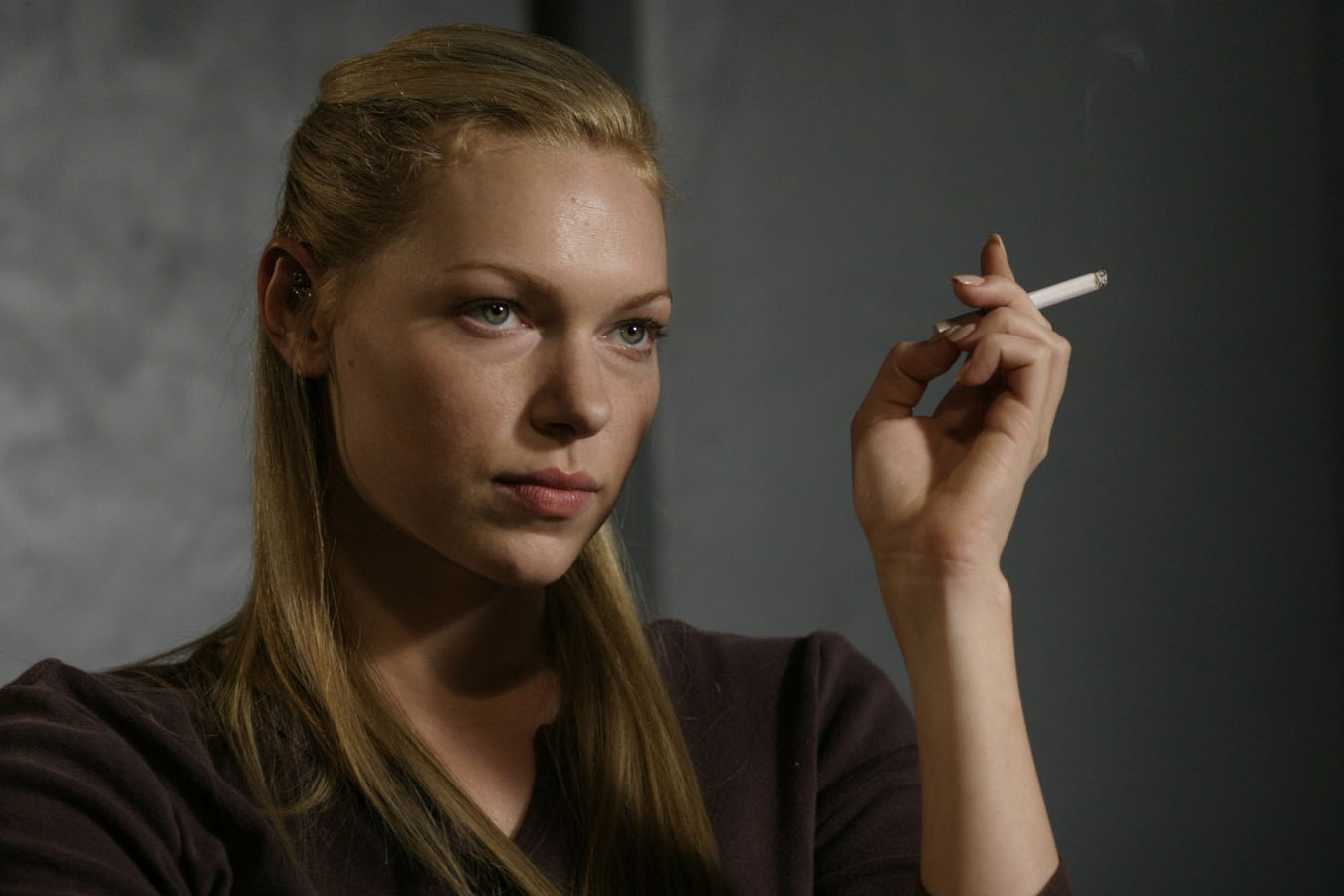
Certainly, one of the best aspects about Karla is the casting of Laura Prepon in the title role. Prepon was previously known as Donna in the tv series That 70s Show (1998-2006). The role of Karla Homolka allows Prepon to spread her wings and show she can carry a film as a serious actress. She does a good job of looking abused and shell-shocked by events. If the film surrounding her had been better than it was, I would happily have considered Prepon as worthy of nomination in this site’s Best of 2006 awards. Alas, one of the major things that Prepon does that kills her (and the film’s) credibility is keep her underwear on during the love scenes. I am not trying to argue for gratuitous nudity but Karla is a film whose subject matter concerns a couple who have a perverse sexual relationship. Any raw realism the film might aspire to in depicting this surely gets shot in the foot when you realise how fake the scenes look when the various actresses seems to be spending as much time protecting their modesty for the camera as they do looking frightened.
However, the biggest problem that one has with Karla is its portrait of the real-life Karla Homolka. The film takes the position that was argued by Homolka and her defence lawyer herself throughout the trial – that she was an innocent party who was constantly beaten by Paul Bernardo and ended up complicit in his crimes out of fear. Certainly, the end titles cards talk about Homolka’s apparent moral vacuity and lack of remorse for the crimes but were that not there the film could leave one with an entirely different portrait of the Karla Homolka that existed in reality. In actuality, a number of things emerged during the trial that showed that Homolka was anything but an innocent party in what went on. There has been her constant refusal to accept any responsibility or show remorse for the crimes; there was the videotape evidence that showed that she was an active participant during the attacks and even joined in and had sex with the bound victims. Furthermore, Homolka encouraged Paul Bernardo’s activities as The Scarborough Rapist and there were reports from eyewitnesses of another woman being present during the rapes videotaping Bernardo (who was almost certainly Homolka). Moreover, if Paul Bernardo had brutalised her into participating in his depravities, her fear of him should surely have lifted once she was incarcerated – but to the contrary Homolka became involved with another killer while in jail, which shows that her problem was not being the victimised and abused innocent but that she had a pathological attraction to dangerous men.
What suspects happened here was that Karla was made concurrent with Karla Homolka’s release from jail. Rather than dramatise what everyone believes happened, the filmmakers ended up being so afraid of lawsuits that they took the position that Karla Homolka argued throughout the trial that she was an abused innocent. This is ultimately the killer disappointment about Karla – a film that reads as afraid the whole way – too afraid of lawsuits to vary from a patently false court testimony, too afraid of an overbearing US censor to venture into any of the rawness that the subject matter begs to be dealt with. All the film ends up as is a justification of Karla Homolka’s actions that could have been written by Homolka herself.
The character of Paul Bernardo is present more as a function of his relationship to Karla than anything else. He is expectedly shown as violently abusive and there is much focus on his unrestrained sexual appetite. Disappointingly, the film only rarely gives us the image of Paul Bernardo as the charmer he was often described as being – we briefly do during one scene where the police interview him about the Scarborough Rapist but that is it.
The Paul Bernardo-Karla Homolka story was far more exhaustively dealt with in the standout four-part documentary series Ken and Barbie Killers: The Lost Murder Tapes (2021) that aired on Discovery+.
Elsewhere, director Joel Bender has only ever made B-budget horror films of no particular distinction. These have included The Returning/Witch Doctor (1983), The Immortalizer (1991), Midnight Kiss/Vampire Cop (1993), Jennifer is Dead (2002) and The Cursed (2010). In trivia notes, one can see an unknown Brandon Routh, later to take the title role in Superman Returns (2006), as the young man that Laura Prepon picks up in a nightclub after splitting up with Paul.
Trailer here