
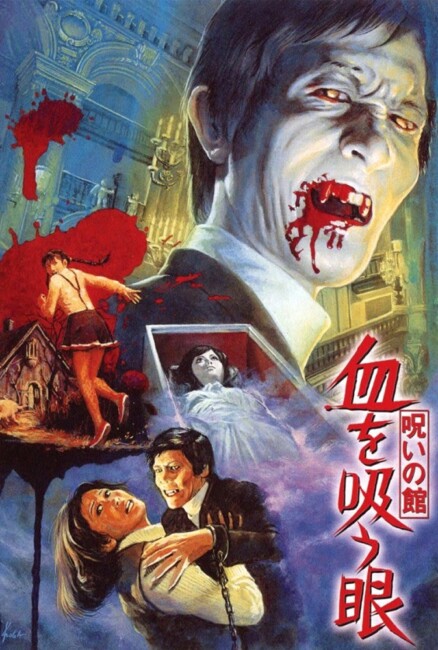
aka The Bloodthirsty Eyes; Japula; Lake of Death
(Chi o Suu Me)
Crew
Director – Michio Yamamoto, Screenplay – Ei Ogawa & Masaru Takesue, Photography – Rokuro Nishigaki, Music – Riichiro Manabe, Art Direction – Shigekazu Ikuno. Production Company – Toho.
Cast
Midori Fujita (Akiko Kashinwagi), Osahide Takahashi (Dr Saeki Takashi), Sanae Emi (Natsuko Kashinwagi), Mori Kishida (The Vampire), Choei Takahashi (Kyusaku)
Plot
Schoolteacher Akiko Kasinwagi is living along the shore of Lake Fujimi. A mysterious coffin is delivered to the house. This later opens and a pale-faced stranger emerges, attacking the groundsman Kyusaku. Kyusaku then tries to attack Akiko, while Akiko’s sister Natsuko starts acting strangely. After being pursued by the white-faced man, Akiko appeals to her boyfriend Saeki, a doctor in the city, for help but Natsuko insists that Akiko is imagining everything. With nobody believing her and all those around her becoming infected by the vampire’s bite, Akiko must fight for her life as the stranger continues to come after her. Clues to dealing with the menace lie in a nightmare from her childhood.
Lake of Dracula was the middle entry in a series of Japanese horror films that has been termed The Bloodthirsty Trilogy. All three were made at Toho Studios by director Michio Yamamoto. Lake of Dracula had earlier been preceded by Legacy of Dracula: The Bloodthirsty Doll/The Bloodsucking Doll/Night of the Vampire/The Vampire Doll (1970) and would be followed by Evil of Dracula (1974). The films are unconnected storywise, although American distributors did try to falsely retitle and promote them as Dracula films. With an extraordinary crassness, this film was at one point retitled Japula in a clear attempt at mimicry of the Blaxploitation vampire hit Blacula (1972), although does not appear to have been very widely distributed under such name.
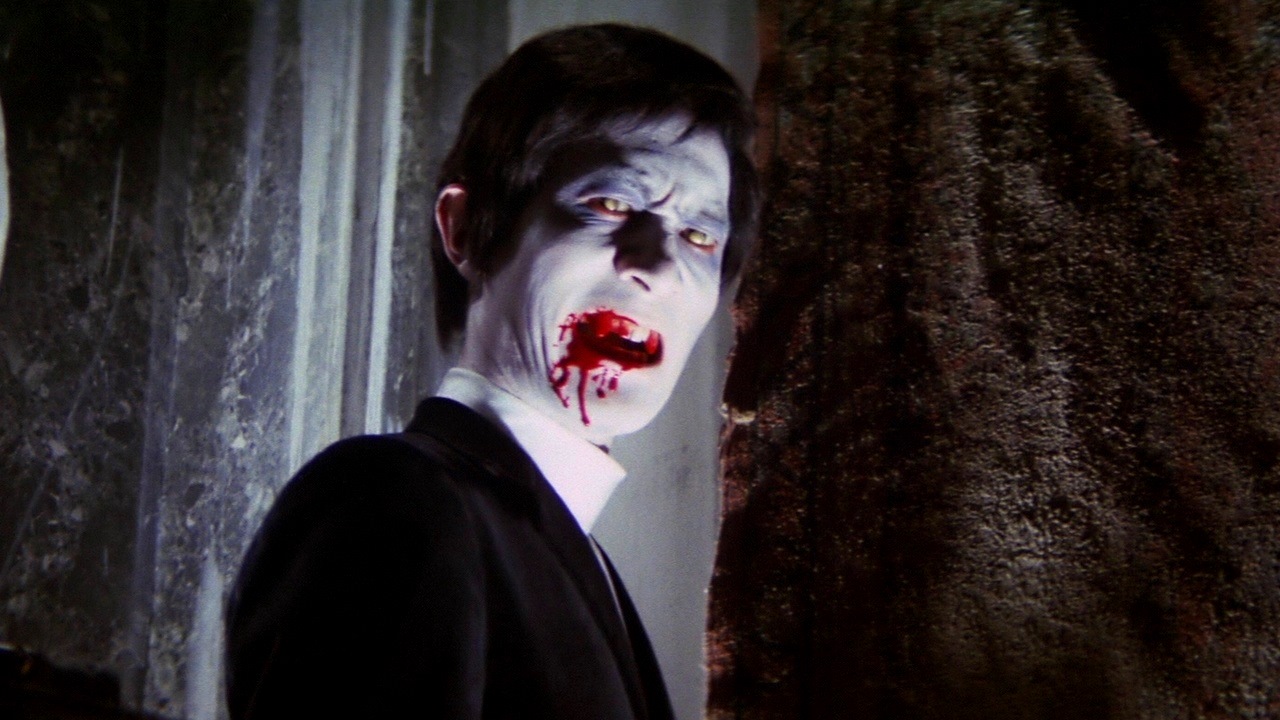
One of the clear influences on Michio Yamamoto throughout the trilogy is the Hammer horror film, which were at their height of popularity during this era. Quite clearly, he has set out to copy the Hammer Dracula films here. In comparison to Hammer, Yamamoto’s films tend towards a much more measured and sedate pace. You keep suspecting that a Terence Fisher or some other Hammer director would have pushed the vampire scenes here for something more. The film’s vampire, for instance, never does much more than glower.
Nevertheless, Yamamoto generates a degree of spookiness during many of the vampire appearances – the girl in the hospital getting up from the bed with a spooky smile and running through the corridors; a scene where the vampire draws the sister Sanae Emi to him; and particularly during the opening scenes when the young Akiko stumbles into an old abandoned house and meets a white-faced woman sitting at the piano. The best scene though is one where the vampire pursues Midori Fujita through the house. Michio Yamamoto is too pedestrian a director to be lyrical or unnerve an audience but there are certainly times when the film evokes something eerie.
What makes for an interesting undertow to Lake of Dracula is the way the script plays up a certain ambiguity where it is suggested by those around her that everything the heroine experiences is something that she could have imagined. The sister keeps smiling with ambiguous intent and for a good part of the film we cannot be entirely sure if she has succumbed to the vampire’s thrall or not. At one point, she almost seems on the verge of seducing the heroine’s boyfriend away. The film even gives it a nominal rational explanation, suggesting that the heroine made up the story about meeting the vampire at the beginning because of rivalry over her sister getting more attention from their parents. It lends an intriguingly Freudian ambiguity to everything, even if the film weighs in too heavily on the side of obviously supernatural for the film to hover in a genuinely uncertain territory between psychological horror and mundane rationalism.
Michio Yamamoto’s films also have a tendency to seem confused about the nature of the supernatural menace. The film clearly identifies the vampire with being Dracula upon a couple of occasions, yet the end explanation about how the woman’s son grew to the age of 25 before becoming a vampire clearly contradicts this. It is hard to tell if this is something that exists at the script level or is a confusion due to the translation.
What is intriguing about this explanation is comparison between it and Western vampires. Western vampires reside in Christian notions of dualities of good vs evil, of fleshly corruption vs spiritual purity. The Japanese vampire here resides more in a question of racial pollution and purity of blood, who is seen as normal for the period of his youth before the foreign pollutant in his blood finally emerged and took over. While the Western vampire film traditionally sees the vampire as a repressed carnal force bursting its way up through polite society, the Japanese vampire by contrast sees the vampire as a foreign racial threat that suddenly erupts through the placidity of everyday life.