

USA. 2009.
Crew
Director/Screenplay – David Ondaatje, Based on the Novel by Marie Belloc Lowndes, Producers – Michael Mailer & David Ondaatje, Photography – David A. Armstrong, Music – John Frizzell, Visual Effects – CIS Visual Effects Group (Supervisor – Gregory D. Liegey), Special Effects Supervisor – Giuliano Fiumani, Production Design – Franco-Giacomo Carbone. Production Company – Stage 6 Films/Michael Mailer/Merchant Pacific.
Cast
Alfred Molina (Detective Chandler Manning), Hope Davis (Ellen Bunting), Shane West (Detective Street Wilkenson), Simon Baker (Malcolm Slade), Donal Logue (Joe Bunting), Philip Baker Hall (Captain Smith), Rachael Leigh Cook (Amanda Manning), Rebecca Pidgeon (Dr Jessica Westmin), Francois Chau (Sam), Mel Harris (Margaret Bunting), Michael O’Hagan (Bruce Lester), David Storrs (Warehouse Attendant)
Plot
In West Hollywood, Detective Chandler Manning is faced with a string of killings that are identical to those conducted by Alonzo Rodriguez who he arrested seven years ago and sent to the death chamber. As Manning and his new rookie partner Street Wilkenson investigate, Manning realises that the murders are mimicking the m.o. of the Jack the Ripper killings. Manning goes out on a limb, determined to pursue the case. Meanwhile, Ellen Bunting, a housewife with a history of mental disorder, and her husband Joe are struggling financially. To bring more money in, they try to rent out the bungalow at the back of their house. Ellen meets the charming but mysterious Malcolm Slade who says he will take the room, although is insistent that he be given absolute privacy. Ellen finds Malcolm’s comings and goings in the middle of the night mysterious, while at the same time finds herself attracted to him. Soon however, evidence begins to indicate that Malcolm might be the killer. Equally, Joe claims that there is nobody in the bungalow and that Ellen is imagining Malcolm.
The Lodger (1912) was originally a novel by English writer Marie Belloc Lowndes and concerned a family who believed that the border in their upstairs flat might by Jack the Ripper. Belloc Lowndes grew up in London during the time of the Jack the Ripper killings and the book was based on a dinnertable conversation where she heard about a family who had suspicions that their lodger might have been The Ripper. The Lodger was a popular work and Belloc Lowndes later adapted it into a stage play Who Is He? (1916). The story gained fame when it was adapted to the screen as one of Alfred Hitchcock’s first films, the silent The Lodger: A Story of the London Fog (1927) starring Ivor Novello, although Hitchcock changed the ending so that the lodger turned out not to be the killer after all. This was later remade three times as The Lodger (1932) with Ivor Novello, a sound version of the Hitchcock film, 20th Century Fox’s The Lodger (1944) starring Laird Cregar and as the cheap Man in the Attic (1953) with Jack Palance as the lodger.
This was a further remake of the story, although is the most variant version attempted yet. This is especially noticeable when it comes to the opening credits, which take place against the backdrop of contemporary Los Angeles as opposed to Victorian London where all the other versions of the story take place. There is still a lodger (in the person of the mysteriously charming Simon Baker – the role having been taken back to the way it was originally conceived in the Alfred Hitchcock version) who now rents the bungalow at the back of the property as opposed to the upstairs flat. The landlords are no longer a family but a couple with domestic issues, including the wife having a history of mental illness to such extent that her husband starts to believe that the lodger might only exist in her head. In a more radical move, rather than a subplot where the lodger becomes attracted to the daughter of the household, the housewife now develops a sexual attraction to the lodger as an alternative to her unhappy marriage, even appears to become complicit in helping cover his activities up.
Surprisingly, the Jack the Ripper angle is still there, although this is now a serial killer in the present-day who is conducting a series of Ripper copycat killings. [The Lodger makes for the second work of 2009 to feature a Jack the Ripper copycat after the superior and much better researched British tv mini-series Whitechapel (2009)]. This version also adds a parallel plot, a police procedural that follows a cliched dogged investigator (Alfred Molina) as he goes out on a limb to follow his leads, which was never there in the original. The remake does at least manage to homage the classic scene from the Hitchcock version where the lodger takes down the portraits in the room feeling unnerved by their eyes staring at him.
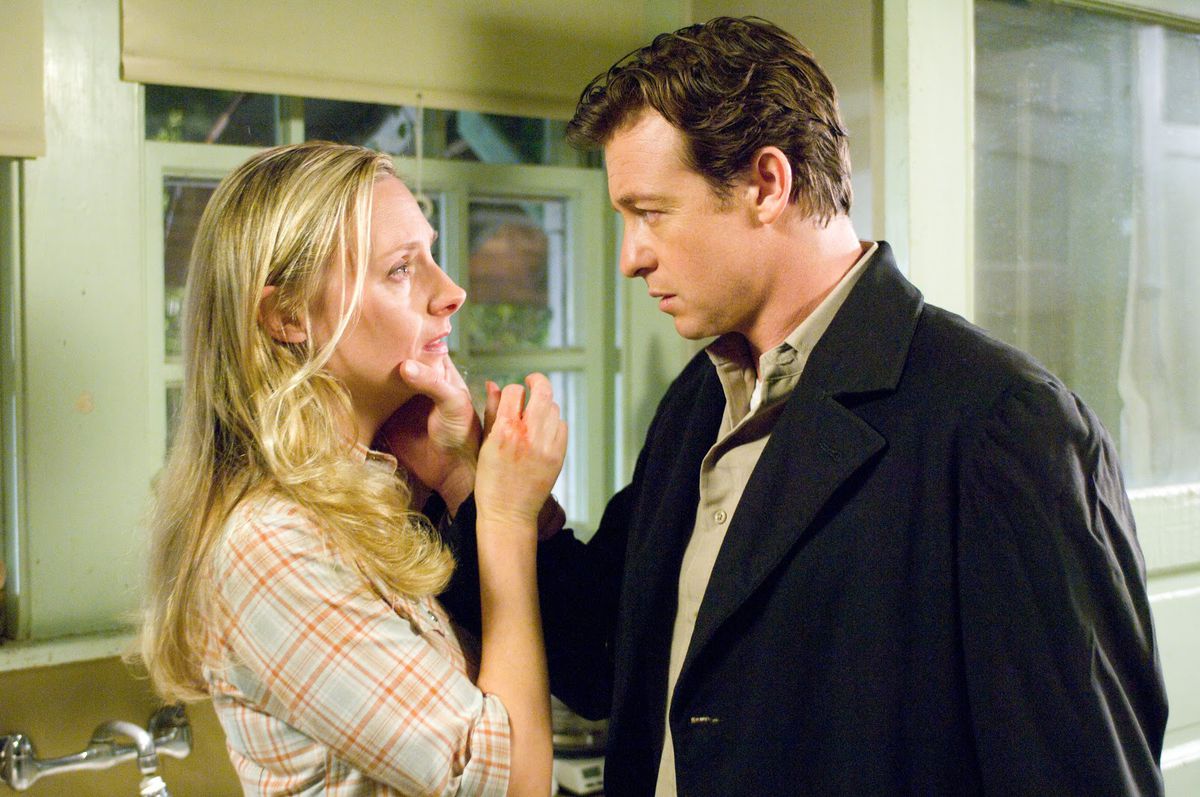
The Lodger was the feature-length directing-writing debut of David Ondaatje, the nephew of celebrated Canadian author Michael Ondaatje, best known for the book that became The English Patient (1996). Mostly, David Ondaatje’s handling is routine. The police procedural aspect, which does not exist in most other versions of the story, is given far more screen time that the family’s suspicions about the identity of the lodger, but proves nothing standout. Moreover, Ondaatje plays hard and fast with the facts of the Jack the Ripper case, mostly adhering to canon but inventing suspects when it suits him to do so.
Far more interesting is the latter half of the film where David Ondaatje winds the script in a constantly twisting pretzel that makes us think every person in the principal cast may be the killer – husband Donal Logue going off to work with his black bag, wife Hope Davis with her history of mental illness, with even detective Alfred Molina falling under suspicion at one point – and causes us to doubt whether there is a lodger at all or if they are just a figment of Hope Davis’s imagination. The film reaches an interesting ending that abandons Marie Belloc Lowndes’ more traditional thriller plotting and heads entirely into M. Night Shyamalan territory, before a coda that shows this too to be the wrong conclusion. It is during this half that The Lodger 2009 comes to life and David Ondaatje has some fun weaving the audience into a genuine mind-bender.
The other Jack the Ripper films include:- those that conduct supposedly straight tellings of the details of the case such as Jack the Ripper (1959), the Spanish Jack the Ripper of London (1971) with Paul Naschy, Jess Franco’s Jack the Ripper (1976) with Klaus Kinski, Jack the Ripper (tv mini-series, 1988) starring Michael Caine, The Ripper (1997), the Alan Moore graphic novel adaptation From Hell (2001) with Johnny Depp, the German Jack the Ripper (2016), and Ripper Untold (2021) and its sequel Ripper’s Revenge (2023). There are a number of other works that feature The Ripper as a central character like Room to Let (1950), although most of these vary widely from the known details. More prevalent have been speculative treatments, including the likes of:- having the contemporary but fictional figure of Sherlock Holmes solve the mystery in A Study in Terror (1965) and Murder By Decree (1979); the Ripper being an alien spirit that possesses Scotty in Star Trek‘s Wolf in the Fold (1966) and with similar stories occurring in episodes of Kolchak: The Night Stalker (1974-5) and The Outer Limits (1995-2002); the Ripper being Dr Jekyll in both Dr Jekyll and Sister Hyde (1971) and Edge of Sanity (1989); Jack the Ripper’s daughter featuring in Hands of the Ripper (1971); H.G. Wells and the Ripper travelling through time to the present day in Time After Time (1979) and its tv series remake Time After Time (2017), as well as a time-travelling Ripper appearing in episodes of tv series like Fantasy Island (1977-84), Goodnight Sweetheart (1993-9) and Timecop (1997-8); The Ripper having travelled out West in the Knife in the Darkness (1968) episode of the Western tv series Cimarron Strip (1967-8) and the film From Hell to the Wild West (2017);The Ripper being resurrected or copycated in the present day in The Ripper (1985), Bridge Across Time/Terror at London Bridge (1985), Jack’s Back (1988), Ripper: Letter from Hell (2001), Bad Karma (2002), The Legend of Bloody Jack (2007) and Whitechapel (tv mini-series, 2009); a parody segment of Amazon Women on the Moon (1987) that speculates that the Ripper was in fact the Loch Ness Monster; the Babylon 5 episode Comes the Inquisitor (1995) that reveals the Ripper was taken up by aliens and redeemed; transposed to Gotham City in the animated Batman: Gotham By Gaslight (2018); even turning up as a character in the French animated film Jack and the Cuckoo-Clock Heart (2013). Also of interest is the tv series Ripper Street (2012-6), a detective series set in London in the immediate aftermath of the Ripper killings.