

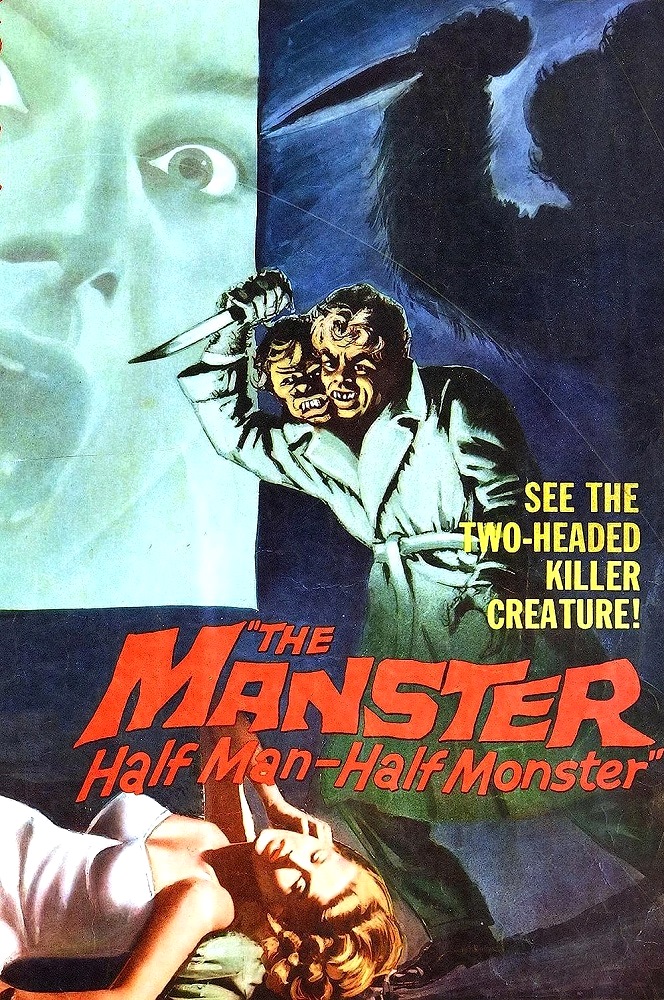
Crew
Directors – George Breakston & Kenneth G. Crane, Screenplay – Walt Sheldon, Story/Producer – George Breakston, Photography (b&w) – David Mason, Music – Hirooki Ogawa, Special Effects – Shinpei Takagi, Makeup – Fumiko Yamamoto, Art Direction – Noboru Miyakuni. Production Company – United Artists of Japan.
Cast
Peter Dyneley (Larry Stanford), Terri Zimmern (Tara), Satoshi Nakamura (Dr Robert Suzuki), Van Hawley (Ian Matthews), Jane Hylton (Linda Stanford), Jerry Ito (Superintendent Aida), Toyoko Takechi (Emiko Suzuki), Alan Tarlton (Dr Jensen)
Plot
Larry Stanford, an American journalist working in Tokyo, goes to interview research scientist Dr Robert Suzuki. However, Suzuki drugs Larry’s drink and then injects him with a serum while he is out. Afterwards, Larry becomes surly towards the people around him and starts drinking, while he lets Suzuki take him out to carouse with Japanese women. When his wife Linda comes to visit, Larry leaves her for Suzuki’s assistant Tara. Larry then begins to conduct a series of random killings, although is unable to remember what he did afterwards. Soon another head emerges out of Larry’s shoulder and transforms him into a bestial killer.
This American-Japanese co-production is an interestingly obscure film, one where its reputation as a B movie has preceded its actual availability on video or tv. It is, of course, a venture into the schlock movie theme of the two-headed transplant. However, The Manster is one entry that, when seen, proves a whole lot more entertaining than other variants on the theme such as the terrible The Incredible 2-Headed Transplant (1971) and the deliberately silly The Thing with Two Heads (1972).
The Manster comes with a luridly entertaining torridness. There is the wonderful schlock moment where Peter Dyneley takes off his shirt to reveal an eye on his shoulder or later when the head first pops up during the attack on the psychiatrist. The two-headed creature suffers from the inevitable Zaphod Beeblebrox effect – the attempt on tv’s The Hitch Hikers Guide to the Galaxy (1981) to create a two-headed man that just ended up looking like an actor with a fake head sitting on his shoulder. The second head in these films always looks incredibly fake or just like two actors squeezing together – a modern CGI-created two-headed monster movie could prove kinda cool.
What makes The Manster entertaining is its unquestionably racist subtext. There is another whole level the film operates on where it could almost have worked without any mad scientist or two-headed monster elements about a man being tempted by another culture and straying from the path of marital fidelity. In reality, The Manster is a Jekyll and Hyde film – if you can imagine a crosshatch between a two-headed transplant film, Dr Jekyll and Mr Hyde and The Lost Weekend (1945). This is a Dr Jekyll variant where the decent ordinary man is not just struggling with his dark side but one that is also polarised into a struggle between Japanese and American cultures.
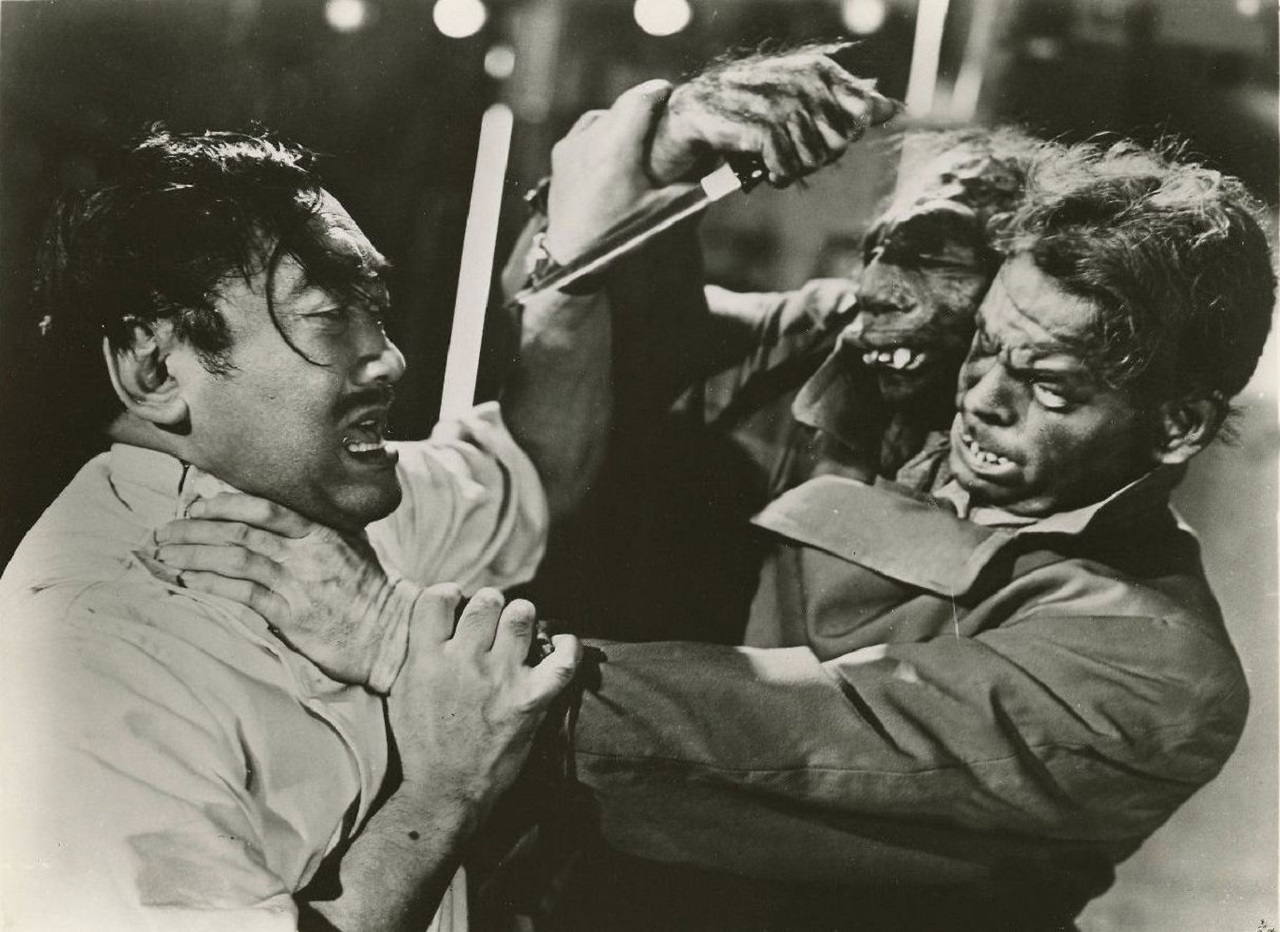
Here American culture is seen as the norm and Japanese culture as carnal and corrupting. What is interesting is that the monster does not emerge until some way into the film and the interim is filled with a number of scenes with Peter Dyneley languishing in bathhouses with geishas, who are shown with as much eroticism as the period would allow, and drinking heavily, while abandoning his decent wife for the mad scientist’s vixen of a lab assistant. The fear of cultural pollution and the belief that Japanese culture represents a wantonness is fascinatingly laughable.
The racism is even further demonstrated in the characters – all the supporting roles, except those in subservient positions, are played by Caucasians, while only the evil ones – the mad scientist and his assistant – are played by Japanese actors. With perfectly apt symbolism, the ending has the hero and his other half split in two, the bestial half and the Japanese strumpet vanishing to be consumed in a volcano, while leaving the hero racially pure again to return to the arms of his wife. On the plus side, the film is cautiously respectful of Japanese culture and does at least feature the white actors speaking undubbed Japanese.
Kenneth G. Crane also directed the very cheap giant bug film Monster from Green Hell (1957) and the US insert scenes for Ishiro Honda’s Abominable Snowman film Half Human (1958). Co-director George Breakston directed several other B adventure films but no other works of genre interest.
Full film available here:-