
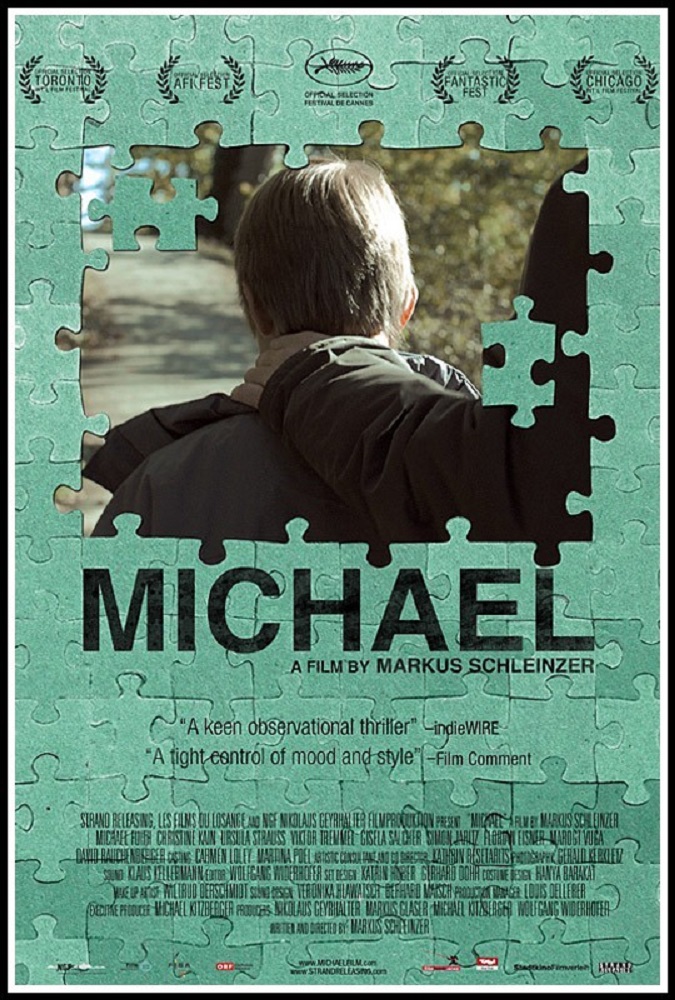
Crew
Director/Screenplay – Markus Schleinzer, Producers – Nickolaus Geyralter, Markus Glaser, Michael Kitzberger & Wolfgang Widerhofer, Photography – Gerald Kerkletz, Visual Effects – CHVFX, Mathias Halbrad & Christopher Hivers, Production Design – Gerald Dohr & Katrin Huber. Production Company – Nickolaus Geyralter Filmproduktion/Stadtkino Filmverleih.
Cast
Michael Fuith (Michael), David Rauchenberger (Wolfgang), Gisela Salcher (Christa), Christine Kain (Michael’s Mother), Ursula Strauss (Karin, Michael’s Sister), Victor Tremmel (Brother-in-Law)
Plot
Michael is a dull anonymous man who works in an insurance office and lives on his own. The secret he holds is that he keeps a young boy Wolfgang locked up in a room in his cellar and uses him for sexual purposes. They lead a calm and ordered domestic life together with Michael often taking Wolfgang out on daytrips. Wolfgang resents being there and has withdrawn inside himself.
Michael – which is no relation to and is about as far removed from Nora Ephron’s kooky angel drama Michael (1996) as it is possible to get – is a film that leaves you balking before you walk in the theatre door. It is a sympathetic work about a paedophile. It is a film where the back of your mind half wonders if maybe the Feds or Interpol are not marking your name down on a list to keep tabs on for future note in case you were turning up with the idea of getting some tips on how to be a better child predator. You even feel a little uneasy telling people you have been to see, let alone liked, Michael, as doing so gets some oddly raised eyebrows in polite company. All of this is surely even more of an inflammatory subject coming from Austria, a country that is still reeling from the international headlines made in 2008 by the arrest of Josef Fritzl who imprisoned his own daughter in his cellar as a sex slave for thirty years.
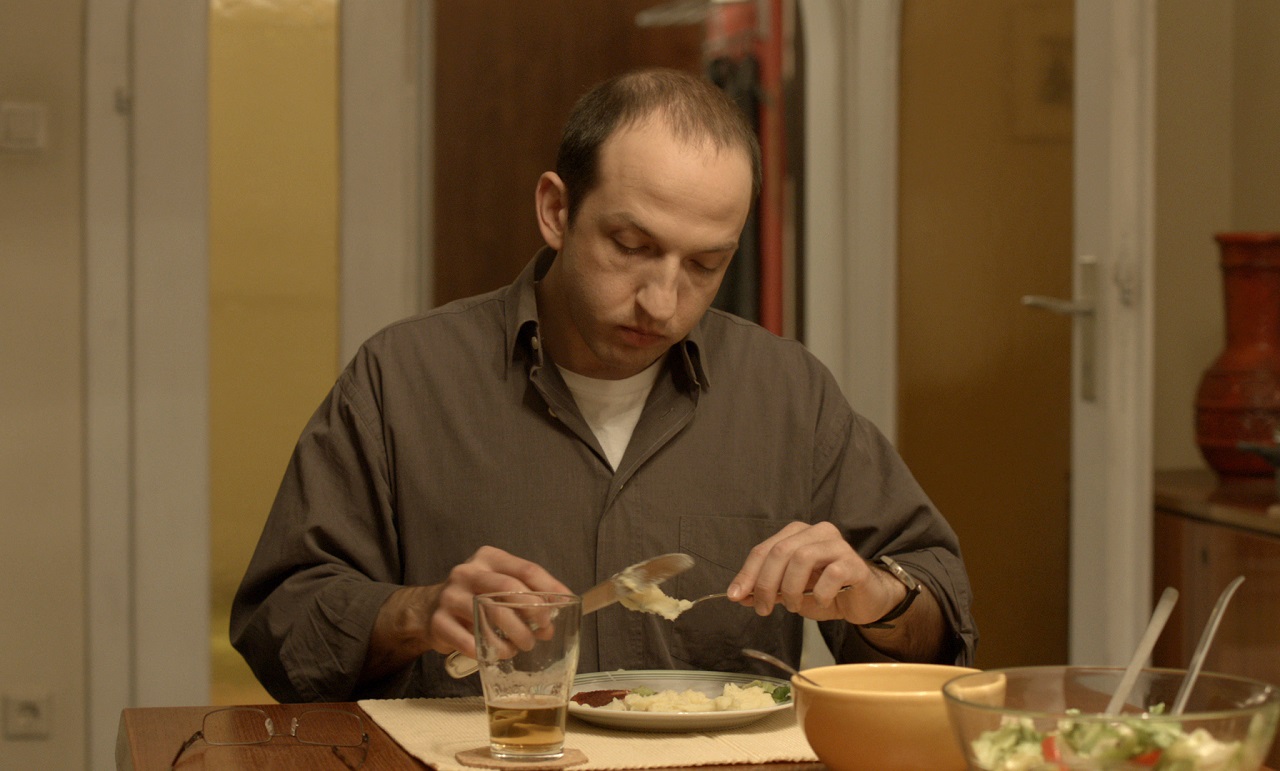
Throughout the film, director Markus Schleinzer takes a mannered and understatedly cool approach to the subject matter, assiduously avoiding any big dramatics. This he does almost to the point of making Michael something dull. Given the subject matter however, the cool detachment of Markus Schleinzer’s direction proves completely chilling. Just the opening scenes – a montage of shots where we see Michael Fuith entering through his drive-in garage, the two of them sitting down to eat dinner, young David Rauchenberger asking to watch television and being told he can until 9 pm, Michael could be an ordinary parent-son drama but for the fact that the boy is being locked up in a bolted room in the cellar. Even more chilling is the complete understatement of the next scene where we see Michael Fuith exiting from the cellar and washing off his genitals in a hand basin. The nonchalance and understatement of such a scene is astonishing.
The very calm understatement of the film, the way it shows what is happening coolly and factually, like a documentary that could simply be saying “This is the lives they lead”, gives Michael unnerving effect. There is no attempt to make any moral judgement or take a position on what is happening – the entire film is simply a series of montage shots of the life of Michael and Wolfgang. There are almost no characters other than he two of them on screen for the bulk of the film. Indeed, the film rarely ever moves beyond the tableaux that depict their lives to develop a plot. You might want to compare Michael to Hard Candy (2005), an American treatment of a very similar subject matter. Hard Candy seemed determined to hammer home the moral points and judgements in a flamboyantly entertaining way; Michael covers similar territory but works at almost the opposite extreme.
One of the most chilling scenes is the one where we first see Michael Fuith building a set of bunks in the cellar and wonder where this is going. We next see him at a go-kart rink talking to young boys. The final tracking shot where we see him walking out into the parking lot with one boy, only for the boy’s father to come looking for him and call out and Fuith to just keep on walking is superbly unsettling in what it implies was about to happen.
Markus Schleinzer only varies from the detachment of approach to throw in a single black joke – the scene where Michael Fuith repeats a line from a film he has been watching and stands up at the dinnertable to expose himself, asking “This is my knife, this is my cock – which do you want in you?”, only to be disinterestedly rebuffed by David Rauchenberger who says “the knife” without even looking up from what he is eating. The film’s final scene holds us in great suspense as Christine Kain and Victor Tremmel do their clean-up, the camera following them through the house before the moment where she ventures down into the cellar and opens the door at which perfectly chosen moment Markus Schleinzer chooses to cut to black.
As played by Michael Fuith, the character of Michael with prematurely balding hair, cold blue eyes behind his glasses, and a lack of expression or reaction to what is happening merely an anal-retentive obsession with order is fascinating to watch. Indeed, Michael could otherwise be a character study in total anonymity. The film and Michael Fuith’s performance is perfectly calculated so that we neither necessarily feel sympathy for, nor at the same time can entirely hate Michael or regard him as an inhuman monster.
The only other film Markus Schleinzer has gone on to make so far has been the historical film Angelo (2018).
(Winner in this site’s Top 10 Films of 2011 list. Nominee for Best Actor (Michael Fuith) at this site’s Best of 2011 Awards).