
aka The Atomic Brain
Crew
Director – Joseph Mascelli, Screenplay – Dean Dillman Jr, Sue Dwiggins & Vy Russell, Producers – Dean Dillman Jr & Jack Pollexfen, Photography (b&w) – Alfred Taylor, Music – Gene Kauer, Special Effects – Space Age Rentals, Makeup Effects – Lou Yates. Production Company – Cinema Venture.
Cast
Marjorie Eaton (Mrs March), Frank Gerstle (Dr Otto Frank), Frank Fowler (Victor), Erika Peters (Nina Rhodes), Judy Bamber (Beatrice Mullins), Lisa Lang (Anita Gonzales)
Plot
In a laboratory set up on the estate of wealthy Mrs March, Dr Otto Frank is conducting a series of experiments using an atomic reactor to transfer animal brains into the bodies of corpses. He is hoping to perfect the process in order to transfer the aging Mrs March’s brain into a young body so that she can regain her youth. Mrs March has three girls flown in from various parts of the world – the English Beatrice, the Austrian Nina and the Mexican Anita – ostensibly to work as her servants. However, once in the house, the girls find that phone lines have been cut and that they are forbidden to leave. What they do not know is that Dr Frank and Mrs March are preparing to select one of them as the vessel Mrs March’s brain to be transplanted into.
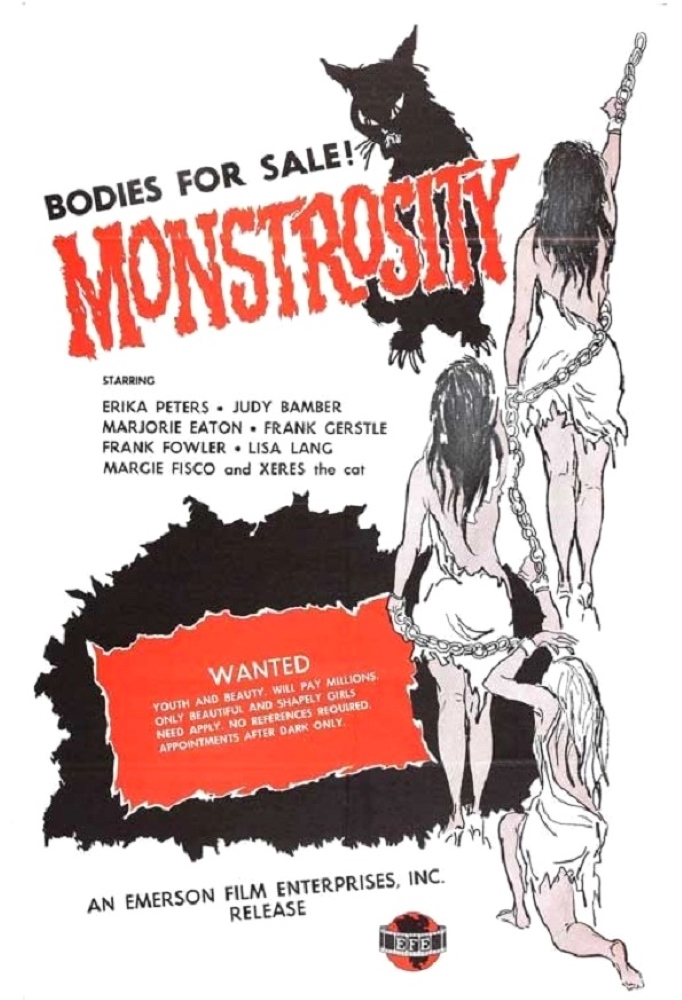
Monstrosity, also known under the more accurate tv retitling of The Atomic Brain, is an amusingly lurid B budget film from the 1960s. The production came from producer/writer Jack Pollexfen who had made various other B genre films in the previous decade – The Man from Planet X (1951), Son of Dr Jekyll (1951), Captive Women (1952), The Neanderthal Man (1953), Son of Sinbad (1955), The Indestructible Man (1956) and Daughter of Dr. Jekyll (1957). Monstrosity was the only directorial outing of Joseph Mascelli, a former cinematographer who worked on several Ray Dennis Steckler films – Wild Guitar (1962), The Incredibly Strange Creatures Who Stopped Living and Became Mixed-Up Zombies (1964) and The Thrill Killers (1964).
Monstrosity falls into the sub-genre of mad scientist films that was all the rage about two decades earlier. The mad scientist film had fairly much died away during the 1950s – apart from odd throwbacks like The Fly (1958) and The 4D Man (1959) – and was supplanted by the atomic monster and alien invader film. Monstrosity tries to combine the atomic monster and mad scientist film, a genre amalgamation that one is surprised was never more popular than it was – about the only other film that ever did so was Edward D. Wood Jr’s Bride of the Monster (1955). Of course, by the time that Monstrosity came out, it was a dinosaur and both the atomic monster and the mad scientist genres were passé.
Nevertheless, there is something luridly entertaining about Monstrosity. There is the wonderful opening narration: “Can death be outwitted? Is the secret of eternal life just around the corner? Today medical science patches up mutilated bodies, transplanting human eyes, limbs, even vital organs. Is the next step the transplantation of the human brain? Many scientists answer yes. But they pause and add a grim warning. For in the ancient legends, tales are told of blood-sucking vampires crawling out of the graves to live on the bodies of helpless victims. Is man now doomed to produce a race of ever-living monstrosities worse than the vampires of legend? Will ruthless men and women of power readily buy and steal the bodies of the young and beautiful so their brains may live on forever? Such questions may seem fanciful but at this very moment scientists are working on the answer to brain transplantation and human bodies are used.”
One particularly liked the wholly spurious leap being made between standard transplant surgery and association with vampires. The opening sequence also offers up images of a near-naked woman inside a reactor and Frank Gerstle’s scientist fussing around in a radiation suit, before the narrator tells us that the woman died yesterday, that her body has been stolen from the grave and that she has now been given an animal’s brain and brought back to life via atomic radiation.
There is something wonderfully lurid to the combination that is pure B-budget mad science cinema. There are all the obvious connections made to Frankenstein – the mad scientist is even named Dr Frank. In one amusing part, we learn that he has built a self-destruct device in the laboratory that will cause the reactor to melt down and blow up should the police discover him. Joseph Mascelli pushes the sexual element as much as he could get away with during the day – naked but artfully covered girls inside the reactor, the actresses playing the various maids parading around in towels and exposing their bared backs. There are some highly amusing scenes seeing Lisa Lang after her brain is supposedly replaced by one from a cat – naturally, she falls to her death while trying to climb along a roof.
There is a wonderful just desserts ending involving much squabbling over Mrs March’s will, which Frank Gerstle’s scientist solves by transferring Mrs Match’s brain into the cat’s body, planning to keep Nina (Erika Peters), the beneficiary of Mrs March’s will and the intended brain recipient, a prisoner to get the funds he needs for his experiments, until the cat with Mrs March’s brain inside traps him inside the reactor and triggers the self-destruct. There is a fine fadeout with the house burning down, Erika Peters walking off and, in the last shot, the cat seen following her looking for revenge.
On the minus side, such a wonderfully lurid and amusing stew of B movie elements fails to come to a boil as a film. Joseph Mascelli’s direction is drearily dull and the photography downright primitive. The drama is accompanied by a portentous and dull musical score. Judy Bamber who plays Bea affects what is possibly the worst attempt to create a British accent ever recorded on film.
Full film available online here:-