
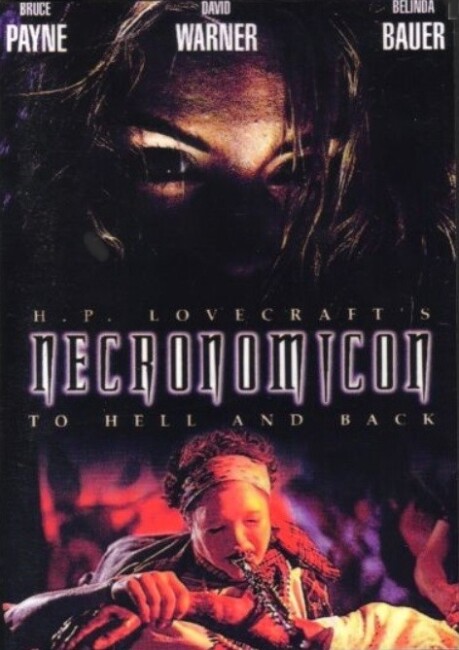
USA/Japan. 1993.
Crew
Producers – Samuel Hadidia & Brian Yuzna, Digital Effects/CGI – Perpetual Motion Pictures, Animation Effects – Bart Mixon, Physical Effects – G. Bruno Stempel, Makeup Effects – Thomas C. Rainone, Production Design – Anthony Tremblay. Production Company – Davis Films/Pioneer LDC/Ozla Pictures/Necronomicon Films.
The Library/The Whispers
Crew: Director – Brian Yuzna, Screenplay – Brent V. Friedman, Story – Brent V. Friedman & Brian Yuzna, Based on the Short Story The Whisperer in Darkness by H.P. Lovecraft, Photography – Gerry Lively, Music – (Wraparound) Joseph Lo Duca & (Whispers) – Daniel Licht, The Library Makeup Effects – Steve Johnson’s XFX Inc (Supervisors – Dave Barton & Christopher Nelson), Magic Media Industries (Supervisors– John Buechler & John Foster), Screaming Mad George Inc (Supervisors – Chris Robbins & Screaming Mad George) & John Vulich, Whispers Makeup Effects – Todd Masters Co (Supervisor – Mark Mantle)
Cast: The Library: Jeffrey Combs (H.P. Lovecraft), Tony Azito (Librarian)
The Whispers: Signy Coleman (Sarah), Don Calfa (Harold Benedict), Judith Drake (Daisy Benedict), Obba Babatunde (Paul)
The Hotel of the Drowned
Crew: Director – Christophe Gans, Screenplay – Brent V. Friedman & Christophe Gans, Based on the Short Story The Rats in the Walls by H.P. Lovecraft, Photography – Russ Brandt, Music – Joseph Lo Duca, Miniatures – David B. Sharp Productions Inc (Supervisor – David B. Sharp), Makeup Effects – Bart Mixon’s Monster Fixin’s (Supervisor – Bart J. Mixon), Optic Nerve Studio (Supervisor – Everett Burrell) & Tom Savini.
Cast: Bruce Payne (Edward DeLapoer), Richard Lynch (Jethro De Lapoer), Belinda Bauer (Nancy Gillmore), Maria Ford (Clara)
The Cold
Crew: Director – Shusuke Kaneko, Screenplay – Brent V. Friedman & Kazunori Ito, Based on the Short Story Cool Air by H.P. Lovecraft, Photography – Gerry Lively, Music – Daniel Licht, Makeup Effects – Bart Mixon’s Monster Fixin’s (Supervisor – Bart J. Mixon) & Screaming Mad George Inc (Supervisors – Chris Robbins & Screaming Mad George)
Cast: Bess Meyer (Emily/Amy Osterman), David Warner (Dr Richard Madden), Millie Perkins (Lena Cayman), Dennis Christopher (Dale Porkel), Gary Graham (Sam Linder), Curt Lowens (Al)
Plot
In the Fall of 1932, writer H.P. Lovecraft learns that an order of Ontraggi Monks have a copy of the fabled work of occult lore, The Necronomicon. Getting into the monastery library on a pretext, Lovecraft steals a monk’s keys and sneaks into the vault where the Necronomicon is. However, as he sits down to read, something below the vault starts to stir. The Hotel of the Drowned:- Edward DeLapoer returns to inherit the family hotel, which has remained disused for sixty years. He reads a letter that tells how his ancestor Jethro De Lapoer survived a shipwreck in which his wife and son were lost. At night, a creature came to Jethro and left a copy of the Necronomicon. Inside it Jethro found a ritual that he used to raise his wife and son from the dead, only for them to return as inhuman things. Finding The Necronomicon, Edward now uses it to call his late love Clara back to him. The Cold:- Journalist Dale Porkel visits the Boston home of Amy Osterman, having worked out that eleven people have disappeared after coming to the house over the last forty years. When he threatens exposure, Amy invites him in. She tells him the story of how 22 years earlier her mother Emily came to the house in answer to an ad for boarders. She befriended the reclusive Dr Richard Madden who lived upstairs and was engaged in experiments in cryptobiosis. He had a found a means of preserving the body from aging, although this required keeping it away from sunlight and in cold temperatures. Emily then found that Madden required a constant influx of human spinal fluids as part of the process. The Whispers:- Police officers Sarah and Paul crash during the pursuit of a suspect. Sarah comes around to see someone dragging Paul’s body away. She follows to a warehouse where the owners Harold Benedict and his blind wife Daisy tell her that Paul has been taken by The Butcher. She follows the trail of The Butcher down beneath the warehouse only to find herself in an ancient temple where she and Paul have been intended as sacrificial victims.
H.P. Lovecraft was a horror writer who produced a great many works in the 1930s. Although Lovecraft enjoyed little published success within his lifetime, his influence has been far-reaching and he has created indelible images of cosmic horror – inimical elder gods waiting beyond the edge of known spaces, blasphemous miscegenation with non-human creatures or questors after forbidden knowledge driven insane by what they have found. The Necronomicon was one of the principal occult tomes within what is known as Lovecraft’s Cthulhu Mythos, supposedly authored by the mad Arab Abdul Alhazared and containing forbidden knowledge, including the ability to conjure elder gods. Many people have come to believe that The Necronomicon was a real occult tome. Some publishers have attempted to offer copies of it, while H.R. Giger offered a book of his perverse artwork entitled H.R. Giger’s Necronomicon (1977), designs from which purportedly inspired Ridley Scott to hire Giger to create Alien (1979). Reference to The Necronomicon has been cited in several other films such as Equinox (1970), The Evil Dead (1981) and sequels, even episodes of The Simpsons (1989– ).
There had been a handful of H.P. Lovecraft adaptations on film under the aegis of Roger Corman with the likes of The Haunted Palace (1963), Die, Monster, Die! (1965) and The Dunwich Horror (1969), as well as a couple of episodes of Rod Serling’s Night Gallery (1970-3). However, what popularised H.P. Lovecraft on film was Stuart Gordon’s gore-drenched blackly comedic adaptation of Lovecraft’s Herbert West stories with Re-Animator (1985). Even though Gordon’s approach was at opposite remove from the way that Lovecraft wrote, Re-Animator created a mini vogue of Lovecraft films. Stuart Gordon made subsequent adaptations of Lovecraft’s From Beyond (1986) and Dagon (2001). Other filmmakers turned out adaptations such as The Curse (1987), The Unnameable (1988), The Resurrected (1992), Lurking Fear (1994), The Dream-Quest of Unknown Kadath (2003), Beyond the Wall of Sleep (2006), Cool Air (2006), Chill (2007), Cthulhu (2007), The Tomb (2007), Colour from the Dark (2008), the remake of The Dunwich Horror (2009) and Pickman’s Muse (2009). There were Lovecraft homages like Cast a Deadly Spell (1991), which features a detective named H.P. Lovecraft dealing with the occult, the cheap Spanish Cthulhu Mansion (1992) and John Carpenter’s In the Mouth of Madness (1995). Lovecraft’s greatest popularity would appear to be among amateur filmmakers – there are a number of celebrated works among these, even entire film festivals – see The H.P. Lovecraft Film Festival – North (1999) for one such. (See below for a full list of Lovecraft adapted and inspired films).
Necronomicon is a portmanteau film of H.P. Lovecraft adaptations. It was made by Brian Yuzna, producer on all of Stuart Gordon’s Lovecraft films and a substantial genre director in his own right. (See below for Brian Yuzna’s other films). For the other segments, Yuzna brought on board a range of international directorial talent with the French Christophe Gans and the Japanese Shusuke Kaneko who both went onto substantially greater fame. (See bottom of page for either’s other films).
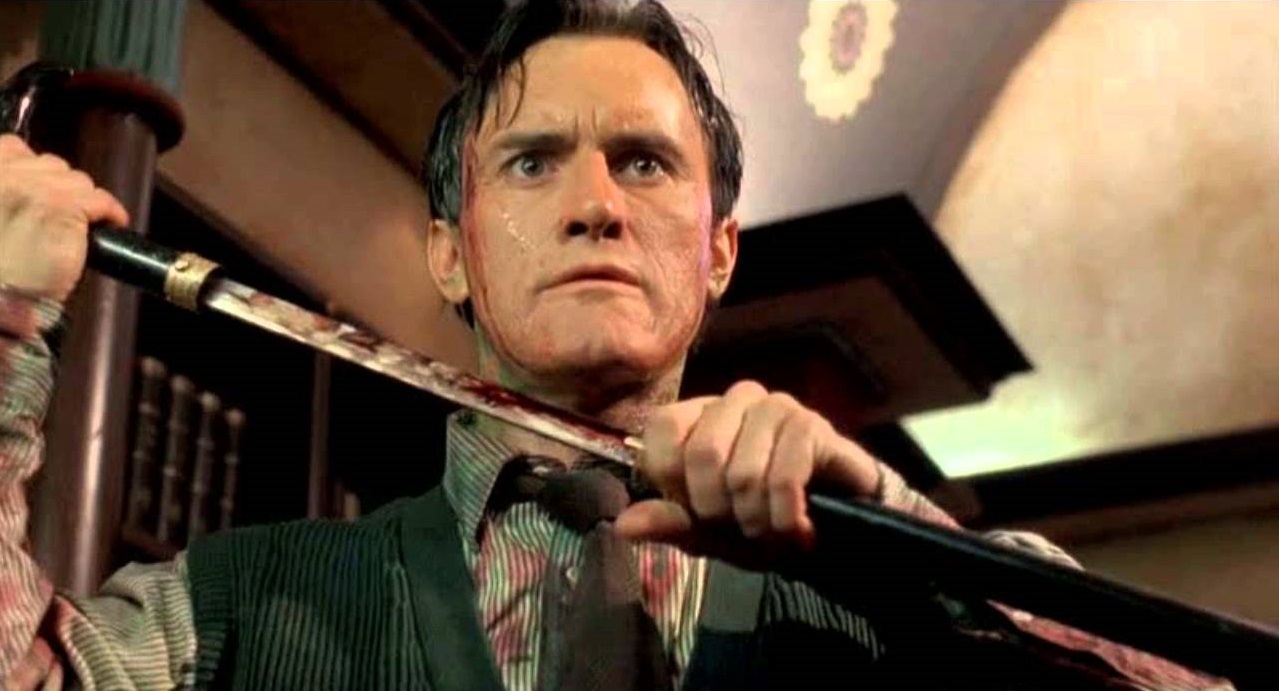
To claim such a quintessentially Lovecraftian title as Necronomicon, one feels that this should have been a definitive Lovecraft film. Unfortunately, Necronomicon is far from a classic. Most of the episodes are staggeringly routine. The most disappointing is the first episode The Hotel of the Drowned, an adaptation of Lovecraft’s story The Rats in the Walls (1924). Christophe Gans fails to invest the episode with any atmosphere. The flashback to the ritual of resurrection lacks any sense of horror – much more should have been made out of the play between the return of Richard Lynch’s family from the dead and their possession by something other. As it is, they just appear and then dissolve into tentacle-faced things and green goo. The episode lacks anything other than serving as a showcase for the makeup effects people.
This is sadly a problem that is too symptomatic of Necronomicon – the substitution of effects for any sense of atmosphere and in particular of Lovecraftian cosmic horror. H.P. Lovecraft’s work has been much parodied for its prose where he was constantly referring to his monstrosities as ‘indescribable’ but most of these film adaptations of the 80s-90s have worked to the contrary by portraying Lovecraft’s horrors very much up front in terms of makeup effects. Brian Yuzna’s contributions, the framing story and The Whispers, an adaptation of The Whisperer in Darkness (1928), are clear examples of this, lacking anything other than special effects. There are very occasional moments where this does work – The Whispers conjures a sense of something primordial during its descent into the temple and has a nice twist shock with the revelation of Signey Coleman with her arms and legs severed and the baby transferred to Judith Drake’s body. The Cold is the best story in the film but it too is saddled with extraneous meltdown effects even when it works perfectly well without them.
The only episode that works satisfyingly is The Cold, an adaptation of Cool Air (1931), which works both as a story and in terms of the atmosphere that Shusuke Kaneko engenders. The twist ending about the daughter being the mother is predictable but there is a nicely squeamish twist with the mother saying she needs the spinal fluids so that she can feel the baby kicking inside her.
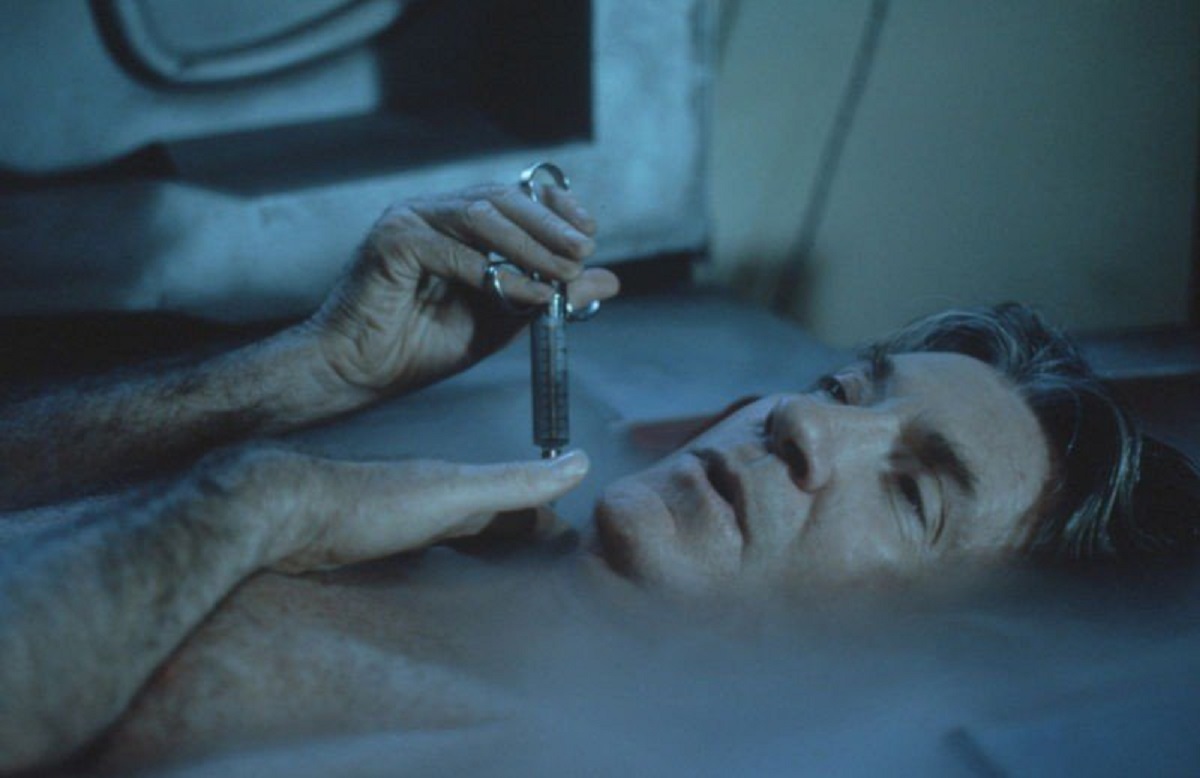
With the exception of The Cold, the rest of Necronomicon is a disappointment. Moreover, for all the film’s claim to being a definitive Lovecraftian work, the three short stories adapted vary extremely liberally from their source material. Hotel of the Drowned, for example, bears almost no resemblance to The Rats in the Walls other than the names of the protagonist and his ancestor. In The Rats in the Walls, there is nothing about the use of The Necronomicon to revive the dead (or for that matter any hotels or even any reference to The Necronomicon), rather DeLapoer is driven insane after discovering a vast underground city where his ancestors used to keep humans as cattle to feast on their flesh. Similarly, The Whisperer in Darkness features an investigation into rumours of an alien species that have been hiding in the hills of the Vermont countryside. There is nothing about sacrificial cults or cops investigating a warehouse. There are at best some vague similarities – the story starts with investigations into rumours of people being dragged off, while the ending of both the story and film episode is somewhat analogous. The Cold is the segment that follows the original the closest – the episode adds narrative flashbacks and a reporter, but mostly follows the story of a person entering a boarding house and discovering a Dr Munoz who has extended his life by reducing the temperature.
Brian Yuzna’s other films as director are Society (1989), Bride of Re-Animator (1990), Initiation: Silent Night, Deadly Night 4 (1990), Return of the Living Dead III (1993), The Dentist (1996), The Dentist 2 (1998), Progeny (1998), Faust: Love of the Damned (2000), Beyond Re-Animator (2003), Rottweiler (2004), Beneath Still Waters (2005) and Amphibious 3D (2010). Yuzna has also produced a number of genre films including Re-Animator (1985), From Beyond (1986), Dolls (1987), Honey, I Shrunk the Kids (1989), The Guyver (1991), Infested (1993), Crying Freeman (1995), Arachnid (2001), Dagon (2001), Darkness (2002), Romasanta: The Werewolf Hunt (2004), The Nun (2005), Takut: Faces of Fear (2008) and Suitable Flesh (2023).
Christophe Gans went onto make the underrated manga adaptation Crying Freeman (1995), the silly historical monster movie Brotherhood of the Wolf (2001), the videogame adaptation Silent Hill (2006) and a version of Beauty and the Beast (2014), as well as produced the ghost story Saint Ange (2004).
Shusuke Kaneko’s other genre films are Gamera, The Guardian of the Universe (1995), Gamera 2: Assault of Legion (1996), School Ghost Story 3 (1997), Gamera 3: Revenge of Iris (1999), Cross Fire/Pyrokinesis (2000), Godzilla Mothra and King Ghidorah: Giant Monsters All-Out Attack (2001), Toast of Love (2002), Death Note (2006) and Death Note: The Last Name (2006), and Danger Dolls (2014).
Brent V. Friedman has written a number of genre films, including Evil Altar (1989), Syngenor (1990), American Cyborg: Steel Warrior (1992), another H.P. Lovecraft adaptation The Resurrected (1992), HellBound (1993), Ticks (1993), Prehysteria! 2 (1994), Magic Island (1995), Pet Shop (1995), Prehysteria! 3 (1995), Mortal Kombat: Annihilation (1997), Mermaids (2003) and Foodfight (2009), as well as created the tv series Dark Skies (1996-7) and Secret Agent Man (2000).
Other films based on the works of H.P. Lovecraft include:- The Haunted Palace (1963), Die, Monster, Die/Monster of Terror (1965), The Shuttered Room (1967) and The Dunwich Horror (1969). The big success in the modern era was Stuart Gordon’s splattery black comedy version of Re-Animator (1985), which popularised Lovecraft on film. This led to a host of B-budget Lovecraft adaptations, including Stuart Gordon’s subsequent From Beyond (1986), The Curse (1987), The Unnameable (1988), The Resurrected (1992), The Unnamable II: The Statement of Randolph Carter (1993), Lurking Fear (1994), Gordon’s Dagon (2001), and other works such as The Dream-Quest of Unknown Kadath (2003), Beyond the Wall of Sleep (2006), Cool Air (2006), Chill (2007), Cthulhu (2007), The Tomb (2007), Colour from the Dark (2008), The Dunwich Horror (2009), The Color (2010), Pickman’s Muse (2010), The Whisperer in Darkness (2011), The Dark Sleep (2013), The Haunter of the Dark (2015), Herbert West: Re-Animator (2017), Color Out of Space (2019), H.P. Lovecraft’s The Deep Ones (2020), the tv series Lovecraft Country (2020), Markham (2020), H.P. Lovecraft’s Witch House (2021), The Resonator: Miskatonic U (2021), The Lurking Fear (2023), Suitable Flesh (2023), H.P. Lovecraft’s The Old Ones (2024) (2024) and Unspeakable: Beyond the Wall of Sleep (2024). Lovecraft: Fear of the Unknown (2008) is a documentary about Lovecraft. Also of interest is The Manitou (1978), which features an appearance of the Great Old One; Cast a Deadly Spell (1991) and its sequel Witch Hunt (1994), a tv movie set in an alternate world where magic works and where the central character is a detective named H.P. Lovecraft; Juan Piquer Simon’s cheap and loosely inspired Cthulhu Mansion (1992); John Carpenter’s Lovecraft homage In the Mouth of Madness (1995); the fan parodies Lovecracked: The Movie (2006), The Last Lovecraft: Relic of Cthulhu (2009) and Call Girl of Cthulhu (2014); even a trilogy of animated children’s film Howard Lovecraft and the Frozen Kingdom (2016), Howard Lovecraft and the Undersea Kingdom (2017) and Howard Lovecraft and the Kingdom of Madness (2018) in which a young Lovecraft encounters his own creations; while Batman faces Lovecraftian horrors in the animated Batman: The Doom That Came to Gotham (2023); and Lovecraft homages such as The Breach (2022), H.P. Lovecraft’s Monster Portal (2022) and Gods of the Deep (2023). The Elder Gods turn up at the end of The Cabin in the Woods (2012), Lovecraft (Paul Titley) appears as an imaginary companion in Ghostland/Incident in a Ghostland (2018) and In Search of Lovecraft (2008) features a tv news crew discovering that Lovecraft’s works are true. Lovecraft’s key work of demonic lore The Necronomicon also makes appearances in films such as Equinox (1970), The Evil Dead II (1987) and Army of Darkness (1992), and was also borrowed as an alternate retitling for Jesus Franco’s surreal and otherwise unrelated Succubus/Necronomicon (1969) about a BDSM dancer.
Trailer here