

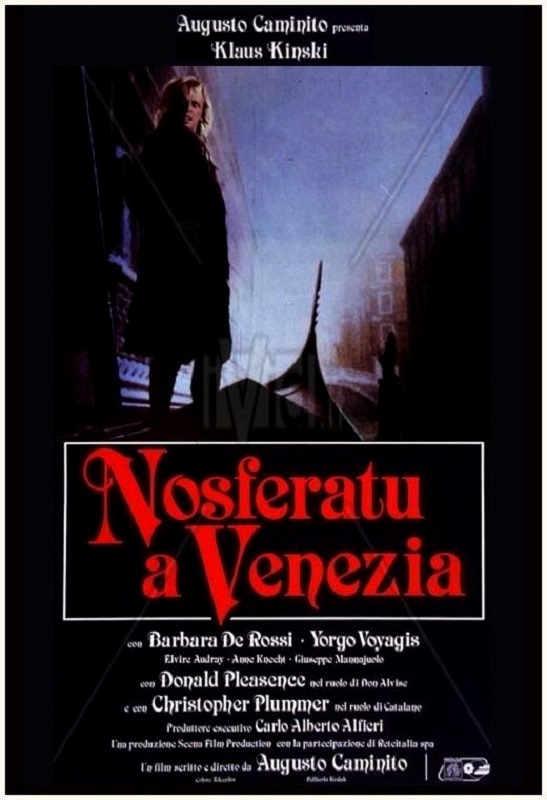
aka Vampires In Venice
(Nosferatu a Venizia)
Crew
Director/Screenplay – Augusto Caminito, Story – Alberto Alfieri & Leandro Lucchetti, Photography – Antonio Nardi, Music – Luigi Ceccarelli & ‘Mask’ Vangelis, Makeup – Sergio Angeloni, Franco Corridori & Luigi Rocchelli, Production Design – Luca Antonucci & Joseph Teichner. Production Company – Scena Film/Reitalia S.p.A
Cast
Klaus Kinski (Nosferatu), Christopher Plummer (Professor Catalano), Barbara De Rossi (Helieta), Elvire Audray (Maria), Donald Pleasence (Don Alvise), Yorgo Voyagis (Dr Barnaval), Anne Knecht (Princess)
Plot
Professor Catalano, an expert on vampirism, goes to Venice in search of the great vampire Nosferatu. He believes Nosferatu has tired of immortality and is seeking a way to die. Helieta, the daughter of the Venetian family that Catalano stays with, believes a coffin in the house’s basement is Nosferatu’s and holds a seance to prove her case. This succeeds in calling Nosferatu from his tomb elsewhere. He comes to Venice, seeking love with Helieta, the means whereby he will be able to finally die.
Nosferatu in Venice/Vampires in Venice is a semi-sequel to Werner Herzog’s Nosferatu the Vampyre (1979). It features a return appearance from Klaus Kinski, who played the vampire in Nosferatu. He is also made up similarly, although this time has a full head of hair. Oddly though, the film never pursues the connection any further than that and it could otherwise stand as its own story. He is also now referred to as Nosferatu as opposed to Dracula.
Nosferatu in Venice is not a particularly successful film but it is one of interesting potentials. Venice is always a location that has afforded an enormous symbolic resonance – see films like Death in Venice (1971), Don’t Look Now (1973) and The Comfort of Strangers (1990). The city’s age, its narrowness, the shadows that seem to lurk in its corners – all have an aching beauty, but contrarily the film uses this it never does anything with it. Occasionally there are images that strike – there is one great shot of the vampire’s giant shadow pursuing a girl along the opposite wall of the street around a corner, an effect that could have been taken right from the original Nosferatu (1922).
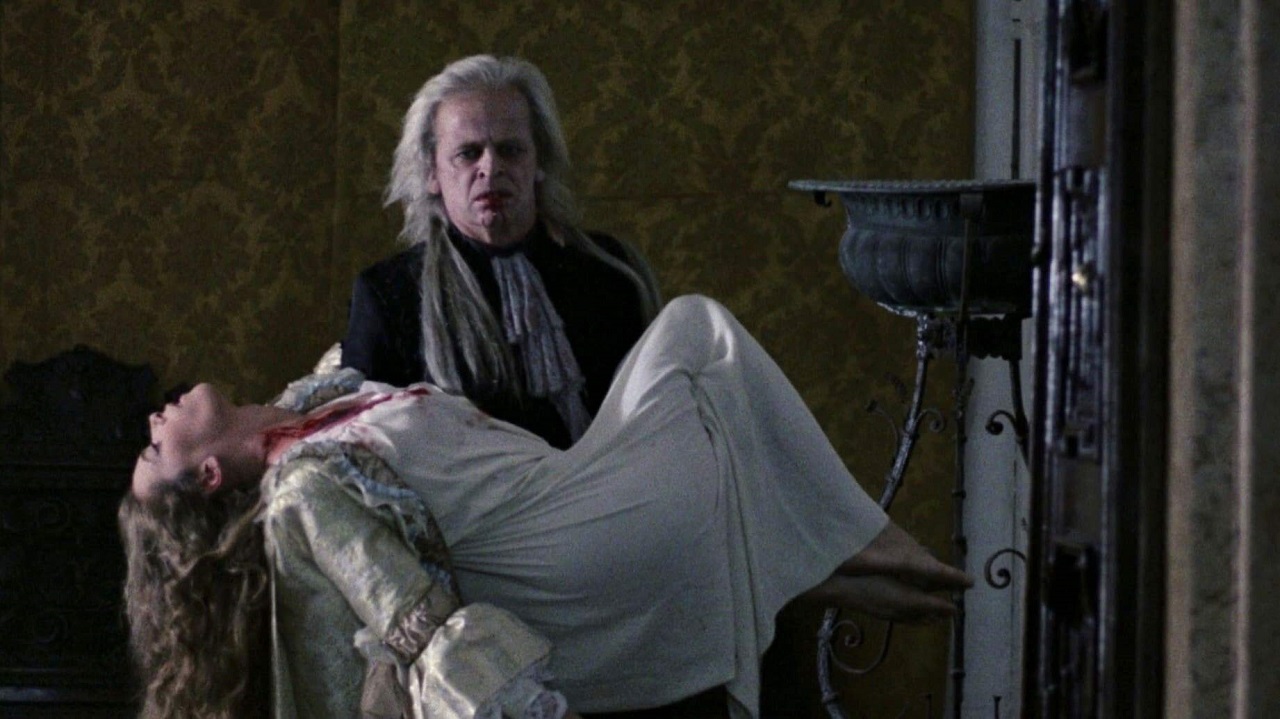
The dialogue does tend to epigrammatic vagueries but occasionally offers some potent images. Like in one scene where we get an appealing explanation for why the vampire must sleep in a patch of its own earth: “He carries with him always a patch of cursed land. He is lulled to sleep by the cries of the dead.” The ending in which the fearless vampire hunters, in seeking to kill the vampire, instead kill the person who offers him his release into true death and curse him to keep living, is rich in irony.
The film was a troubled one, facing several changes of director and the notoriously difficult Klaus Kinski who decided that he would only allow the producer to direct him, refused to shave his head and forced the crew to quit until he apologised for his bad behaviour. In the documentary FantastiCozzi (2016), Luigi Cozzi talks about shooting second unit. Kinski insisted on only being shot at dawn as he believed that the light then was the most beautiful, ending in his shooting endless scenes of Kinski walking about the streets shot for a single hour each morning.