

Crew
Director/Screenplay – Mark Romanek, Producers – Pamela Koffler, Christine Vachon & Stan Wlodkowski, Photography – Jeff Cronenweth, Music – Reinhold Heil & Johnny Klimek, Visual Effects – Method (Supervisor – Chris Staves), Special Effects Supervisor – David Peterson, Makeup Effects – Masters FX, Production Design – Tom Foden. Production Company – Killer Films/Laughlin Park Pictures.
Cast
Robin Williams (Seymour ‘Sy’ Parrish), Connie Nielsen (Nina Yorkin), Gary Cole (Bill Owens), Michael Vartan (Will Yorkin), Dylan Smith (Jake Yorkin), Eriq La Salle (Detective James Van Der Zee), Paul Hansen Kim (Yoshi Araki), Erin Daniels (Maya Burson)
Plot
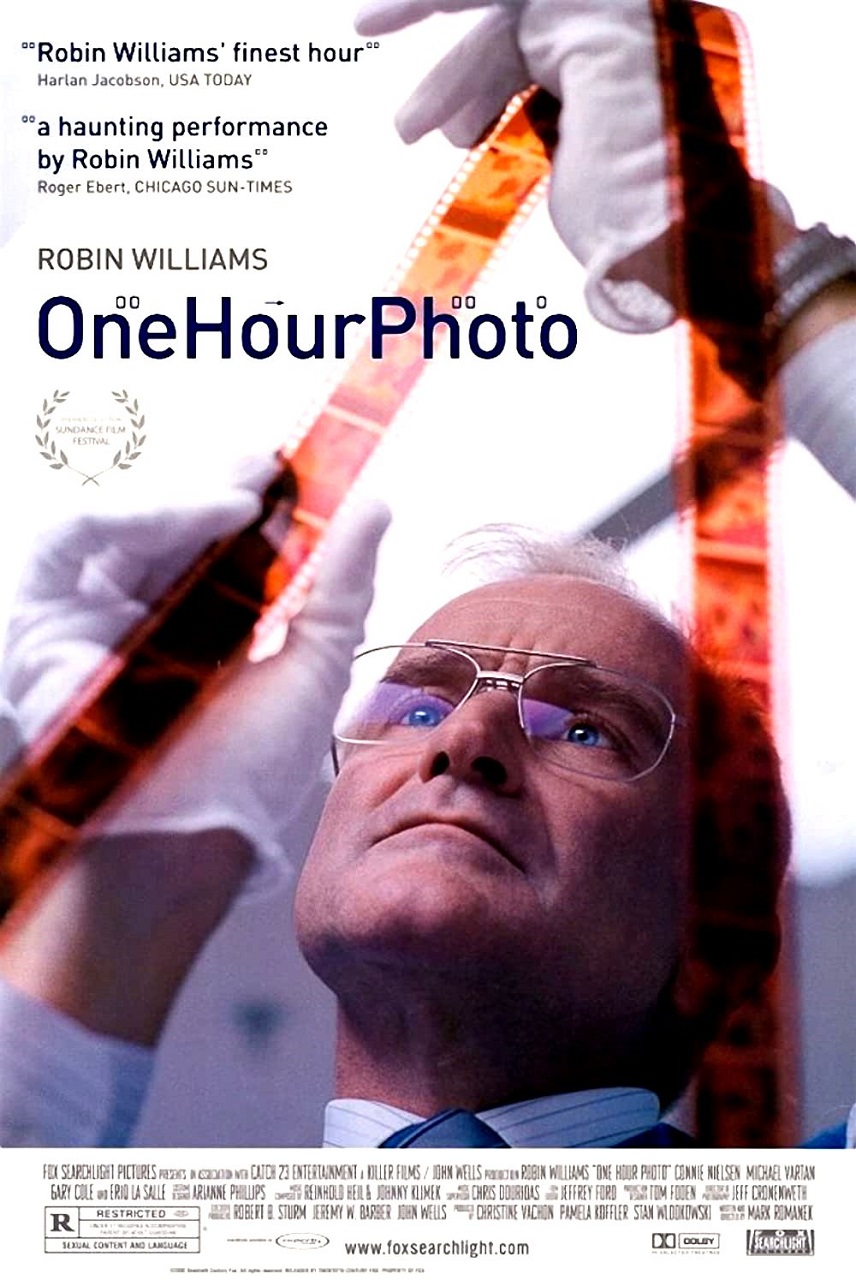
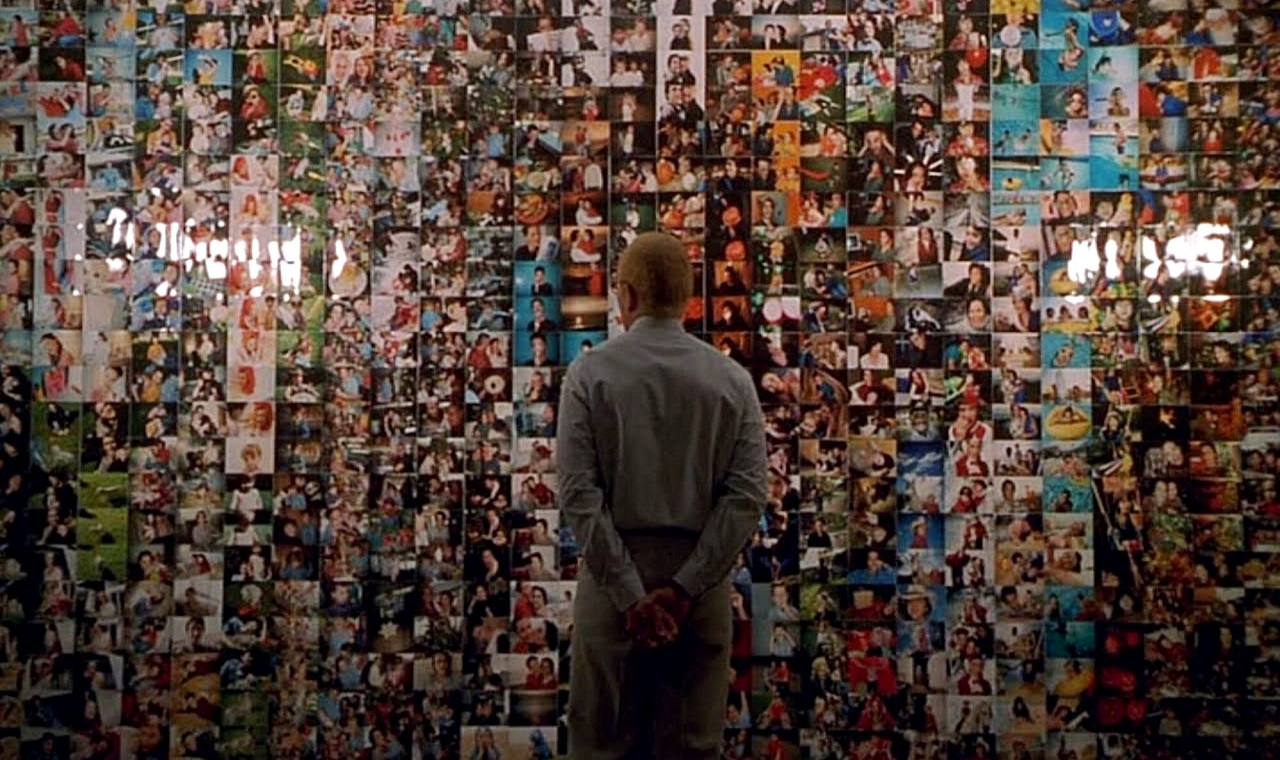
Seymour ‘Sy’ Parrish, the technician in the one-hour photo booth in Savmart, takes great pride in his job, but has no family or social life outside of that. Instead he is obsessed with the Yorkin family, husband and wife Will and Nina and their young son Jake, who bring the family photos in to be developed. He secretly makes copies of the photos and has built an entire wall in his apartment centred around their life and even tells others that they are his family. When another customer, Maya Burson, drops photos off to be developed, Sy discovers that Will is having an affair with her. When Sy is fired from his job for printing excess copies, his obsession with the Yorkins becomes dangerous and he determines to punish Will.
Robin Williams used to be a wild and crazy guy. Every time you saw him interviewed, he was like a manic multiple-personality disorder sufferer, firing off a machine-gun like battery of one-liners and impersonations. That kind of infectious zaniness was more than ably communicated on screen in films like Good Morning Vietnam (1987), Dead Poet’s Society (1989) and The Fisher King (1991). But then – about the time that Williams started having kids – he demonstrated an appalling penchant for the most woolly-headed mush. As the 1990s dragged on, it was something that seemed to know depths with Williams signing onto the increasingly more nauseating likes of Hook (1991), Mrs Doubtfire (1993), 9 Months (1995), Jack (1996), Flubber (1997), Jakob the Liar (1998), Patch Adams (1998) and Bicentennial Man (1999). Finally in 2002, the message seemed to get through to Williams that he was losing all credibility and this was the year he started taking roles with a much darker edge with parts such as the vengeful children’s tv host in Death to Smoochy (2002), the game-playing killer in Insomnia (2002), and this.
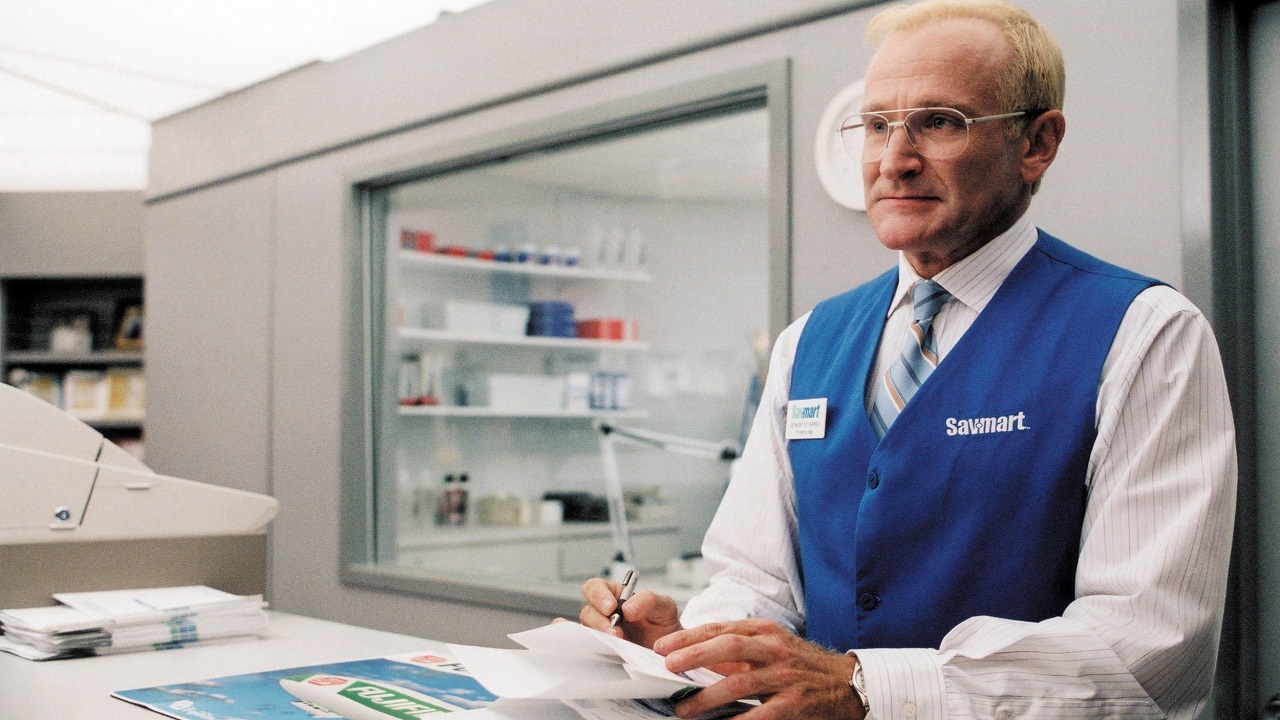
One Hour Photo is a study in stalker obsession. It is an everyday-man-goes-over-the-edge type film akin to the likes of Taxi Driver (1976) and The Fan (1996). Williams is rather well cast here. Director Mark Romanek gives him a blonde hair-dye job but otherwise employs the same gooey, bashful innocence that Williams has affected through most of his mush films – but at the same time pushes the affectation of shy introversion to an extreme. Williams downplays the character and there are times that the mellow wimpiness is downright creepy.
Romanek also does an excellent job in portraying the sheer banality of shopping mall suburbia. Williams is outfitted with neatly pressed polyester pants and shirt that looks like they have been in his wardrobe since the 1970s. The mall is designed as an expanse of white-on-white floors and walls, all neatly stacked with consumer goods, while the soundtrack fills with muzak and elsewhere banal epithets welcoming customers and encouraging staff to smile fill the screen behind characters with looming ominousness. Even at the end when Mark Romanek mimics the final scene of Psycho (1960) with an incarcerated Williams framed behind a window in a cell, the white-on-white scheme of the cell seems like the final triumph of this banal consumerist world.
Mark Romanek uses photographs as a metaphor for people’s lives. As Robin Williams says in the opening narration, photographs are the happiest moments in people’s lives – nobody chooses to photograph unhappy memories. Later he has a nice line of dialogue about how a photo of a forgotten person is a sign that that person once mattered enough for someone to take the photo. Unlike the great Australian film Proof (1991), photos here are not seen as conveyors of unbiased truth, but something that portray a happy illusion. The pictures of the blissfully happy Yorkin family are contrasted with the reality that father Michael Vartan is having an affair; while Gary Cole’s boss is denoted by his perfectly arranged line of family photos, which contrast with the officious authority figure he is in the film. Robin Williams’s character’s life is seen as wholly empty – he is a person who seems to ache throughout to find the significance of it mattering to someone else that they take his photo. In its absence, he clings to the illusion offered by photos, pathetically offering up a picture he buys in a flea market as that of his mother and telling waitress Lee Garlington that the Yorkin family shots are of his own family.
While Mark Romanek does a fine job of entering into Robin Williams’s obsession and in portraying the banality of the world he lives in, he is less effective in making One Hour Photo pay off as a thriller. There is a fine moment where Robin Williams uncovers the photos of the affair and leaks them to Connie Nielsen, a scene subtly denoted by the sudden swerving of the car she is driving to the side of the road. Romanek also throws in unnecessary fantasy sequences with Robin Williams imagining himself inside the Yorkin house and an especially crude dream where he imagines his eyes exploding in blood.
The stalking at the hotel is built up to well, but Romanek inexplicably flubs it at the payoff. He builds up to Robin Williams bursting in on Michael Vartan and Erin Daniels with a big knife. It’s the moment that Williams explodes into psychosis, the point a great deal of the film has been building up towards – only when all that Williams ends up doing, rather than killing anybody, is to make them pose for sex photos, the effect is a washout. Moreover, it is unexplained in terms of the character’s psychology – we never know why Robin Williams wants to take photos of them faking sex – to show Connie Nielsen? for his own gratification?
There are loose ends left hanging – the threat of the photos of Gary Cole’s daughter has sinister effect, but these are forgotten immediately after they are introduced. Equally, the talk about child abuse at the end comes bafflingly left field – we are not sure if it is in reference to Robin Williams’s childhood or not and the scene is too brief to explain anything. (For a moment, it almost manages to make the film suggest something of the classic Peeping Tom [1960]).
Nor is one sure what to make of the finally developed photos that detective Eriq La Salle gives Robin Williams at the very end, which only turn out to be photos of banal pipe fittings and walls – exactly what we are to make of their significance is unclear. Are they meant to represent pictures of the true banality of Williams’s life once all illusion has been removed, or are they of the cell he is about to be sentenced to? It is this petering out of the plot and the uncertainty in being able to make it come together as a thriller that mars an otherwise excellent build-up.
Though largely a specialist in music video, director/writer Mark Romanek had earlier made the very strange Static (1986) about a man who invents a tv set that he claims can show Heaven, although this is not a genre film. He subsequently made the excellent Never Let Me Go (2010) set in a future where people are cultivated to be harvested for their organs, while he also produced the SF tv series Tales from the Loop (2020).
(Nominee for Best Original Screenplay and Best Actor (Robin Williams) at this site’s Best of 2002 Awards).