

(Pafekuto Buru)
Japan. 1997.
Crew
Director – Satoshi Kon, Screenplay – Sadayuki Murai, Based on Character Design by Hisashi Eguchi, Based on the Novel by Yoshikazu Takeuchi, Producers – Hiroaki Inoue & Masao Maruyama, Planning – Koichi Okamoto & Yoshikazu Takeuchi, Photography – Hisao Shirai, Music – Masahiro Ikumi, Animation Director/Character Design – Hideki Hamazu, Production Design – Mitsusuke Hayakawa, Special Advisor – Katsuhiro Otomo. Production Company – Mad House/Oniro.
Plot
Mima Kirigoe takes the risky move of quitting the girl pop trio Cham to pursue an acting career with a part in a tv detective series. However, the part only proves to be a minor one and Mima is forced to accept playing rape scenes and appearing in a nude magazine layout to sustain her career, while her two former compatriots take Cham on to great success. At the same time, Mima is disturbed to find every detail of her life is being reported as a faked diary on a website. As her spirits sink, Mima finds herself haunted by a doppelganger that taunts her with what her life could have been if she had not chosen this path.
The name of Katsuhiro Otomo casts a giant shadow over anime. Katsuhiro Otomo directed Akira (1988) which, with its epic-sized vistas of mass destruction, succeeded in becoming a huge cult hit and launching Western audiences’ appetite for anime. It also made Katsuhiro Otomo, for a time, the only anime name that was recognisable to Westerners. The attachment of Otomo’s name to any project subsequently was enough to carry it to the West.
Although, what may have escaped notice of those who flocked to the Katsuhiro Otomo name, is that for a decade-and-a-half, Otomo only directed one film other than Akira – the live-action World Apartment Horror (1991) – which seems incredible considering the size of the shadow Otomo casts over anime. Otomo did eventually return to anime with Steamboy (2004) and the subsequent live-action Bugmaster (2006) and the Combustible episode of the anime anthology Short Peace (2013). During the sixteen years interim, he directed a segment of Memories (1995) but the greatest Otomo successes – Roujin Z (1991), Memories, Spriggan (1998), Metropolis (2001) and this – ironically were works that waved Otomo’s name above them but little else. Here Otomo’s credit remains the nebulous title of ‘Special Adviser’, which nevertheless was enough for Perfect Blue to be promoted as a Katsuhiro Otomo film.
Perfect Blue turns away from the usual thematic territory for a Katsuhiro Otomo-associated film – Cyberpunk futures and epic-vistas of mass destruction – and is, in fact, a psycho-thriller. The film starts in well – there is a marvellously spooky moment where the heroine, after some amusingly comic moments trying to learn how to use a computer, accesses a blog only to discover the minutiae of her day is being reported in elaborate detail in a series of faked diary entries written as though by her. The story all-too-believably details the fall of an idoru (Japanese pop star) who takes an artistic risk in becoming an actress, fails to succeed as expected and is gradually forced into filming gratuitous rape scenes and modelling nude in order to sustain herself, all the while seeing her former partners prospering. In these scenes, the film manages to convey a portrait of the downfall of a fragile innocent with considerable conviction.
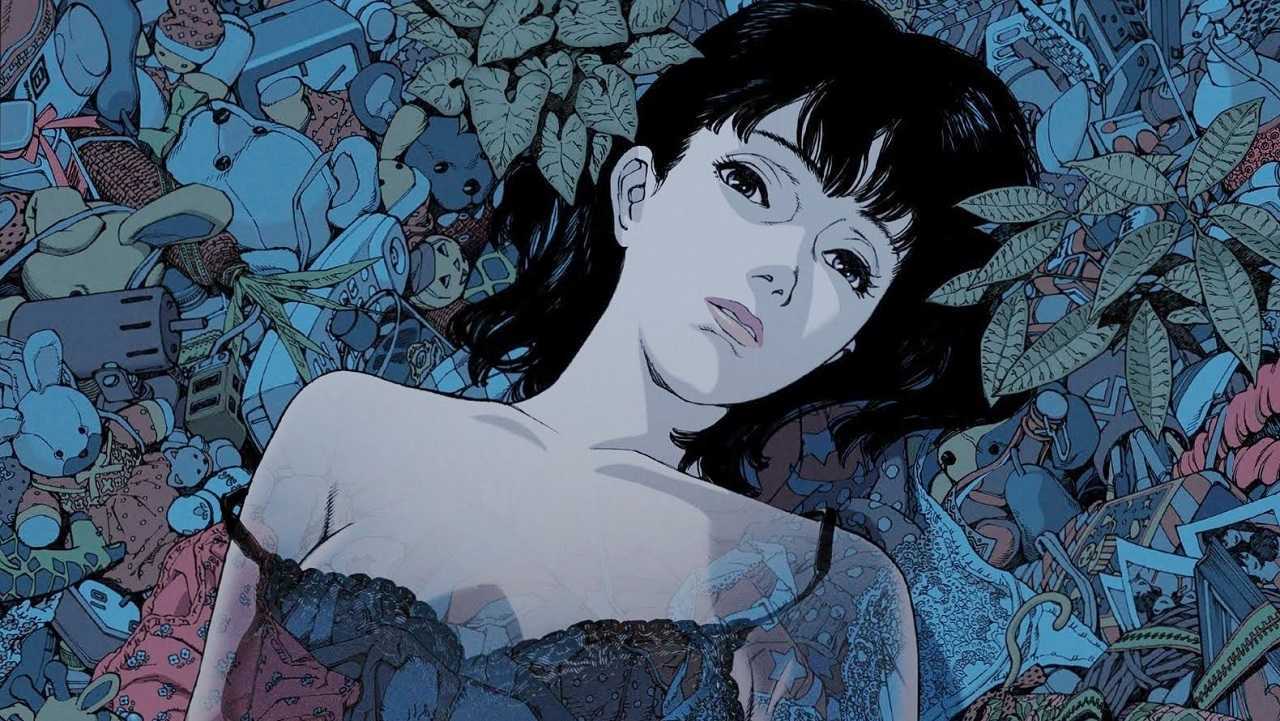
Unfortunately, about halfway through, Perfect Blue becomes somewhat incoherent with the plot becoming a tangle of strands involving the heroine having to deal with her internet stalker; being haunted by a taunting doppelganger who claims to be her alternate self had she stayed with the group and gone on to success; as well as someone assassinating the people around her. When the film then starts to get into her having memory blackouts and missing days and then scenes in the tv show starting to mirror events in her life, it becomes difficult to follow what is meant to be going on.
The film then momentarily pulls back and, in a plotting twist of dazzling ingenuity, suggests that the role of the actress is a split personality created by the heroine to deal with the stress of being a pop star, that the doppelganger is her real self emerging through and that the tv show is a projection of the repressed memories of an abusive childhood. It is a moment of crystalline clarity during which all of the hanging confusions up to that point suddenly make perfect sense.
Oddly enough, the film backs away from this and continues on to an ending where the doppelganger and assassinations are mundanely revealed to be the mere machinations of one of the heroine’s friends. It is a puzzling denouement that holds explanations that are actually less convincing than the ones offered by the multiple-personality disorder twist.
Perfect Blue was also the directorial debut of Satoshi Kon. Satoshi Kon had previously written Katsuhiro Otomo’s World Apartment Horror and an episode of Memories. After making his feature-length debut here, Satoshi Kon subsequently went onto become a promising name in anime with other films like Millennium Actress (2001), Tokyo Godfathers (2003) and Paprika (2006).
The film later underwent a live-action remake with Perfect Blue (2002).
Trailer here