
Crew
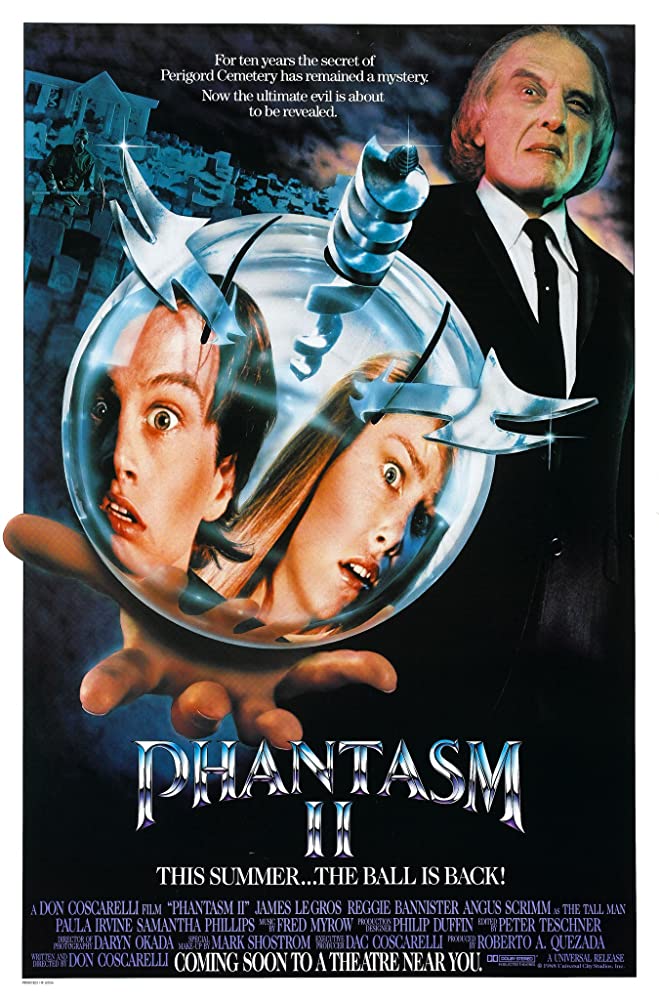
Director/Screenplay – Don Coscarelli, Producer – Roberto A. Quezeda, Photography – Daryn Okada, Music – Fred Myrow & Christopher L. Stone, Visual Effects – Dream Quest (Supervisor – Justin Klarenbeck), Laser Effects – Carl Hannigan, Special Effects Supervisor – Wayne Beauchamp, Sphere Design – Steve Patino, Wire Effects – Robert McCarthy, Makeup Effects Supervisor – Mark Shostrom, Production Design – Philip J.C. Duffin. Production Company – Spacegate Corporation.
Cast
James Le Gros (Mike Pearson), Reggie Bannister (Reggie), Paula Irvine (Elizabeth Reynolds), Angus Scrimm (The Tall Man), Samantha Phillips (Alchemy), Kenneth Tigar (Father Meyers)
Plot
Mike Pearson is released after seven years in a psychiatric institution when he finally agrees that his stories about The Tall Man were all a delusion. Once out, Mike immediately teams up with his old friend Reggie and they set out on a quest to find and stop The Tall Man. The quest leads them on a trail of small towns across the country whose graveyards The Tall Man has robbed. Having to deal with the traps left by The Tall Man, they head towards a precognitive meeting with the girl in Mike’s dreams.
Many at the time were quick to accuse Phantasm II, Don Coscarelli’s sequel to his cult hit Phantasm/The Never Dead (1979), of simply offering the same but with more spheres and a better makeup budget. However, that is a considerable underestimation. Phantasm II is one of the few sequels that extends and goes beyond the original into genuinely original territory.
For at least about a third of the film, Don Coscarelli turns Phantasm II into a haunting quest – with James Le Gros and Reggie Bannister heading through small backwaters towns in the still of night, towns that have been left desolate after being robbed of their dead. “Small towns are like people,” James Le Gros hauntingly comments, “some get old and die, some get murdered.” These scenes are filled with all manner of eerie blurrings between dream and reality or taunting traps and illusions – ‘calling cards’ – left for them by the Tall Man in candle-lit mausoleums, and the sense of heading towards a destined meeting with Paula Irvine.
The constant ambience of candlelit lighting and ominous music creates a film that seems to hover in a twilight zone between the real world and the unworldly. Nothing in the film though is more startling than Coscarelli’s eerie blurrings between dream and reality – where Mike’s dreams continually keep turning real. There is a much more sustained sense of mood in these scenes than in the original, which merely based itself in eruptions of the surreal.
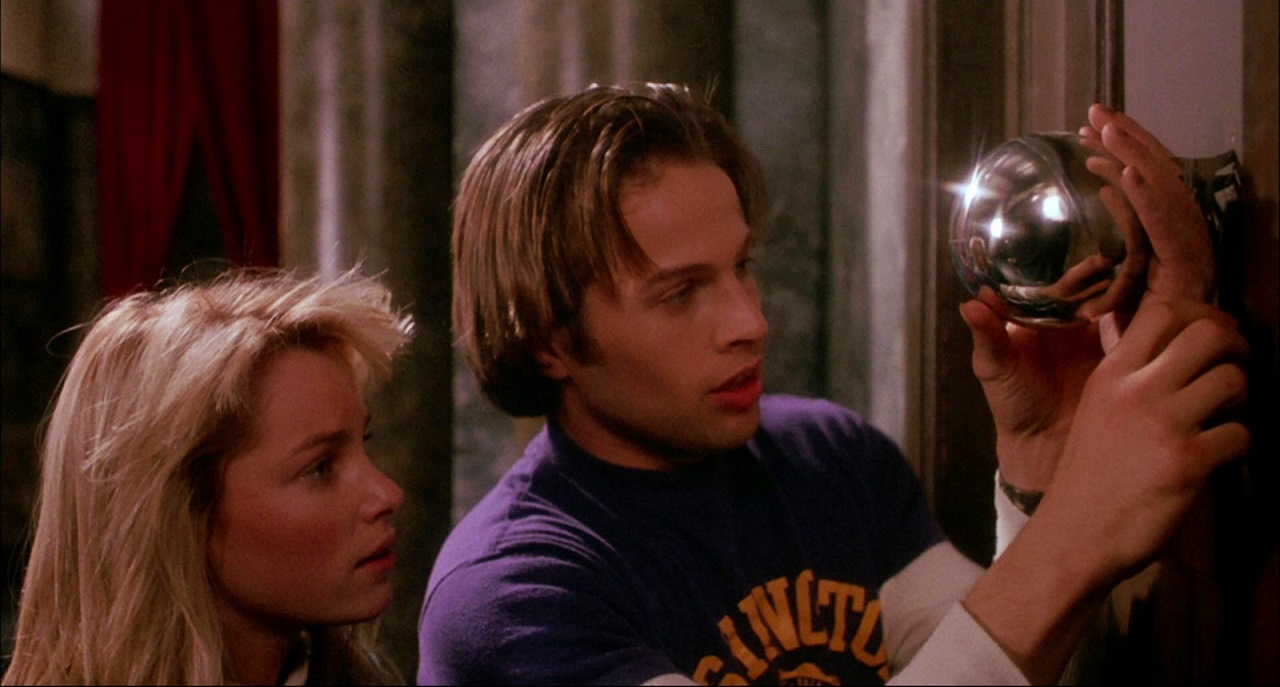
Unfortunately, in the latter third of the film, Don Coscarelli gives in and the film becomes exactly what one would expect of a Phantasm II with a series of effects-heavy set-pieces with silver balls drilling their way through people’s bodies, chainsaw duels, journeys into the other dimension and so on. This has a certain tongue-in-cheek amusement but disappoints on all the eerie and moody build-up. The opening of the film makes sense of the last shot of the first film but the attempt to create another similar twist at the end destroys the careful sense of dream logic that has been painstakingly built up.
The credits contain an amusing throwaway gag: “This motion picture is protected under the laws of the United States and other countries. Unauthorized duplication, distribution and exhibition may result in civil liability, criminal prosecution and the wrath of the Tall Man.”
The other Phantasm films are Phantasm/The Never Dead (1979), Phantasm III/Phantasm: Lord of the Dead (1994), Phantasm: OblIVion (1998) and Phantasm: Ravager (2016).
Trailer here