


Crew
Director/Screenplay – Peter Weir, Producer – Matt Carroll, Photography – David Sanderson, Music – Gerry Tolland, Additional Music – Rory O’Donoghue & Static, Production Design – Wendy Weir. Production Company – South Australian Film Corporation/Channel Nine/Australian Film Commission/Salt Pan Films Pty Ltd.
Cast
Judy Morris (Jill Cowper), Ivor Kants (Max), Robert Coleby (Dr Brian Cowper), Candy Raymond (Meg), Beverley Roberts (Dr Japari)
Plot
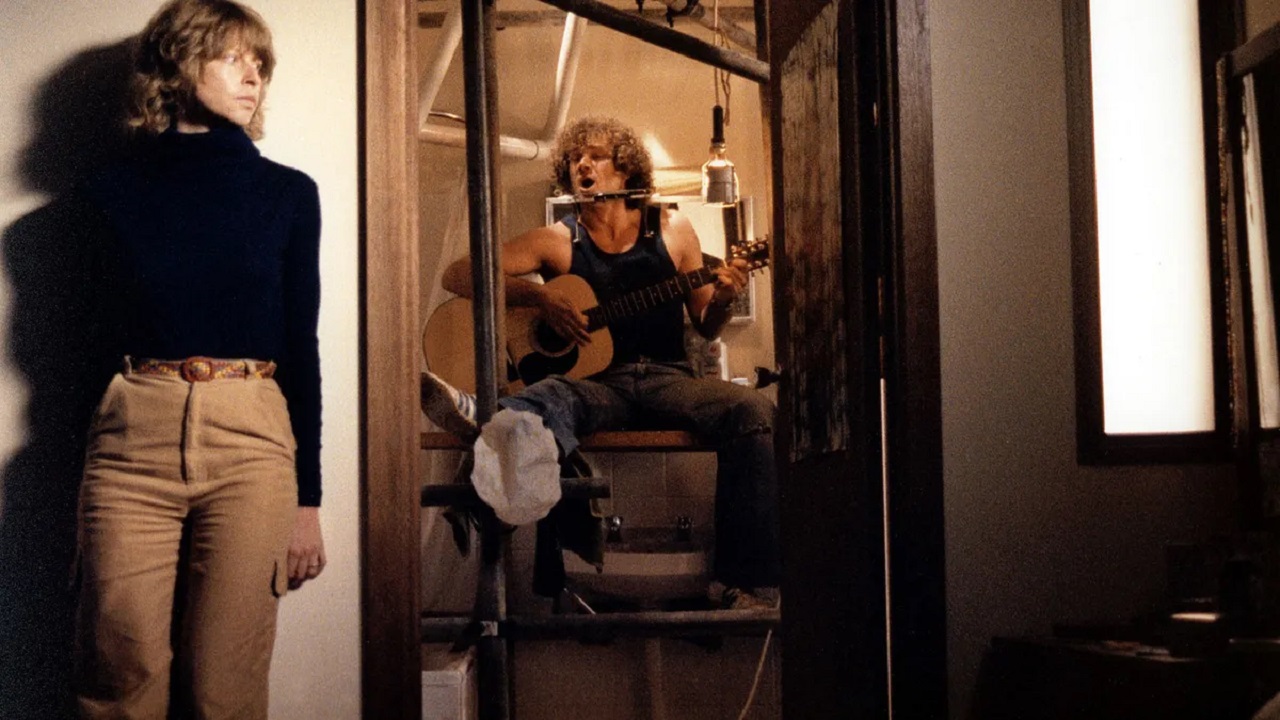
Jill Cowper is a cultural anthropologist and her husband Brian a medical lecturer who have recently moved into a university apartment in Adelaide, South Australia. Jill is interrupted by the arrival of Max, the apartment block’s plumber who says he has come to fix the pipes in the bathroom, despite their not having reported anything wrong with them. What Max initially claims is a half-hour job soon turns into one that takes days, with Max tearing up the bathroom and turning it into a maze of piping. Jill also finds something sinisterly threatening about the increasing liberties that Max takes, including having showers and playing guitar in the bathroom, and his claims to have been in jail. However, when she voices these fears to the people around her, they dismiss it as her imagining things.
The Plumber was one of the early films from Australian director Peter Weir. Weir has of course gone onto acclaimed international hits such as The Year of Living Dangerously (1983), Witness (1985), Dead Poet’s Society (1989), Green Card (1990), The Truman Show (1998) and Master and Commander: The Far Side of the World (2003). Peter Weir is covered several times on this site for the early films that he made in Australia, which are much more eccentric and offbeat than his later mainstream fare. These include the very strange The Cars That Ate Paris (1974) about a town that survives by causing and cannibalising car wrecks; the highly acclaimed The Picnic at Hanging Rock (1975) about the unexplained disappearance of a group of schoolgirls; and The Last Wave (1977), which concerns an apocalyptic Aboriginal prophecy.
During this time, Peter Weir also made The Plumber for the Australian Channel 9 tv station, although it has also had a cinematic release in other parts of the world. After these four films, Weir made the much more mainstream Gallipoli (1981), which skyrocketed him to international success.
One of the recurrent themes of Peter Weir’s work is the meeting between different cultures – the intrusion of the Aboriginal and the primitive past into the present in The Picnic at Hanging Rock and The Last Wave; the meeting between city cop and Amish in Witness; Harrison Ford trying to survive in the Amazonian jungle in The Mosquito Coast (1986) – or stories of characters coming to a sudden conceptual awakening about the world around – the schoolboys being transformed by the inspirational figure of Robin Williams’s teacher in Dead Poet’s Society; Jeff Bridges’ life awakening after surviving a plane crash in Fearless (1993); or Jim Carrey’s growing realisation that his entire life has been staged as a reality tv series in The Truman Show.
In many of Weir’s early Australian films, there is the haunting sense of the primitive past hanging over the modern world as something that is completely alien – in the opening scene here, Judy Morris narrates a story about a frenzied New Guinean tribesman entering her tent when she was in Bougainvillea and she having to remain perfectly still, which in turn becomes an echo of the meeting of the alien (urban) cultures that plays throughout the rest of The Plumber.
The Plumber was apparently based on a real-life incident that happened to friends of Weir’s living in London. In many regards, The Plumber is a film about social boundaries. About how people can be too polite to say no and then before they know it, someone who does not recognise the same boundaries they do has trodden over the limits of politeness into the intrusive. In some places, The Plumber was reviewed as a horror film but more than anything it feels like the surreal escalations of one of Eugene Ionescu’s absurdist plays. Certainly, the character of Ivor Kants’ plumber is not unakin to the locals in Straw Dogs (1971) or David Hess and cohorts in Wes Craven’s The Last House on the Left (1972) where in both cases a group of uncouth people invade and turn upside the home and safety of a middle-class family.
However, Weir’s interest lies in showing the conflict between Judy Morris and Ivor Kants as one of two entirely different cultures. Contrast is made between the two opposing worlds – Judy Morris and her husband Robert Coleby and their polite and refined but stultifyingly dull world of academia; against Ivor Kants who is portrayed as easygoing, blokeish and with a sexually attractive charisma. She instinctively corrects his pronunciation and then apologises for doing so, while he is derisive of her academic upbringing and the posh college she went to. There is even contrast made between Ivor Kants’ populist folk and pop music and Judy Morris listening to the dull narration of her academic recordings.
The Plumber is also very much a film about how the two classes perceive one another – with Judy Morris worrying about Kants’ criminal past and her automatic reaction being to hide the expensive watch her husband gave her. You are not entirely sure if her suspicions are warranted as friends and even her own husband see her as neurotic and possibly imagining of all the intrusion. On the other hand, Weir doesn’t exactly portray Ivor Kants as undeserving of Judy Morris’s suspicions – he is seen as a sinister threat, deliberately waiting for the husband in the car park, admitting to having watched Morris at her party, and at one point forcing his way in through the roof after she ignores his knock at the door. The film sits in a deliberate place of ambiguity, pitting the two against one another across the class divide, but with Weir not making the line between either black or white. The resolution that the film comes to, while perhaps not fully satisfactory for this Ionescu-type story, involves Judy Morris stepping over social boundaries (and buying into her own suspicions) to plant evidence that then has Kants arrested.