
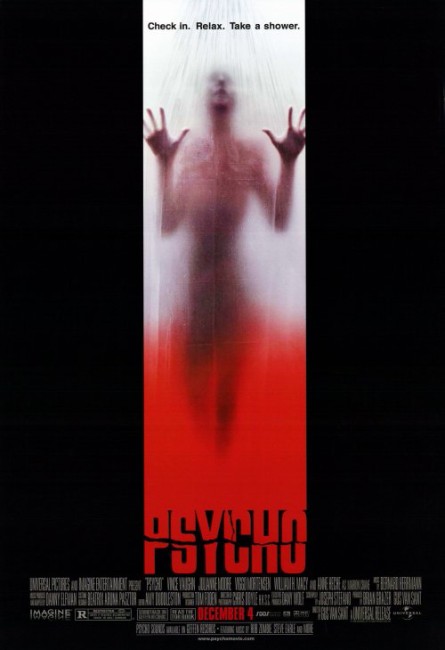
Crew
Director – Gus Van Sant, Screenplay – Joseph Stefano, Based on the Novel Psycho (1959) by Robert Bloch, Producers – Gus Van Sant & Brian Grazer, Photography – Christopher Doyle, Music – Bernard Herrmann, Music Adaptation – Steve Balik & Danny Elfman, Visual Effects – Illusion Arts (Supervisors – Syd Dutton & Bill Taylor), Special Effects – Erick Brennan, Makeup Effects – Matthew Mungle, Production Design – Tom Foden. Production Company – Universal/Imagine Entertainment.
Cast
Vince Vaughn (Norman Bates), Anne Heche (Marion Crane), William H. Macy (Milton Arbogast), Julianne Moore (Lila Crane), Viggo Mortensen (Sam Loomis)
Plot
On an impulse, secretary Marion Crane flees Phoenix City with $400,000 of a client’s money she has been entrusted with, intending to use it to pay off her boyfriend Sam Loomis’s debts so they can be free to marry. On her flight, she stops at a backroads California motel. There she is stabbed to death while showering by motel owner Norman Bates’s mother. Loomis, Marion’s sister and a private detective come investigating her disappearance. They discover that Mrs Bates is in fact dead and only exists as a split personality in Norman’s mind where he is psychologically driven to dress as her and kill that which sexually arouses him.
Over Gus Van Sant’s remake of Alfred Hitchcock’s Psycho (1960) there hangs, like a neon sign in the sky, the single question “Why?” It is the ultimate postmodern conceit – the shot-for-shot remake of a classic film. Even down to the use of the same script, the same musical score and the director making a cameo in exactly the same scene that Alfred Hitchcock did in the original. Psycho 1998 is surely the ultimate fin du siecle celebration of the view that all originality is dead and that all creativity is left with anymore is the endless quoting and reshuffling of the past.
Psycho 1998 seems constructed as a vanity exercise, a conceit – the same way that commercials quote and parody scenes from films or people construct three-dimensional dioramas of classic works of art – one that seems to have been made more to see if it could be done than to serve any real purpose. For what point can a film that admits the original cannot be bettered so much so that it can only copy it shot for shot possibly serve – it is a work that has openly and loudly cheered the unsurpassable superiority of the original even before it has opened?
Needless to say, Psycho 1998 earned itself a thorough hammering even before a single commentator had seen a frame of it for its daring to desecrate a classic – some online film sites even called for a boycott. Indeed, the more one looks at the thinking that has motivated the remake, the more there seems to be an overwhelming a sense of pointlessness to it. It panders to a lowest common denominator in an audience – the film’s sole commercial hopes lay in the belief that modern 16-25 year old audiences are too lazy to watch a film that is made in black-and-white or without contemporary stars. Yet the irony of it is that the niche audience it is aimed at that I spoke to found the exercise slow-paced and tedious, they being too familiar with the modern psycho-thriller conventions that the original Psycho created to find much originality or novelty to it.
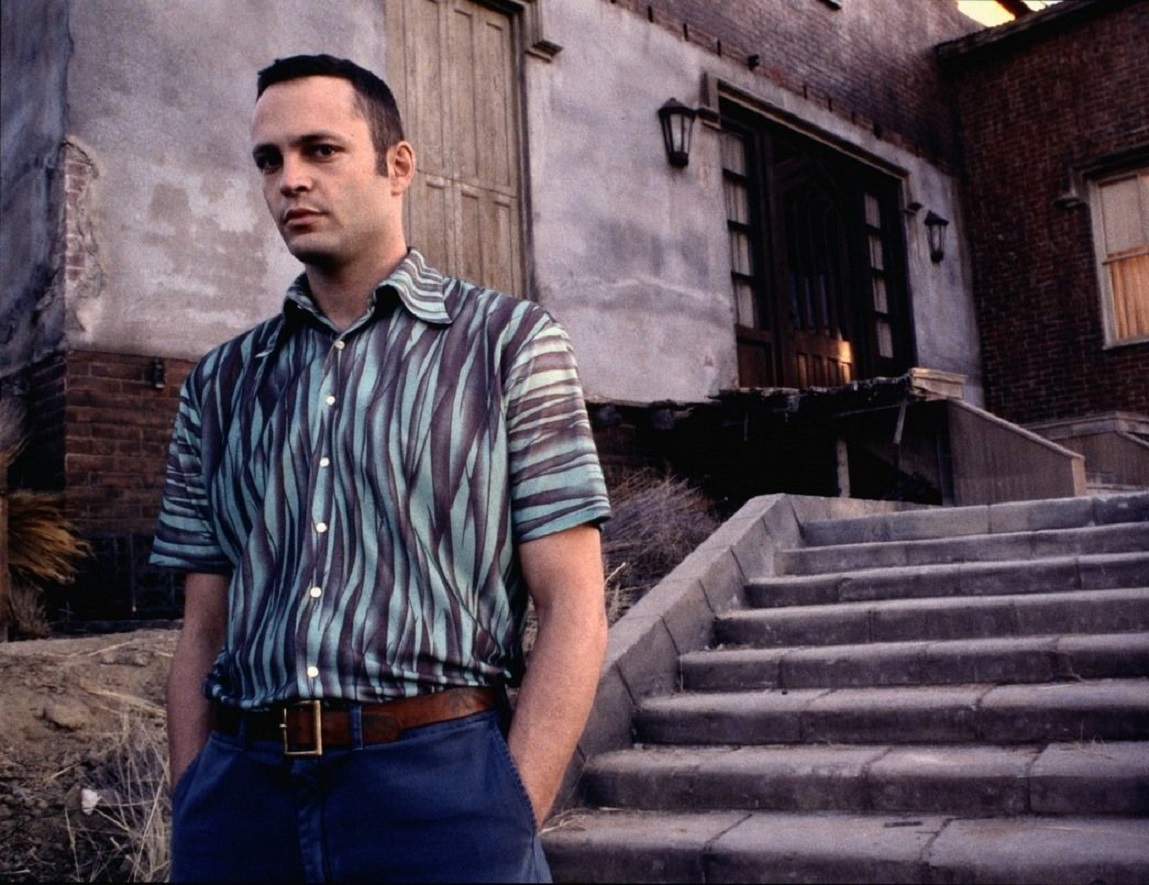
Gus Van Sant has made some fine commercial films – To Die For (1995) and Good Will Hunting (1997) and critically acclaimed hits like Milk (2008) – but also balances these with films that are made with an eccentricity that seems to wilfully challenge an audience’s patience – the likes of My Own Private Idaho (1991) and the universally reviled Even Cowgirls Get the Blues (1993). The latter two were more of a challenge than most audiences and reviewers were prepared to tolerate and it seems that with Psycho, Gus Van Sant allowed his penchant for eccentricity to bite off more than he can chew.
In its favour, Psycho 1998 is never as ghastly a desecration of the original that other films like the campy King Kong (1976) or The Haunting (1999) remakes were, or one that messes with the effectiveness of the original in an attempt to be more upbeat like the remakes of The Vanishing (1993) and Diabolique (1996) did. The sense of desecration that exists is more in the conceit that someone has dared to touch one of the classics. Being a shot-for-shot remake, Psycho 1998 closely adheres to the original and cannot help but work in many of the places that the original did.
The remake makes a number of minor changes. The $40,000 that Marion Crane steals is inflation-adjusted to $400,000; Gus Van Sant is free to show more graphic blood-letting during the shower scene; and now a spider that crawls out of the mouth of the mummified remains of Mrs Bates.
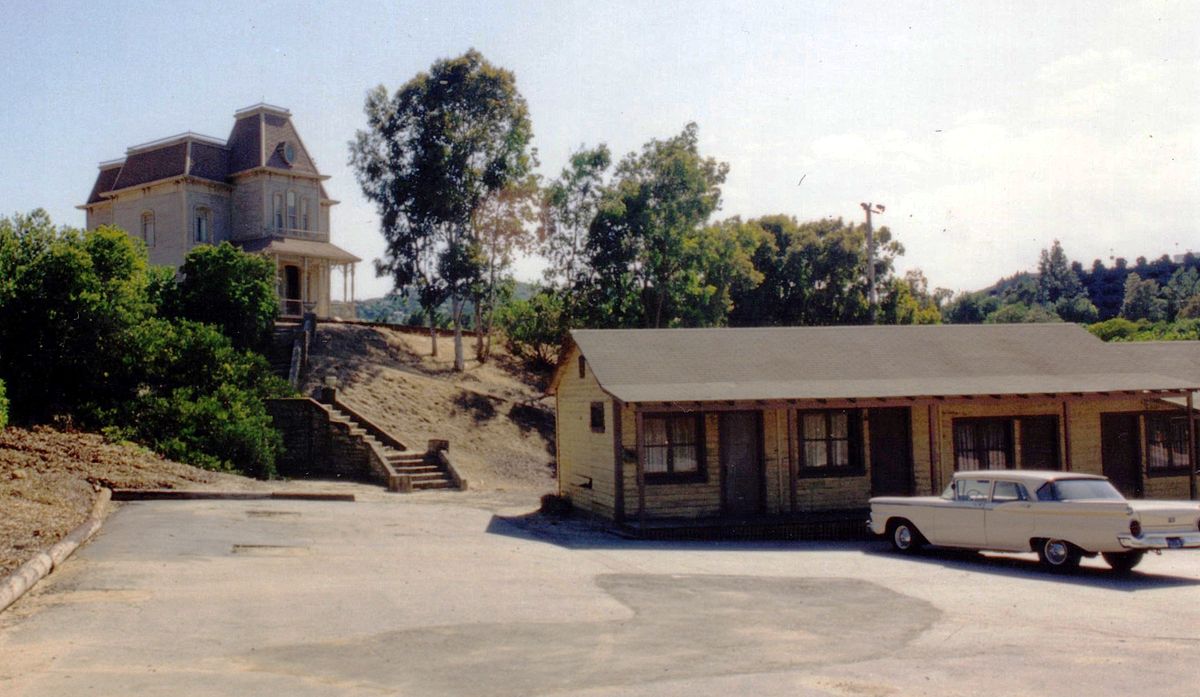
However, the addition of colour works against the film. It bleeds out the stark, atmospheric effectiveness the original had. The depiction of ordinary Arizona desert landscape here lacks any of the same alienating effectiveness that the black-and-white photography lent to the original. Similarly, the black-and-white made Alfred Hitchcock’s low angle shots up on Norman Bates framed by his stuffed birds seem to eerily foreshadow something sinister but the colour robs the shots of any atmosphere. Without black-and-white, the Bates house up on the hill behind the motel loses its looming, foreboding Gothic ominousness.
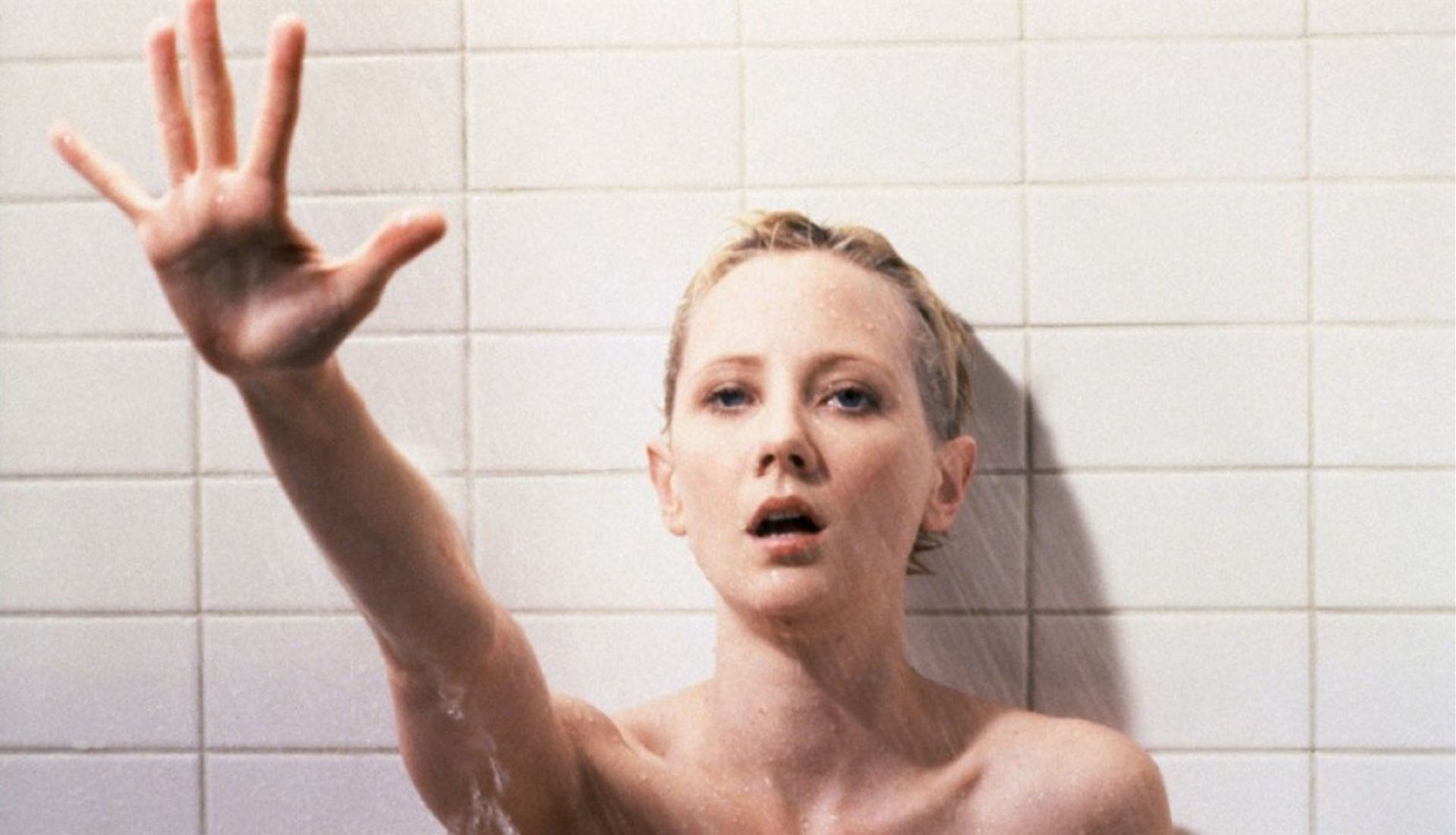
The most radical changes Gus Van Sant makes are to bring out something much more overtly sexual in the material. We get a brief side glimpse of Anne Heche’s breast as she undresses for the shower and a brief labial shot as she keels over dead. There are sounds of panting from neighbouring rooms during the motel room tryst between Marion and Loomis that opens the film; the client whose money Marion steals is more overtly flirtatious with her; the visit to Norman’s room shows a stash of pornography. The most radical affront to purists is Gus Van Sant’s having Norman clearly heard to be masturbating as he peeps at Marion undressing in the shower.
The film’s publicity proudly quotes Alfred Hitchcock’s daughter saying that remaking a film shot for shot is exactly something her father would do. (She seems unaware of the fact that Hitchcock did remake one of his own films – The Man Who Knew Too Much (1934) as The Man Who Knew Too Much (1956) – although not shot-for-shot). One thing Hitchcock would never have done though is cast Anne Heche. The petite and anorexically thin Anne Heche is far from a Hitchcock woman – Hitchcock preferred well-rounded women, usually frosted blondes – Kim Novak, Tippi Hedren, Janet Leigh. You know exactly what Norman means here in his line when he says that Marion “eats like a bird”. It could be a line coined to describe Anne Heche’s performance – she seems all twitchy, nervous energy. While she conveys that part well, there seems to be almost nothing else to the character.
However, she is far better than Vince Vaughn’s Norman Bates. Alas for Vaughn, Anthony Perkins was Norman Bates. It was a piece of casting that was a truly harmonious marriage of actor and the role at hand. Anthony Perkins’ nervous and twitchy, shy boy next door quality became so completely Norman that it ended up typecasting him for the rest of his career. While Vince Vaughn can be a good actor, what you end up watching here is his handsome good looks made down to an unnaturally pasty pallor and him merely imitating Anthony Perkins’s shy twitchiness. It is like watching an impressionist imitate another actor. He maintains a certain twitch and a smile but it is an affectation more than it is a performance.
Far better are some of the supporting performances. William H. Macy makes for a surprisingly good Arbogast. Macy has developed a tendency toward laidback characters that seem as though they are genially ineffectual nuclear family patriarchs caught in a time warp from the 1950s mouthing boy scout euphemisms. He and Gus Van Sant do a good job of working with Macy’s amiable, ineffectual persona while showing a sharp intelligence hidden beneath the surface. Also extremely good is Viggo Mortensen – one of the most underrated actors of the 1990s before his breakout in the 00s – who makes Sam Loomis a solid, earthy smalltown working man.
Gus Van Sant would later return to the psycho genre with the interesting Elephant (2003) about a high-school shooting and Restless (2011), a love story between a terminal cancer patient and a boy with the ghost of a WWII kamikaze pilot as companion.
Elsewhere in the Psycho franchise, there were three sequels – Psycho II (1983), Psycho III (1986) and the cable movie Psycho IV: The Beginning (1990). Bates Motel (1987) was a tv pilot for a never-sold anthology series starring Bud Cort as someone who inherits the Bates Motel after Norman’s death. There is also the tv series Bates Motel (2013-7) starring Freddie Highmore, a modernised version that tells the story of Norman Bates’s childhood. Hitchcock (2012) is a drama about Alfred Hitchcock and the making of the original.
(Nominee for Best Supporting Actor (William H. Macy) at this site’s Best of 1998 Awards).
Trailer here