
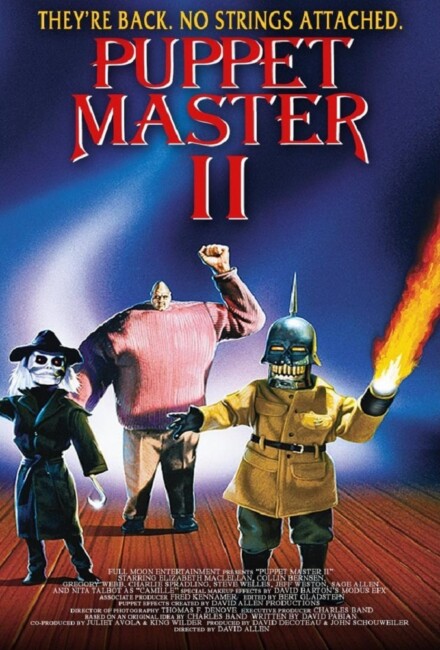
USA. 1990.
Crew
Director – David Allen, Screenplay – David Pabian, Story – Charles Band, Producers – David DeCouteau & John Schouweiler, Photography – Thomas F. Denove, Music’– Richard Band, Stop Motion Animation – Randy Cook & Justin Kohn, Puppet Effects’– David Allen Productions, Additional Creature Effects – Steve Neill, Makeup Effects – David Barton’s Modus EFX (Supervisor – David Barton), Production Design – Kath’leen Coates. Production Company – Full Moon Entertainment.
Cast
Elizabeth MacLellan (Carolyn Bramwell/Elsa), Steven Welles (Andre Toulon/Enrique Chenee), Collin Bernsen (Michael Kenney), Nita Talbot (Camille Kenney), Gregory Webb (Patrick Bramwell), Charlie Spradling (Wanda), Sage Allen (Martha), Jeff Weston (Lance)
Plot
A group of parapsychologists led by Carolyn Bramwell move into the hotel at Bodega Bay to investigate the reports of the living dolls there. The puppets soon emerge and begin killing the members of the group. The elderly Enrique Chenee, who claims to be the owner of the hotel, turns up, his face hidden behind bandages and dark glasses. Chenee is really the puppetmaster Andre Toulon, whose body has been dug up and revived by the puppets. Toulon believes Carolyn to be the reincarnation of his late wife Elsa and prepares to conduct a ceremony that will transfer their souls into life-size mannequins so that they can be together again.
This is the first of ten sequels that father and son producing team Albert and Charles Band and their Full Moon production company managed to squeeze out of Puppetmaster (1989). The first film had been an unexpected hit on video shelves and so they quickly placed a sequel into production.
The principal novelty of Puppetmaster was in seeing the unusual puppets skulking around and killing people in novel ways. The film had no real plot beyond that. Certainly, the slimness of the initial idea becomes steadily more apparent in the attempt to spin the initial premise out into a series – Puppet Master II has to add new puppets, as well as pad out the slender clues given in the film as to their creator and his origins (something that became a substantial part of the subsequent sequels).
Puppet Master II is a routine sequel as sequels go. The plot is a rehash of the first film – another group of paranormal investigators, including a flaky psychic among their number, investigate goings on at the Bodega Bay hotel and become fodder for the puppets who are being used by someone wanting to magically restore themselves to life.
Puppet Master II is directed by long-time Band special effects contributor David Allen, who created the puppet effects for the first Puppetmaster and had been involved on other Band-produced films since 1977, including having created the fabulous Transformer effects in Robot Jox (1990). Allen had earlier directed a segment of the Bands’ The Dungeonmaster (1984). His only full-length outing as a director the legendary Band-produced stop-motion project The Primevals (2023), something he began in 1968 and spent an incredible 57 years in production, not being released until twenty years after Allen’s death in 1999.
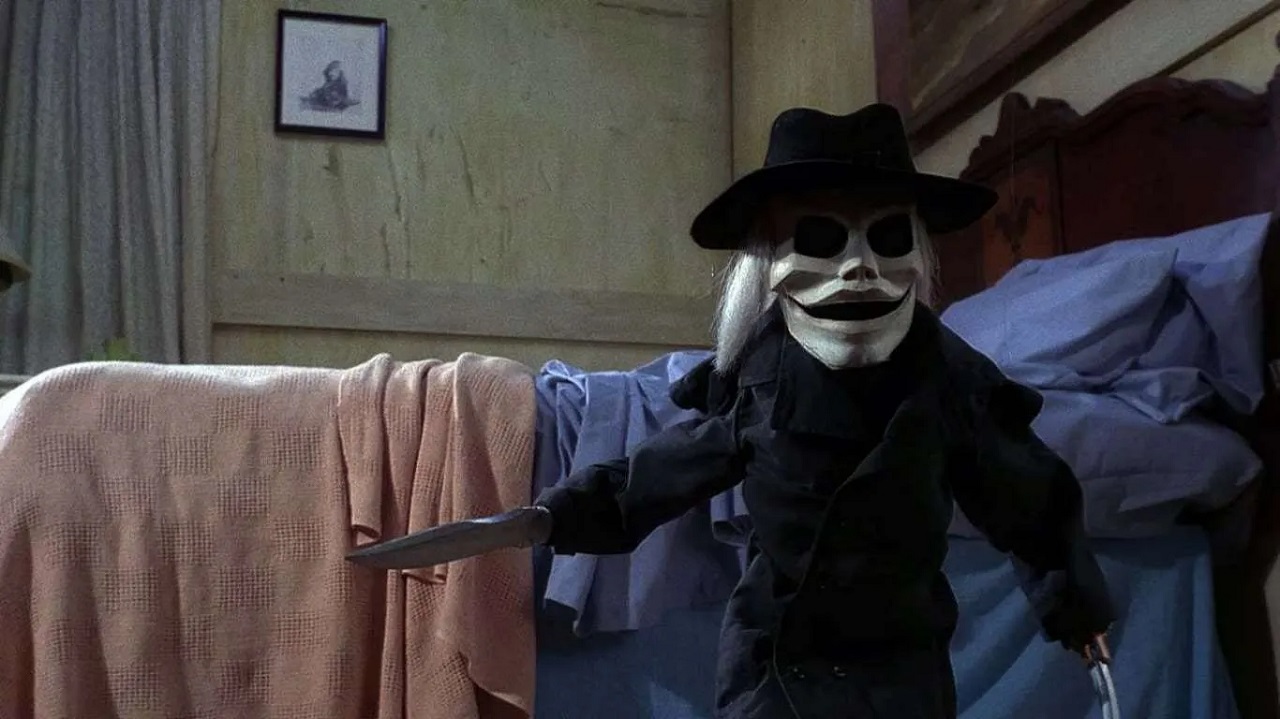
Here however Allen seems to lack what it takes as a director – the puppet scenes lack the outré weirdness they had in the first film and are routine. The latter half of the film is more interesting. Here the script attempts to pump something into the Toulon story. The image of Steven Welles wandering about the hotel in bandages, black fedora and dark goggles is a resonant one that echoes classic films like The Invisible Man (1933) and Mad Love (1935). The film becomes slightly more interesting at its ending – with the image of Steven Welles slashing his own throat into a funnel that runs down into the mouth of his life-size puppet in order to incarnate himself in the puppet’s body; and the fadeout on Nita Talbot driving off with the puppets to a children’s asylum where they will be able to slot in without being noticed.
The cast are not up to much – Elizabeth McLellan fails to convince that she is the leader of a team of parapsychologists. Collin Bernsen, brother of better-known Corbin, fails to convey much in the way of expression. The best player is actually Charlie Spradling, a regular player in the changing Band troupe, mostly known for taking her clothes off in films, who gives a lively and sparkling performance.
The subsequent Puppetmaster films are:– Puppetmaster (1989), Puppetmaster III: Toulon’s Revenge (1991), Puppet Master IV (1993), Puppet Master V: The Final Chapter (1995), Curse of the Puppet Master (1998), Retro Puppetmaster (1999), Puppet Master: The Legacy (2003), Puppet Master vs Demonic Toys (2004), Puppet Master: Axis of Evil (2010), Puppet Master X: Axis Rising (2012), Puppet Master: Axis Termination (2017) and Puppet Master: Doktor Death (2022), as well as the spinoff Blade: The Iron Cross (2020).
Trailer here