

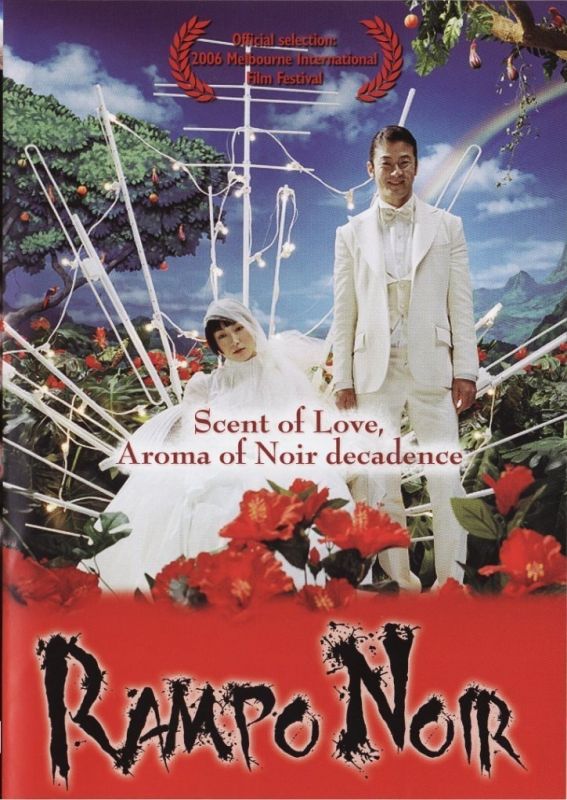
(Rampo Jigoku)
Japan. 2005.
Based on the Novel by Edogawa Rampo, Producer – Dai Miyazaki. Production Company – Micott & Basara/Geneon Entertainment/New Select/Kadokawa Pictures/Toei Channel/Culture Publishers.
Mars’s Canal
Crew: Director/Screenplay/Photography – Suguru Takeuchi, Music – Ryoji Ikeda.
Cast: Tadanobu Asano (Man)
Mirror Hell
Crew: Director – Akio Jissoji, Screenplay – Aiko Satsukawa, Photography – Tsuneari Areyumaki, Music – Jules Massenet.
Cast: Hiroki Narimiya (Toru Itsuki), Tadanobu Asano (Kogoro Akechi), Yuuko Daike, Chisako Hara, Masami Horiuchi, Mikako Ichikawa, Tomoya Nakamura, Minori Terada, Susumu Terajima, Yumi Yoshiyuki
Caterpillar
Crew: Director – Hisayasu Sato, Screenplay – Shiroyo Meno, Photography – Akiko Ashizawa, Music – Yoshihide Otomo,
Cast: Yukiko Okamoto (Tokiko Sunaga), Nao Omori (Lieutenant Sunaga), Ryuhei Matsuda (Taro Hirai), Tadanobu Asano (Kogoro Akechi)
Crawling Bugs
Crew: Director/Screenplay – Atsushi Kaneko, Photography – Hideo Yamamoto, Music – Saiko Ai,
Cast: Tadanobu Asano (Aizo Masaki), Tamaki Ogawa (Fuyo Kinoshita)
Plot
Mars’s Canal:- A naked man reels across a barren landscape, haunted by flashes of a violent confrontation with his lover. Mirror Hell:- The police are joined by the famed private detective Kogoro Akechi for the investigation of a murder at the Enshu School of Tea Ceremony where a woman has been found with her face and skull melted. The trail leads them to mirror maker Toro Itsuki, who was having a relationship with her. When another woman who is fixated on Toro is found similarly dead, Akechi realises that Toro may have uncovered the magic arts of creating a deadly shadow mirror. Caterpillar:- Lieutenant Sunaga has returned from the war with both his arms and legs missing and reduced to a drooling vegetable. His wife Tokiko tends him at their island home. However, she has only contempt for Sunaga, beating, whipping and sexually abusing him. An artist on the island begins to uncover the truth. Crawling Bugs:- The actress/singer Fuyo Kinoshita leaves a performance and is driven to visit her secret lover by chauffeur Aizo Masaki. She reports someone in the house but this turns out to be Masaki. He suffers from a psychosomatic dermatological condition and believes he has bugs crawling beneath his skin. He has fallen for Aizo and now strangles and kills her. He then takes her body to a shrine in his apartment, away from the influence of germs, so that he can be with her.
Rampo Noir is an interesting entry in the modern J-horror fad. Here a group of four different directors have been brought together to adapt three stories and a wraparound segment in an Anthology. The stories have all been adapted from the works of Edogawa Rampo (1894-1954), a celebrated Japanese horror/thriller writer of the 1930s and 40s. Edogawa Rampo’s works have been adapted to the screen a number of times, although hardly any of these are known outside of Japan. The most well known Rampo adaptation was Shinya Tsukamoto’s Gemini (1999), while the surreal arthouse adaptation Rampo/The Mystery of Rampo (1994), which has a modestly acclaimed reputation.
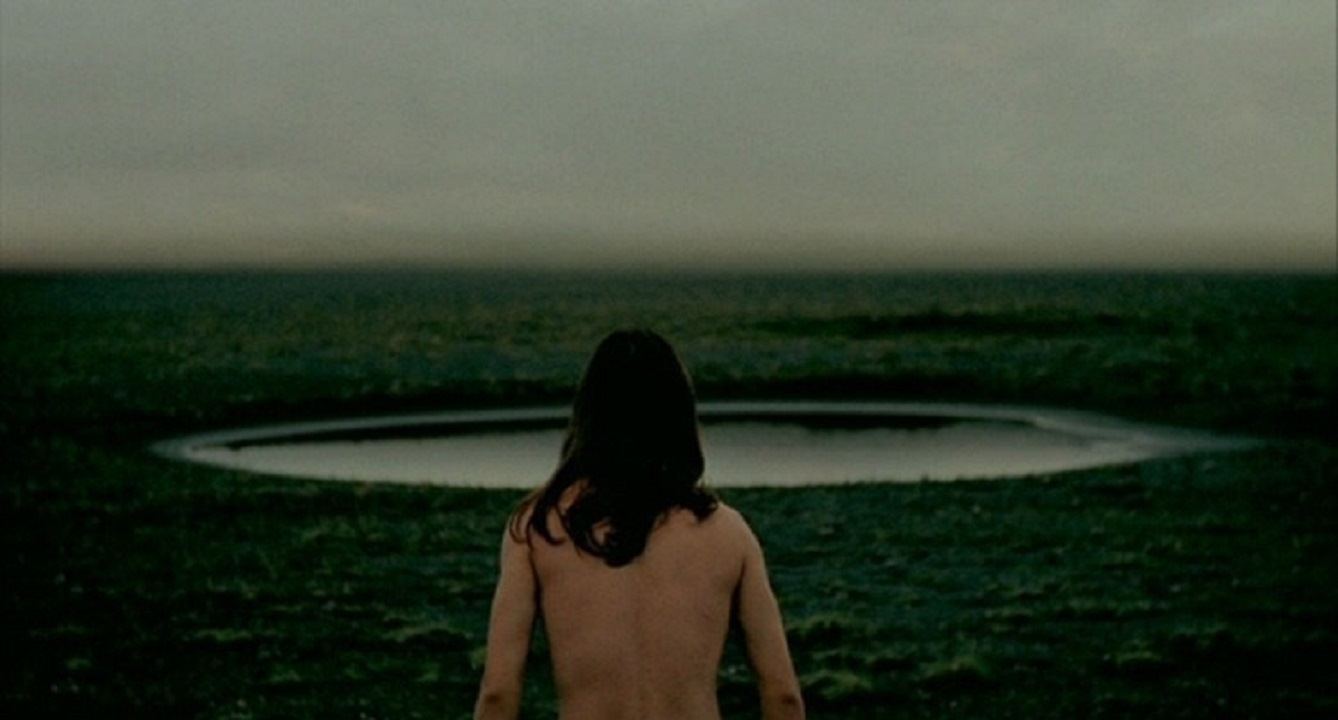
The introductory segment, Mars’s Canal, leaves you end up wondering what on Earth you have sat down to watch. It feels like watching a pretentious experimental student film. The first four minutes of the segment’s six-minute running time are entirely silent. We have a naked man near a circular pool in the centre of a bare open green plain beneath a murky grey sky. This is juxtaposed with fragmentary flashbacks to what look like scenes of the man brutalising a woman, although these flashes are so brief it is hard to tell what is happening. The man looks at his reflection in the pool but in some shots he appears to be a woman. The sound does eventually kick in but this consists of a piercing squeal interspersed with a rushing sound. The episode then ends. One is left scratching their head in puzzlement. The dvd cover for Rampo Noir claims that this episode contains elements and motifs from all the subsequent episodes – maybe. The only common factor in all four stories is actor Tadanobu Asano who plays detective Kogoro Akechi in two of the stories and the lead character in the other two, including the naked man in Mars’s Canal.
Things improve considerably however with the first episode, Mirror Hell, which comes from director Akio Jissoji, best known for the anime Tokyo: The Last Megalopolis (1988). Throughout the episode runs the theme of mirrors and Jissoji decks each location – the teahouse, Toro’s workshop, the hotel, even the autopsy room and the police station – with mirrors covering every conceivable surface. The episode even opens and closes with the image of a dozen mirrors lined up along an otherwise bare beach. At one point, Kogoro Akechi’s detective goes to visit his crippled wife who lives in a wheelchair in a cell that is half flooded with water where the cell bars come at odd angles and we cannot be sure what part of the room is a mirror reflection or not.
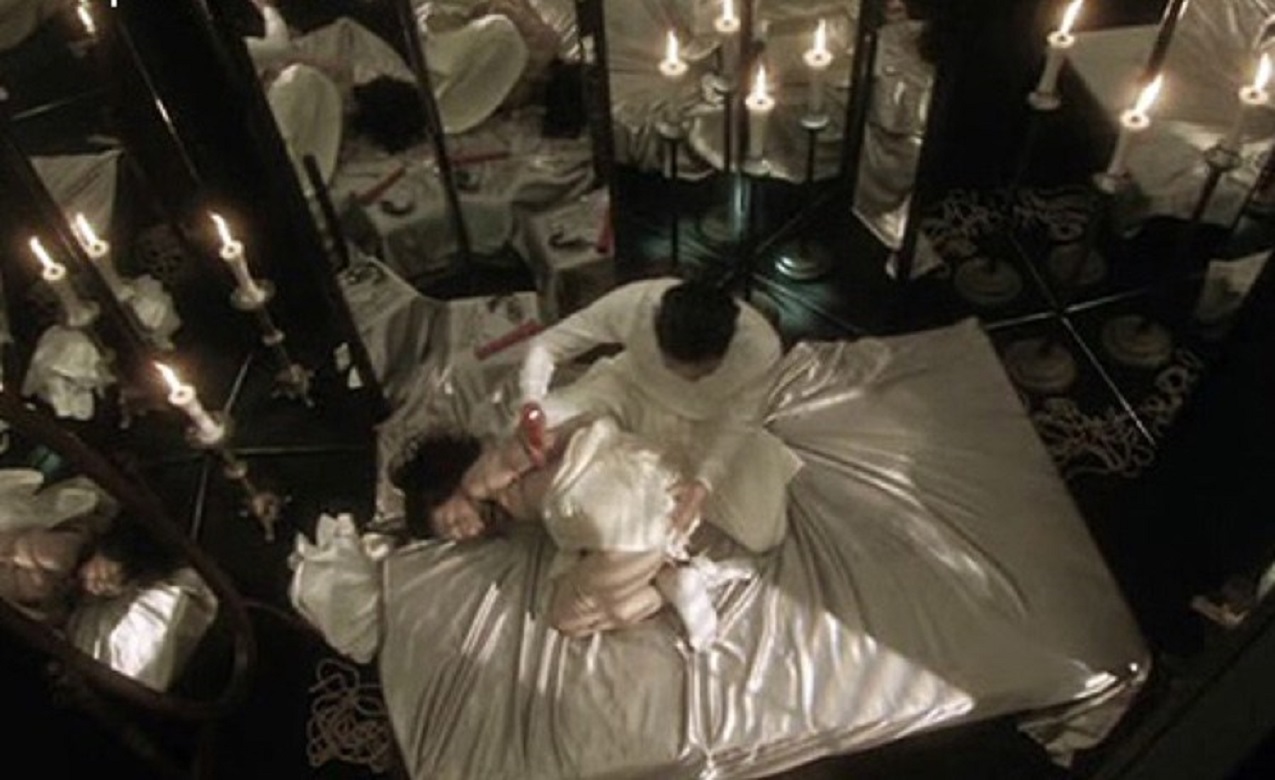
Akio Jissoji plays the episode with a constant weirdness. There is much interestingly enigmatic talk about gods that exist inside mirrors and an odd scene, which almost doesn’t seem to have a place, where a Buddha statue in a rock pool starts glowing and people hear railway line signals. There is a perverse scene where Asuza admits her longing for Hiroki Narimiya and he takes her tongue in his fingers and starts biting and kissing on it and in the next scene we see him in a mirrored hotel room with her tied up as he pours candle wax all over her body and tongue. For the most part, the episode works more than effectively as a horror story.
The second episode, Caterpillar, hits in with a perverse kick. It comes from Hisayasu Sato, a director known for some outre pinko (Japanese porn films). Caterpillar is Boxing Helena (1993) with a sex reversal, while the ending it arrives at has been borrowed somewhat from Freaks (1932). Hisayasu Sato fills the episode with incredibly perverse images – of Yukiko Okamoto tending Nao Omori’s limbless and drooling torso, she shaving him and caressing the razor across his nipples, cutting him and licking up the blood and then whipping him with a riding crop. A few minutes later, she strips, climbs atop and rides the husband before he starts licking his way up her legs, breasts and then climbing on top of her, before she turns him over and jabs her thumbs into his eyes.
The episode comes to a horrible ending [PLOT SPOILERS] – where the wife reveals that she cut the husband’s arms and legs off to prevent him from returning to the war and where the artist (Ryuhei Matsuda) persuades her to join him by cutting her own legs off. The entire segment appears to have been filmed in abandoned building. The same Rampo story was also later adapted into a feature-length film Caterpillar (2010).
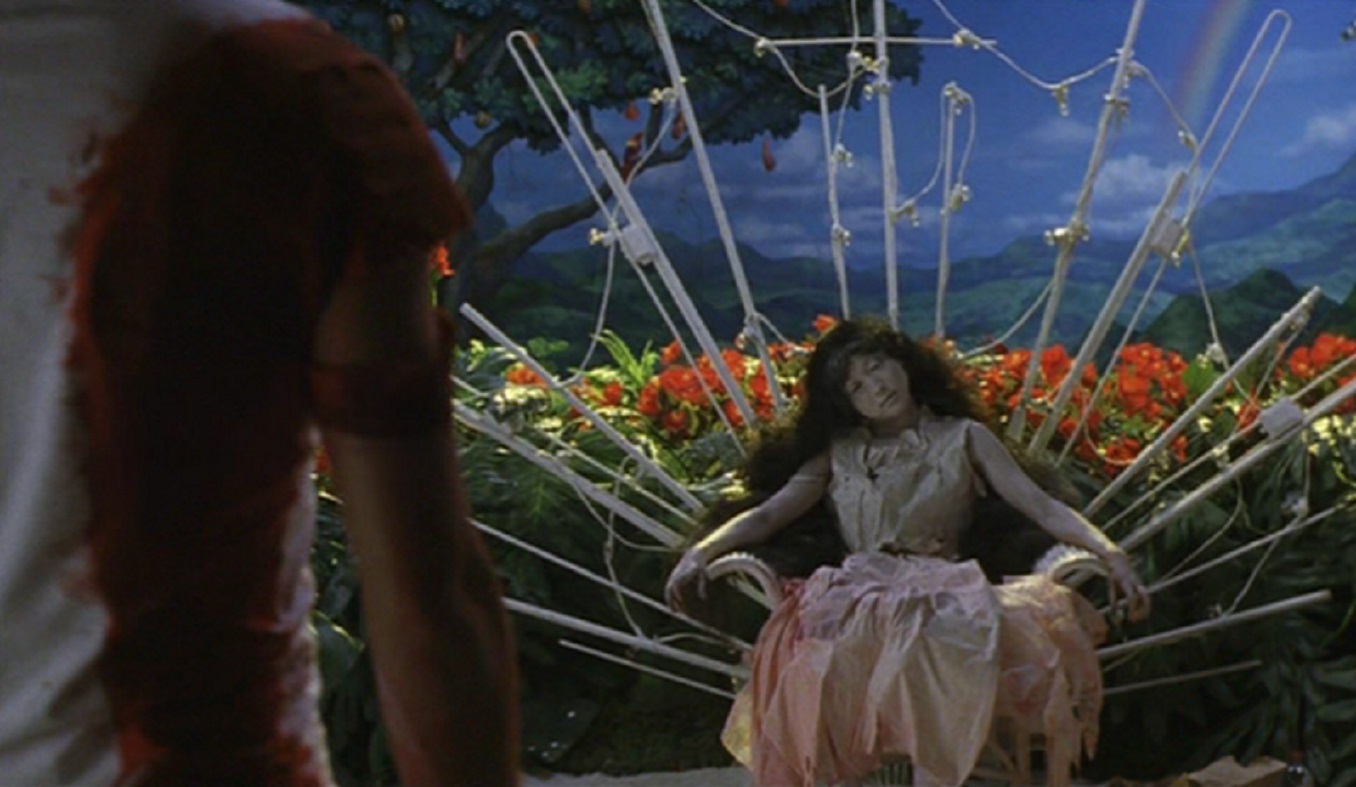
The third episode, Crawling Bugs, is the gem among the three. It is an episode that inhabits a genuinely whacked-out headspace. For one, it is a not always linear tale and moreover appears to change points-of-view halfway through. The first half, which would seem to tell the story from singer Tamaki Ogawa’s viewpoint is eccentric – she has a giant horizontally bouffed-out afro and the score is played seemingly using xylophones and bongo drums. There are random weird images like Tamaki Ogawa seen placing a leech on her neck and it sucking her blood out while she sighs in ecstasy. Playing the chauffeur this time, Kogoro Akechi gives an intensely neurotic and withdrawn performance where he spends most of the episode perpetually scratching his skin.
The most perverse part of the film is the necrophile element when Kogoro Akechi takes Tamaki Ogawa’s body and places her in a kitsch shrine in his apartment where he starts cutting into the body and then attempting to inject her with formaldehyde, or keeps trying to perfect her makeup but failing, and then eventually lies down with her as her blood spills out in a pool across the floor. The episode reaches a stunningly grim ending where the police break into the apartment and we suddenly see that there is no shrine and that they are in fact pulling Kogoro Akechi out from where he has his head buried in a hole in the stomach of a rotted corpse.
Trailer here