
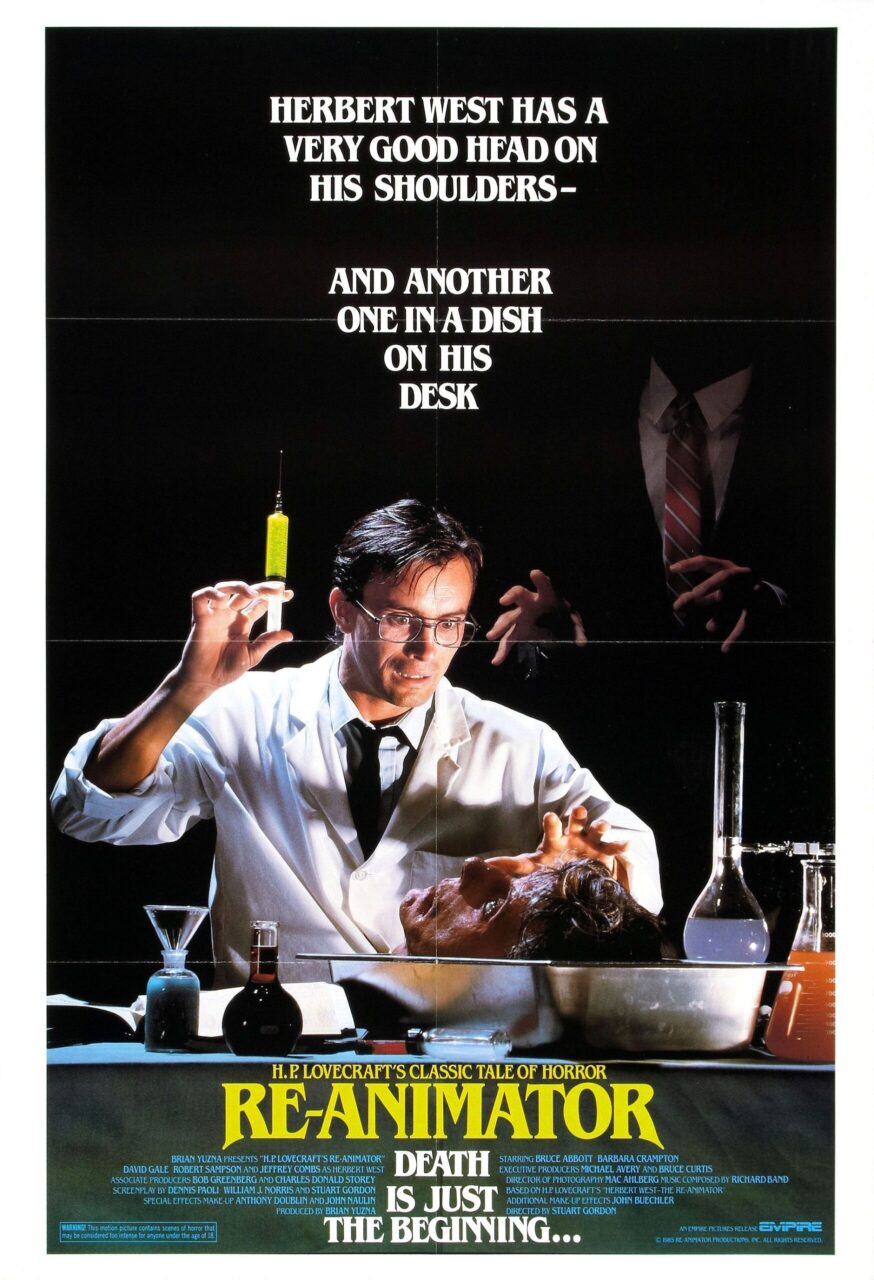
USA. 1985.
Crew
Director – Stuart Gordon, Screenplay – Stuart Gordon, William J. Norris & Dennis Paoli, Based on the Herbert West – Re-Animator Short Stories by H.P. Lovecraft, Producer – Brian Yuzna, Photography – Mac Ahlberg & Stephen Sealy, Music – Richard Band, Special Effects/Makeup Effects – Anthony Doublin & John Naulin, Additional Makeup Effects – Mechanical and Makeup Imageries (Supervisor – John Carl Buechler), Art Direction – Robert A. Burns. Production Company – Empire.
Cast
Jeffrey Combs (Herbert West), Bruce Abbott (Daniel Cain), Barbara Crampton (Megan Halsey), David Gale (Dr Karl Hill), Robert Sampson (Dr Alan Halsey)
Plot
Medical student Dan Cain allows the brilliant but very strange fellow student Herbert West to move into the empty room in his apartment. Dan then finds that Herbert is conducting experiments. Using Dan’s cat as subject, Herbert demonstrates a fluid he has formulated that is capable of returning the dead to life. Dan reports Herbert to Dean Halsey, who is also his girlfriend Megan’s father, only to have his student grant suspended. Dan decides to join Herbert and they set out to prove that the formula works using bodies from the school morgue. However, things get out of hand when Herbert manages to turn Dean Halsey into a re-animated corpse, followed by the self-serving Dr Hill and his decapitated head.
This outrageous gore comedy is the best thing that Albert and Charles Band ever produced during the mid 1980s at their Empire production house, which was best known for low-budget horror films such as Ghoulies (1985), Troll (1986) and Sorority Babes at the Slimeball Bowl-o-Rama (1987). Between them, Re-Animator and Sam Raimi’s The Evil Dead (1981) pioneered the 1980s trend of popcorn horror – campily tongue-in-cheek horror founded on makeup driven effects.
Re-Animator was a cult success. It created a vogue of cinematic interest in the works of horror writer H.P. Lovecraft. Between 1916 and his death in 1937, Howard Phillips Lovecraft, a reclusive Rhode Island conservative, created a body of pulp horror stories that have gained legendary status. H.P. Lovecraft’s specialty was a sense of cosmic horror, a vision of humanity as a species standing on a tiny island of ignorance surrounded by the unimaginable horror of ancient gods and demons, and of seekers after forbidden knowledge and venturers into abominable science who at the end of a typical Lovecraftian story are driven insane by what they uncover. H.P. Lovecraft’s stories have developed a cult, with numerous other authors rushing to complete unfinished fragments after his death and many others borrowing elements from Lovecraft stories – the notion of Lovecraft’s occultic tome The Necronomicon has become so widespread that there have even been published versions of it and people who believe that it is an existing work.
Prior to Re-Animator there had been a handful of mediocre H.P. Lovecraft adaptations on film – The Haunted Palace (1963), Die, Monster, Die/Monster of Terror (1965), The Shuttered Room (1967) and The Dunwich Horror (1969) – but it was Re-Animator that popularised Lovecraft on film. The success of Re-Animator subsequently unleashed a host of B-budget Lovecraft adaptations – the likes of Stuart Gordon’s subsequent From Beyond (1986), The Curse (1987), The Unnameable (1988), The Resurrected (1992), Necronomicon (1993), Lurking Fear (1994), Gordon’s Dagon (2001), The Dream-Quest of Unknown Kadath (2003), Beyond the Wall of Sleep (2006), Cool Air (2006), Chill (2007), Cthulhu (2007), The Tomb (2007), Colour from the Dark (2008), the remake of The Dunwich Horror (2009), The Color (2010), Pickman’s Muse (2010), The Whisperer in Darkness (2011), The Dark Sleep (2013), The Haunter of the Dark (2015), Herbert West: Re-Animator (2017), Color Out of Space (2019), H.P. Lovecraft’s The Deep Ones (2020), Markham (2020), the tv series Lovecraft Country (2020), H.P. Lovecraft’s Witch House (2021), The Resonator: Miskatonic U (2021), The Lurking Fear (2023), Suitable Flesh (2023), H.P. Lovecraft’s The Old Ones (2024), The Innsmouth School for Girls (2024) and Unspeakable: Beyond the Wall of Sleep (2024). Lovecraft: Fear of the Unknown (2008) is a documentary about Lovecraft. Also of interest is The Manitou (1978), which features an appearance of the Great Old One; Cast a Deadly Spell (1991) and its sequel Witch Hunt (1994), a tv movie set in an alternate world where magic works and where the central character is a detective named H.P. Lovecraft; Juan Piquer Simon’s cheap and loosely inspired Cthulhu Mansion (1992); John Carpenter’s Lovecraft homage In the Mouth of Madness (1995); the fan parodies Lovecracked: The Movie (2006), The Last Lovecraft: Relic of Cthulhu (2009) and Call Girl of Cthulhu (2014); even a trilogy of animated children’s film Howard Lovecraft and the Frozen Kingdom (2016), Howard Lovecraft and the Undersea Kingdom (2017) and Howard Lovecraft and the Kingdom of Madness (2018) in which a young Lovecraft encounters his own creations; while Batman faces Lovecraftian horrors in the animated Batman: The Doom That Came to Gotham (2023); and Lovecraft homages such as The Breach (2022), H.P. Lovecraft’s Monster Portal (2022) and Gods of the Deep (2023). The Elder Gods turn up at the end of The Cabin in the Woods (2012), Lovecraft (Paul Titley) appears as an imaginary companion in Ghostland/Incident in a Ghostland (2018) and In Search of Lovecraft (2008) features a tv news crew discovering that Lovecraft’s works are true. Lovecraft’s key work of demonic lore The Necronomicon also makes appearances in films such as Equinox (1970), The Evil Dead II (1987) and Army of Darkness (1992), and was also borrowed as an alternate retitling for Jesus Franco’s surreal and otherwise unrelated Succubus/Necronomicon (1969) about a BDSM dancer.
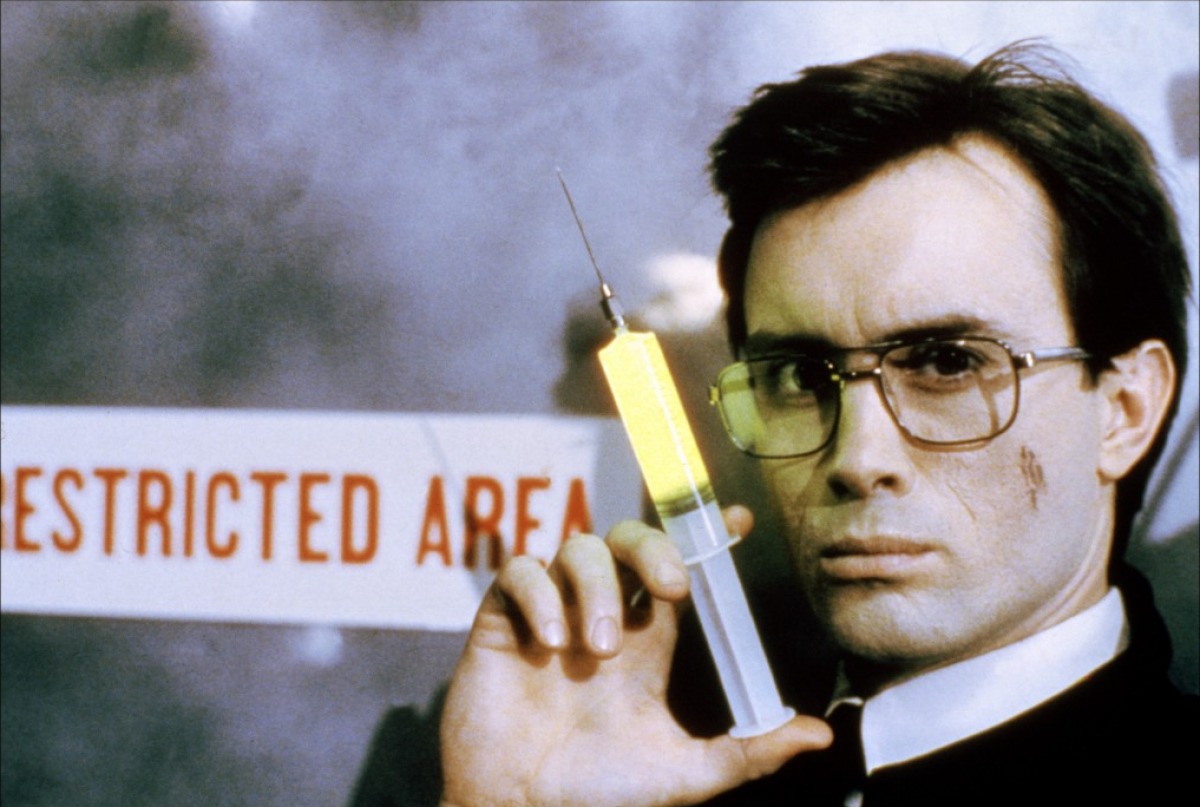
H.P. Lovecraft, were he alive today though, would probably not recognise most of the films made from his stories. This is especially so in the case of Re-Animator. Herbert West – Reanimator was a series of six serialised stories that H.P. Lovecraft published in Home Brew magazine in 1922. Lovecraft was later cynical about the Herbert West stories, dismissing them as only being written for money and considered them the worst thing he had ever written, so probably the question of fidelity to the originals is not as big a one as it might be for some of the other adaptations. That said, Stuart Gordon does end up being surprisingly faithful to the stories.
Nevertheless, the stories are wildly different to the film version in tone. The principal difference between H.P. Lovecraft and Stuart Gordon is that the stories that Lovecraft specialised in are all ones where the horror emerges psychologically – his much described (and often parodied) visions of ‘unspeakable’ and ‘indescribable’ horrors. All of H.P. Lovecraft’s horrors in effect exist off-screen and gain their impression from the sense of dread that Lovecraft is able to suggest, rather than any direct depictions. By contrast, Stuart Gordon’s approach is to put everything up-front and without the slightest in the way of restraint – there is as much in the way of unseen indescribables in Re-Animator as there is subtlety.
However, if one can set H.P. Lovecraft aside and view Re-Animator purely on Stuart Gordon’s own terms though, it is often riotously entertaining. Re-Animator is akin to one of the more serious-minded splatter epics that emerged after George Romero’s Dawn of the Dead (1978) – but as though it were being directed by a diabolically cackling mad scientist. The first few minutes offer up a wholly unnecessary, totally entertaining sequence of a head being sawed open and a brain being removed, which serves to put the audience into the correct mood for the rest of the film – somewhere between gross-out nausea and black comedy. Thereafter, Stuart Gordon proceeds to serve up a constant barrage of decapitations, reanimated cats, fingers bitten off, drills bored through the chests of corpses and attacks by zombie intestines.
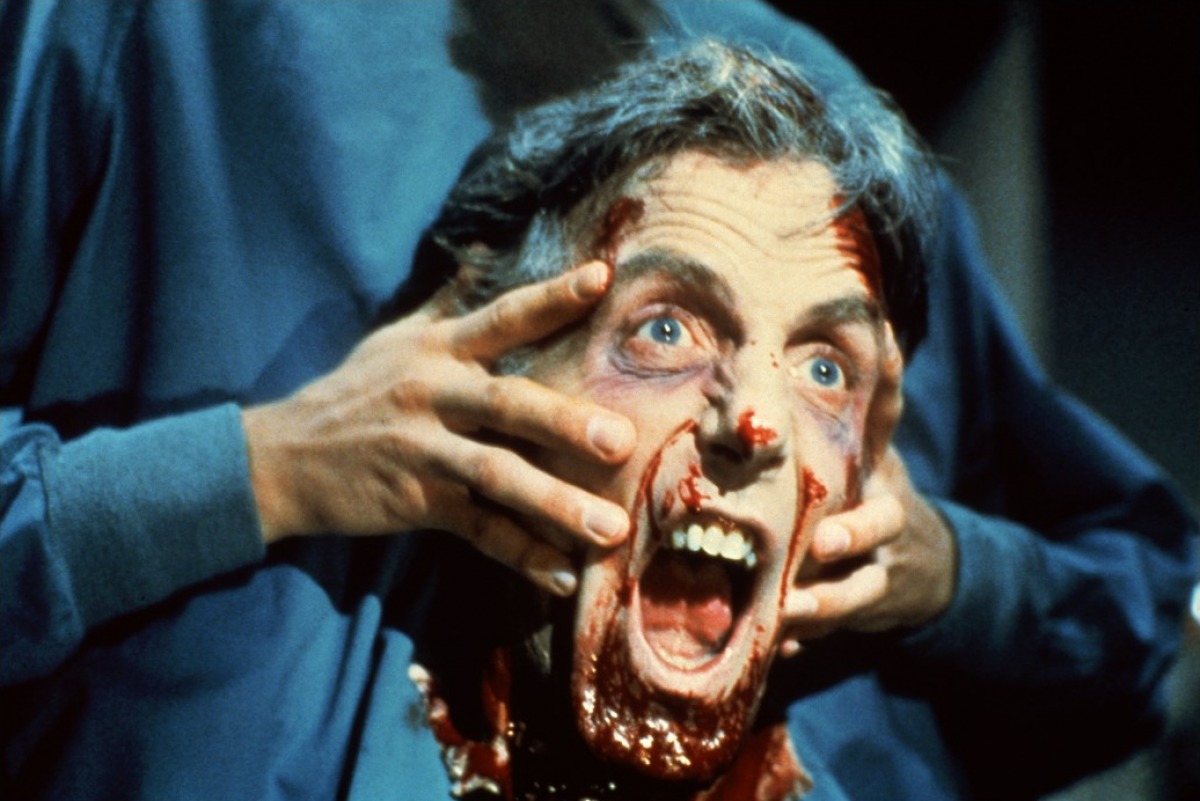
Stuart Gordon’s approach becomes increasingly more blackly comedic the gorier the film gets. In one astounding scene that defies belief, Gordon has heroine Barbara Crampton tied naked to a morgue slab as an ambulatory corpse moves its decapitated head to perform cunnilingus on her, all the while gurgling more goo and blood than it seems possible for a severed head to contain. It was a scene that clinched Re-Animator‘s cult status. (In England, this scene was regarded as so outrageous it was cut from the film altogether). Jeffrey Combs plays with a fiercely determined intensity that belies the film’s tongue-in-cheek tone.
For such an assured debut, Stuart Gordon was seen as the new genre hopeful for the late 1980s but never fulfilled such subsequently. Gordon next made a further H.P. Lovecraft adaptation From Beyond (1986) and Dolls (1987), both of which vanished in a welter of mixed reviews. His subsequent work encountered problems – he signed onto direct Honey, I Shrunk the Kids (1989) for Disney but was fired by the studio; his live-action Transformers film Robot Jox (1990) spent some five years trying to even get a video release; and he saw his planned production of H.P. Lovecraft’s The Shadow Over Innsmouth unceremoniously dumped on him. His other films are the vampire tv movie Daughter of Darkness (1990); the campy Edgar Allan Poe adaptation The Pit and the Pendulum (1991); the future prison action film Fortress (1993); Castle Freak (1995); Space Truckers (1996); the Ray Bradbury adaptation The Wonderful Ice Cream Suit (1998); a return to H.P. Lovecraft with Dagon (2001); and the true-crime based Stuck (2007). Regrettably, while Re-Animator displayed Stuart Gordon’s blend of outrageous splatter and tongue-in-cheek humour to perfection, his subsequent genre films have tended to show that this is all that Gordon has in his arsenal. It was not up until the extraordinary adaptation of the David Mamet play Edmond (2005) that Gordon had a work that could stand up to Re-Animator.
Producer Brian Yuzna later directed two sequels with Bride of Re-Animator/Re-Animator 2 (1990), which featured return performances from Jeffrey Combs, Bruce Abbott and David Gale, and Beyond Re-Animator (2003) with Combs only. For a number of years since the early 00s, Stuart Gordon has been reported to be returning for a proposed House of Re-Animator. Herbert West: Re-Animator (2017) was an Italian-made version of the stories starring Emanuele Cerman as West.
Trailer here