

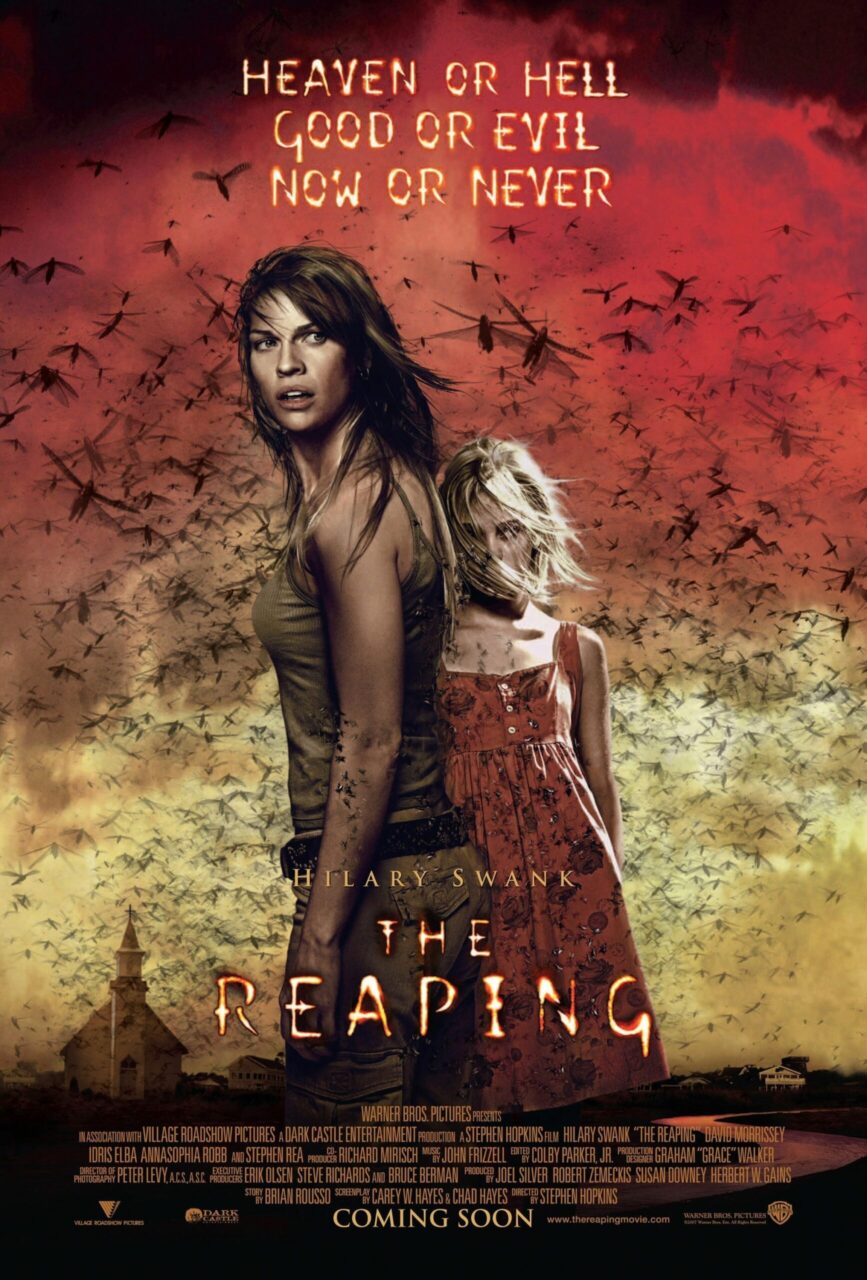
USA. 2007.
Crew
Director – Stephen Hopkins, Screenplay – Carey W. Hayes & Chad Hayes, Story – Brian Russo, Producers – Herb Gains, Susan L. Levin, Joel Silver & Robert Zemeckis, Photography – Peter Levy, Music – John Frizzell, Visual Effects Supervisor – Richard Yuricich, Visual Effects – CIS Hollywood (Supervisor – Bryan Hirota), Digiscope, Double Negative (Supervisor – Ken McGaugh), Peerless Camera Company & Svengali Visual Effects, Special Effects Supervisor – Mike Meinardus, Production Design – Graham ‘Grace’ Walker. Production Company – Dark Castle Entertainment.
Cast
Hilary Swank (Katharine Winter), David Morrissey (Doug Blackwell), Idris Elba (Ben), AnnaSophia Robb (Loren McConnell), Stephen Rea (Father Michael Costigan), William Ragsdale (Sheriff Cade), John McConnell (Mayor Brooks), Andrea Frankle (Maddie McConnell), Stuart Greer (Gordon Small), David Jensen (Jim Wakeman), Lara Grice (Isabelle), Myles Cleveland (Kyle Wakeman)
Plot
Katharine Winter is a former Christian believer who has become a hardened atheist after her husband and son died while on missionary work in the Sudan. Katharine is now an academic at Louisiana State University where she specializes in debunking claims about miracles. She is visited by Doug Blackwell from the small rural Louisiana town of Haven who wants her to investigate a river that has turned red after a boy’s body was found drowned in it, which some locals are calling divine retribution. As Katharine starts investigating, Haven is struck by other Biblical plagues – rains of frogs, swarms of flies, outbreaks of boils and mysterious maladies that are killing livestock, while chemical tests show that it is human blood in the river. These combine to make Katharine’s case for purely mundane causes increasingly difficult to establish. In the midst of this, Katharine meets a mysterious young girl Loren McConnell who is connected to the Plagues in some way. When Katharine discovers the existence of a local Satanist cult, she comes to believe that the Biblical Plagues might be manifestations caused by the cult’s attempts to create a perfect child as an incarnation for Satan.
The Reaping was the sixth film from Dark Castle Entertainment, the production company formed by director Robert Zemeckis and producers Gilbert Adair and Joel Silver. Dark Castle Entertainment initially began producing William Castle remakes – House on Haunted Hill (1999) and Thir13en Ghosts (2001) – and then went onto the likes of Ghost Ship (2002), Gothika (2003) and House of Wax (2005) and subsequent to this Return to House on Haunted Hill (2007), The Hills Run Red (2009), Ninja Assassin (2009), Orphan (2009), Splice (2010), The Apparition (2012), The Factory (2012) and Seance (2021). Where the majority of studio horror films these days are only given quick theatrical releases before finding their natural home on video/dvd shelves, Dark Castle’s films have enjoyed widespread mainstream release. The Reaping was Dark Castle’s most expensive production to date with a budget reportedly somewhere around the $40-50 million range.
Dark Castle’s other films up to this point were all been directed by relative unknowns seeking a break into the Hollywood mainstream – House on Haunted Hill‘s William Malone who had been a B-budget director on the fringes of Hollywood for a number of years; Steve Beck, an Industrial Light and Magic art director who made his debut with Thir13en Ghosts; and two relatively unknown European directors, the French Mathieu Kassovitz and the Spanish Jaume Collet-Serra, who handled Gothika and House of Wax respectively. Contrarily, The Reaping comes from a reasonably established director – in this case the Australian-born Stephen Hopkins. Hopkins started in the industry with two horror films – the Australian-made psycho cop film Dangerous Game (1987) and then A Nightmare on Elm Street: The Dream Child (1989) – before going onto the likes of Predator 2 (1990), Judgement Night (1993), Blown Away (1994), The Ghost and the Darkness (1996), Lost in Space (1998), The Life and Death of Peter Sellers (2004) and Thorne: Sleepyhead (2010).
The Reaping sounded interesting going by its pre-publicity – the idea of a horror film centred around the Biblical Plagues of Egypt being revisited upon modern-day smalltown Louisiana was a fascinating one. It held a conceptual promise that none of the other Dark Castle films operated on. The plot suggested something along the lines of the excellent Christian end of the world fantasy The Rapture (1991), which had Mimi Rogers as a lone woman trying to stand against the Biblical End of the World, or perhaps on a more failed level the pretentious The Seventh Sign (1988), which had lone woman Demi Moore trying to hold back the signs that signified the Biblical End of the World.
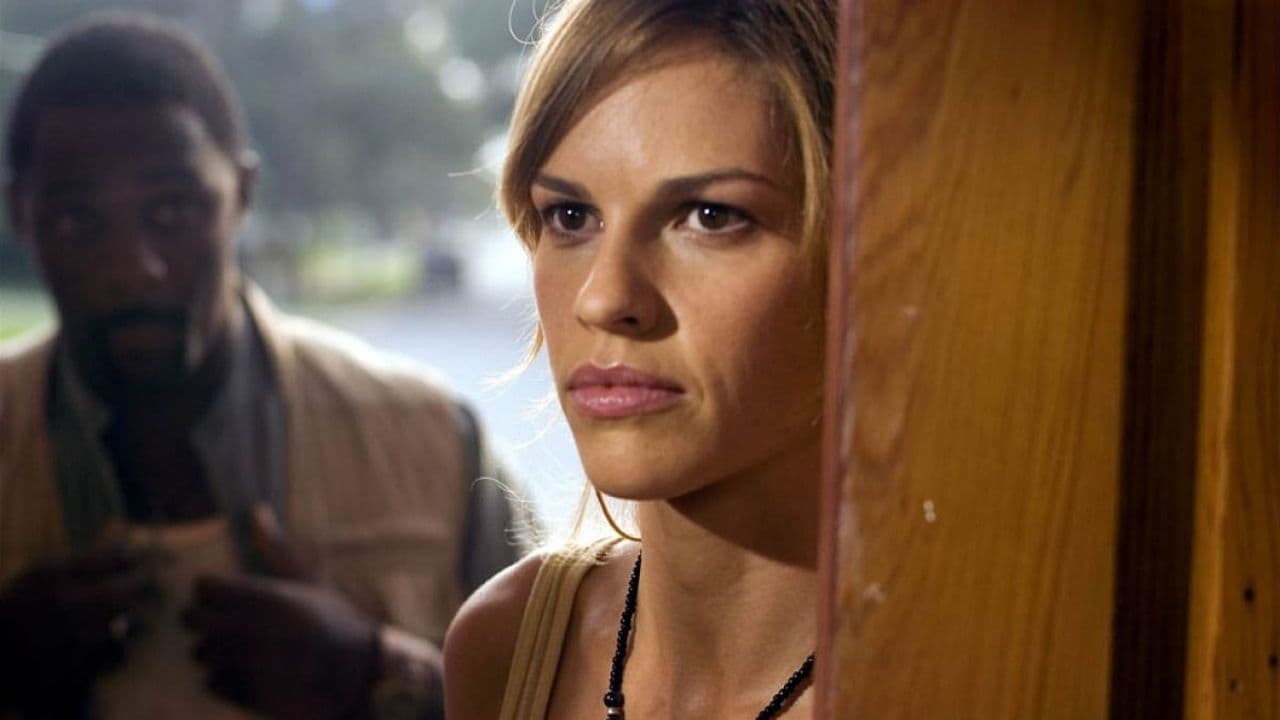
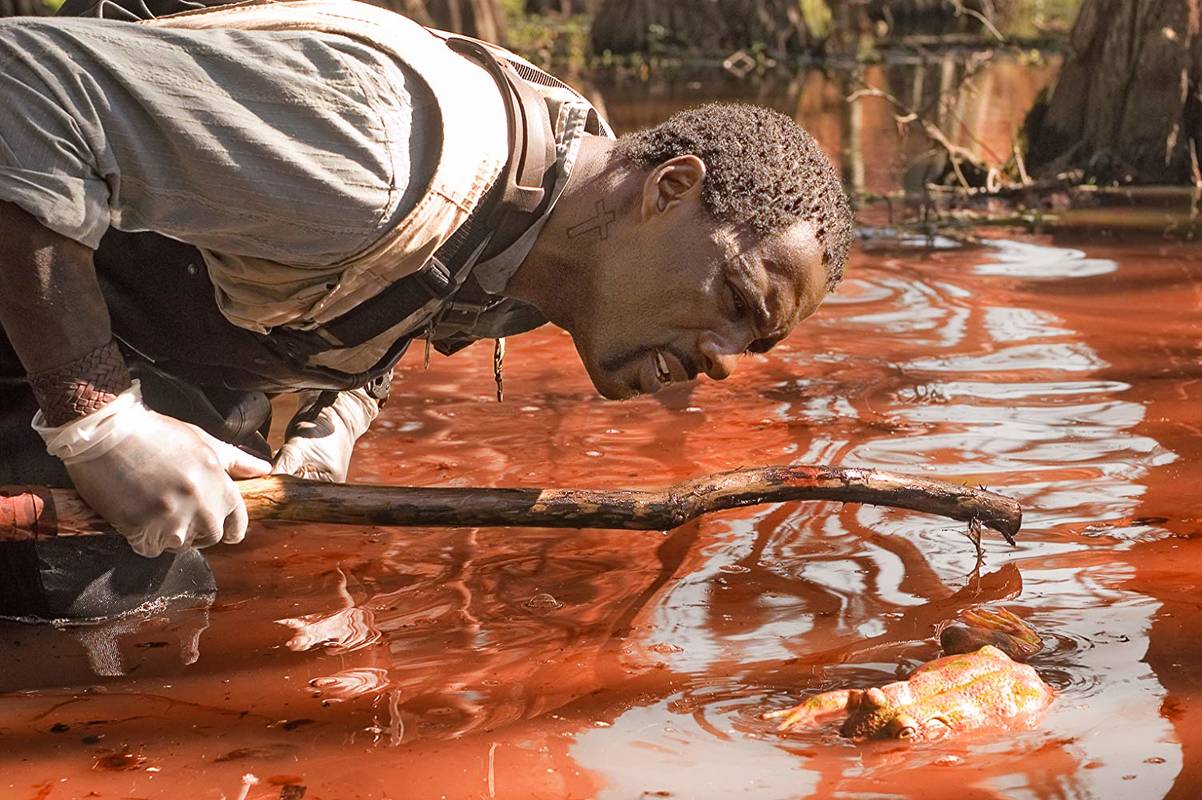
Only for all the promise that it holds, The Reaping sits on the screen and resolutely refuses to work in almost all ways. Despite being made on an A-budget, not much of this shows up on screen. There is a moderately impressive CGI locust swarm at the end and someone has clearly gone to a lot of effort to dye the water in large stretches of Louisiana bayous red in order to provide the river of blood. However, when these are the only things that an A-budget film has to show for itself, the results are highly disappointing – indeed, outside of one or two effects flourishes, there is not much that distinguishes The Reaping from a modestly-made direct-to-dvd release. Certainly, Stephen Hopkins rarely does anything to generate any atmosphere or tension.
Even more so, The Reaping fails on its conceptual promise. The film starts out with an interesting and original idea – the Biblical Plagues of Egypt seemingly being replayed in a rural Louisiana town and a sceptical miracle debunker who used to be a missionary but has lost her faith brought in to decide whether it is an authentic miracle or not. Hilary Swank has an interesting character set-up – even if her character has been borrowed directly from Jason Miller’s Father Karras in The Exorcist (1973) and Ed Harris in The Third Miracle (1999) – where she is introduced in a way that suggests that the fundamental character fulcrum the film hangs on is her regaining her faith in order to tackle the particular threat.
Disappointingly, after having set up the expectation of this character arc, the film fails to provide any scene where she ends up regaining her faith. This is something that takes place off screen and only by implication – one minute Hilary is a hardline sceptic and next she has abandoned this without any explanation and is taking the existence of the Biblical universe for granted again. Likewise, her assistant Idris Elba has a potentially even more originally defined character than she does – that of the tough streetwise gang banger who has become a believing Christian yet is also engaged in the debunking of miracles – however, his character shadings are of no relevance to the plot.
The other more challenging possibility that The Reaping could have taken is to have told an ambiguous or non-fantastical tale wherein there a mundane explanation is offered for the Biblical plagues, something akin to the way that The X Files (1993-2002, 2016-8) used to vie between rationalism and paranormal explanations. The film seems to be pointing the way towards this in one scene where Hilary Swank gets to deliver a speech that offers up a purely mundane explanation for all of the Biblical Plagues. It is a superb speech that is the single best piece of writing in the film – alas, it has no bearing whatsoever on anything that subsequently happens.
The most disappointing aspect of The Reaping‘s conceptual failings is that it fails to follow through on the modern-day Biblical Plagues plot. About halfway through, the investigation into the Biblical Plagues is dropped and the film turns into a more routine investigation into a rural Satanic cult and a miraculously empowered divine or diabolical child – a plot element that has been mostly borrowed from Bless the Child (2000). Here the Biblical Plagues disappointingly appear to only be something wielded by the forces of darkness to protect the child. This is a plot twist that avoids any of the ideas the film raises – like why Biblical Plagues should be visited in the modern-day and why the people of this small town are being divinely judged – as though the screenwriters had sold an interesting idea but had no way to resolve their last act. In the Biblical Book of Exodus, the Plagues are meant to be divine judgement rained down on Egypt by God because the Pharaoh refuses to release the Jews from slavery; here the film seems to absurdly suggest that the rains of frogs, rivers of blood and cattle pestilence are no more than the equivalent of the evil dog that protects Damien in The Omen (1976). Even then this explanation is rendered meaningless by the twist ending that reveals that the child in question is not the vessel of Satan after all. The twist ending also feels disappointing and contrived – not to mention borrowed somewhat from Rosemary’s Baby (1968).
The Reaping toplines Hilary Swank, the former teen actress who has become a serious acting name in recent years after the Oscar-winning success of her roles in Boys Don’t Cry (1999) and Million Dollar Baby (2004). Here Swank’s part is limited to a role that requires no particular acting stretches and could have been filled by anybody. Second-billed against Swank is British actor David Morrissey who has done some sterling work on British television. Here Morrissey struggles vainly to maintain what is presumably a backwoods Louisiana accent. The Reaping did nothing to raise his profile and he has subsequently returned to work in the UK. The film welcomely offers decent screen presence to the then unknown Idris Elba, a British-born actor of mixed African heritage, who had been doing some fine work in tv series such as The Wire (2002-8) and Luther (2010-9) and was just on the cusp of bigger breaks.
The script comes from twin brothers Carey W. and Chad Hayes who both come from a Baptist background and have written a number of other works dealing with supposed real-life occurrences of the occult and supernatural with The Conjuring (2013), The Conjuring 2 (2016) and The Crucifixion (2017). They have also written other genre works such as The Dark Side of the Moon (1990), House of Wax (2005) and The Turning (2020), while the two had also acted as producers on the tv series’ The Crow: Stairway to Heaven (1998) and Beastmaster (1999-2000), plus The Conjuring spinoff Annabelle (2014).