

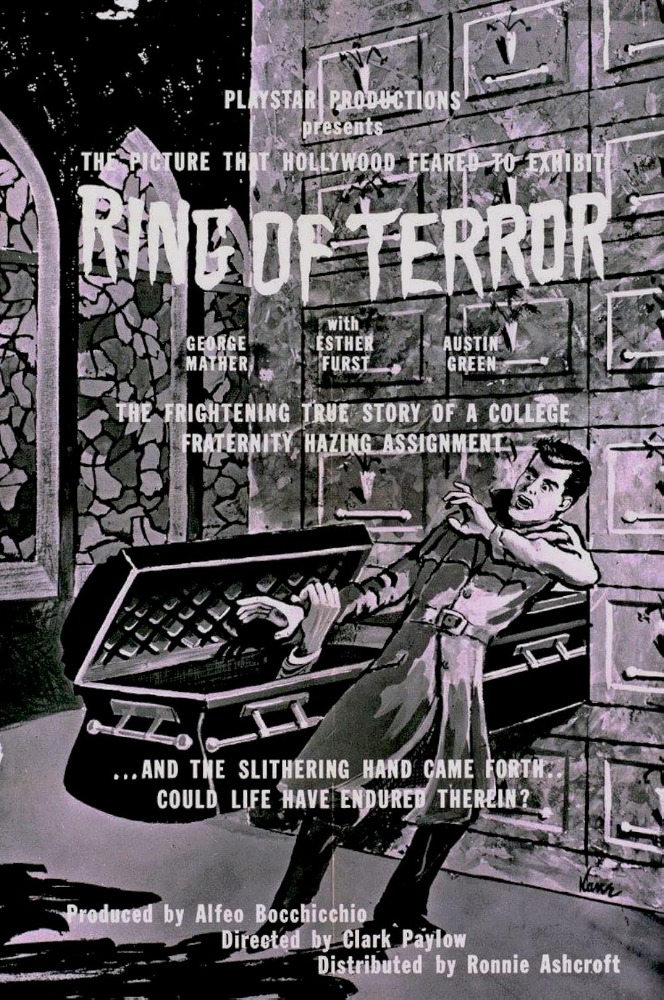
Crew
Director – Clark L. Paylow, Screenplay – Lewis Simeon & Jerrold I. Zinnamon, Story – Lewis Simeon, Producer – Alfeo Bocchicchio, Photography (b&w) – Brydon Baker, Music – James Cairncross, Makeup – Roland Ray, Art Direction – Gene La Rouche. Production Company – Playstar Productions, Inc.
Cast
George E. Mather (Lewis B. Moffitt), Esther Furst (Betty Crawford), Lomax Study (Professor Rayburn), Pamela Raymond (Alice Lund)
Plot
While searching for his cat, a cemetery custodian comes across the grave of Lewis B. Moffitt who died in 1955. The custodian recalls Lewis’s story. Lewis was a med student who was regarded as odd by his colleagues and girlfriend Betty because he had no sense of fear. Lewis happily volunteered for Professor Rayburn’s anatomy class and showed no emotion while the others in the class fainted at the sight of a body being cut up. However, seeing the ring on a corpse’s finger caused Lewis to have flashbacks to when he was a child and was locked in a room with a dead body. The college fraternity planned an initiation stunt for Lewis but were unaware of the consequences that this would have.
Ring of Terror is a fascinatingly obscure artifact that saw almost no release of any note at the time it came out. It turned up during the dvd revolution of the 00s where all manner of oddities have been resurrected and given life. As is often the case, there are justifiable reasons why these films were obscure in the first place. Certainly, Clark L. Paylow never went onto direct any other films – although did turn up as an associate producer on Steven Spielberg’s Close Encounters of the Third Kind (1977) – while none of the cast went onto anything other than minor tv work again.
Ring of Terror has an interesting premise – in many ways, it is more of a story about abnormal psychology than it is a horror film. It is perhaps the first horror film to be made about the idea of fear itself. The film starts out like an episode of The Twilight Zone (1959-63) – or perhaps even more so of a straight version of the Crypt Keeper from Tales from the Crypt comics – with a cemetery custodian following a cat through the graveyard and then coming to the grave of Lewis B. Moffitt and sitting down to tell the story of how he died. It is all delivered in the solemn portentous narration of a Rod Serling.
On the minus side, the plot is founded on a series of absurd ideas where nobody seems to have bothered to research basic facts – like the film’s belief that it is not possible to store corpses in a freezer for a weekend, meaning that autopsy classes have to be held as soon as a body becomes available; or that it is normal for med students to be grossed out at watching autopsies and that someone who has no such reaction is highly abnormal; indeed, that it is highly strange for someone to display no fear period. Nor does the psychology of the film ring true – George E. Mather has no fear of corpses in anatomy class but at the same time has a pathological fear as a result of being left in the dark with a dead body as a child.
Ring of Terror has a terminal dullness to it – the photography is crude and dreary. The scene where the rattler attacks in the car is directed with a complete lack of suspense. It plods through much talk and gratingly forced humour. The beauty contest is the dullest part of the film where everything is centred around lowbrow comedy relief involving two fat lovers, with the guy trying to get his girlfriend declared the beauty queen, as well as a nerd character running about dressed as Cupid.
The film picks up somewhat when it comes to the autopsy scene, which is conducted with some atmosphere as Clark L. Paylow focuses on the assembled faces in the lecture hall, the lecturer speaking using detached medical terminology while a skeleton is shadowed in silhouette on the bare wall behind him as various med students pass out, and everything is run over by a grinding score.
Ring of Terror eventually arrives at a silly and anticlimactic denouement. The dialogue gets decidedly bizarre at times: “Where’ve you been?” George E. Mather asks girlfriend Esther Furst. “At the hairdresser.” “You’re going to be the slickest chick at this ever-loving hop” [meaning (I think) that she will be the most beautiful girl at the happening party they are about to go to].
Full film available here