
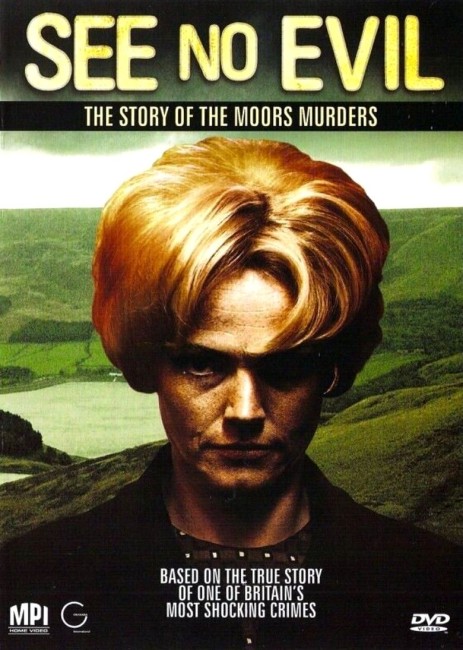
UK. 2006.
Crew
Director – Christopher Menaul, Teleplay – Neil McKay, Producer – Lisa Gilchrist, Photography – Lukas Strebel, Music – John Lunn, Visual Effects – Matt Ross, Production Design – Christopher J. Truelove. Production Company – ITV Productions.
Cast
Joanne Froggatt (Maureen Smith), Maxine Peake (Myra Hindley), Michael McNulty (Dave Smith), Sean Harris (Ian Brady), George Costigan (DCI Joe Mounsey), Charlotte Emmerson (WDC Pat Clayton), John Henshaw (DCS Arthur Benfield), Susan Twist (Nellie Hindley), Steve Evets (Jack Smith)
Plot
Gorton, Manchester, 1965. David and Maureen Smith are a struggling young pregnant couple. David is drawn in by Ian Brady, the boyfriend of Maureen’s sister Myra Hindley. Ian talks about planning a bank robbery with David and gives him reading material on sexual sadism. Meanwhile, Detective Chief Inspector Joe Mounsey tries to argue with his superiors that the disappearances of four children in the area are related. With David and Maureen facing eviction, Ian hatches a plan for them to lure a gay man and rob him for money. However, when David goes to Ian and Myra’s place, he sees Brady bashing the man’s head in with an axe while Myra gleefully looks on. Shocked, David goes to the police and confesses what happened. Brady is arrested but police are uncertain to what extent David was complicit. The chance finding of a suitcase uncovers a series of photographs and audio recordings that Brady and Myra made of them torturing the missing children. An extensive search is made of the moors in the surrounding area, with Mounsey believing that Brady and Myra are standing on the graves of their victims in some of the photos. Two of the children’s bodies are found. Brady and Hindley are placed on trial in 1966, although the trial also has David, even though he is not charged, vilified by the public as the third Moors Murderer.
See No Evil: The Moors Murders is a British tv mini-series based on the Moors Murders, one of the most infamous crimes in modern British history. In Manchester in the early 1960s, secretary Myra Hindley had become involved with Scottish-born Ian Brady, who introduced her to his bizarre life, which included a fetish with Nazis, sadomasochism and fantasies of being a bank robber. Between 1963 and 1965, Hindley and Brady killed five children between the ages of ten and seventeen, usually sexually assaulting them and then strangling them with their shoelaces and burying the bodies on the nearby moors (hence the term Moors Murders).
The two were arrested in 1965 after attempting to induct Myra’s brother-in-law David Smith into their activities, only for Smith to panic at witnessing a murder and run to the police. The two were convicted after the police discovery of a suitcase of photographs and audio recordings of the murders. In years subsequent to the trial, the case remained in the public spotlight through Myra Hindley’s persistent attempts to gain freedom, including claims that she was innocent and had been forced into things by Brady, that she had converted to Catholicism and was repentant, and an attempt to escape with the aid of a lesbian warder that she had seduced. See No Evil was commissioned for the fortieth anniversary of the Moors Murder trial.
There have been a number of films about true life killers in recent years – Ed Gein (2000), Dahmer (2002), Ted Bundy (2002), Gacy (2003), Monster (2003), The Hillside Strangler (2004), Zodiac (2007) etc. See No Evil: The Moors Murders has a unique method of telling its story that none of these others have. It is an approach that is almost entirely designed to wring out the slightest interest one might have in finding anything out about the crime. First of all, the focus of the series is not on the characters of the two killers, Ian Brady and Myra Hindley, but rather Hindley’s sister Maureen and brother-in-law David Smith who only feature as supporting characters in the case.
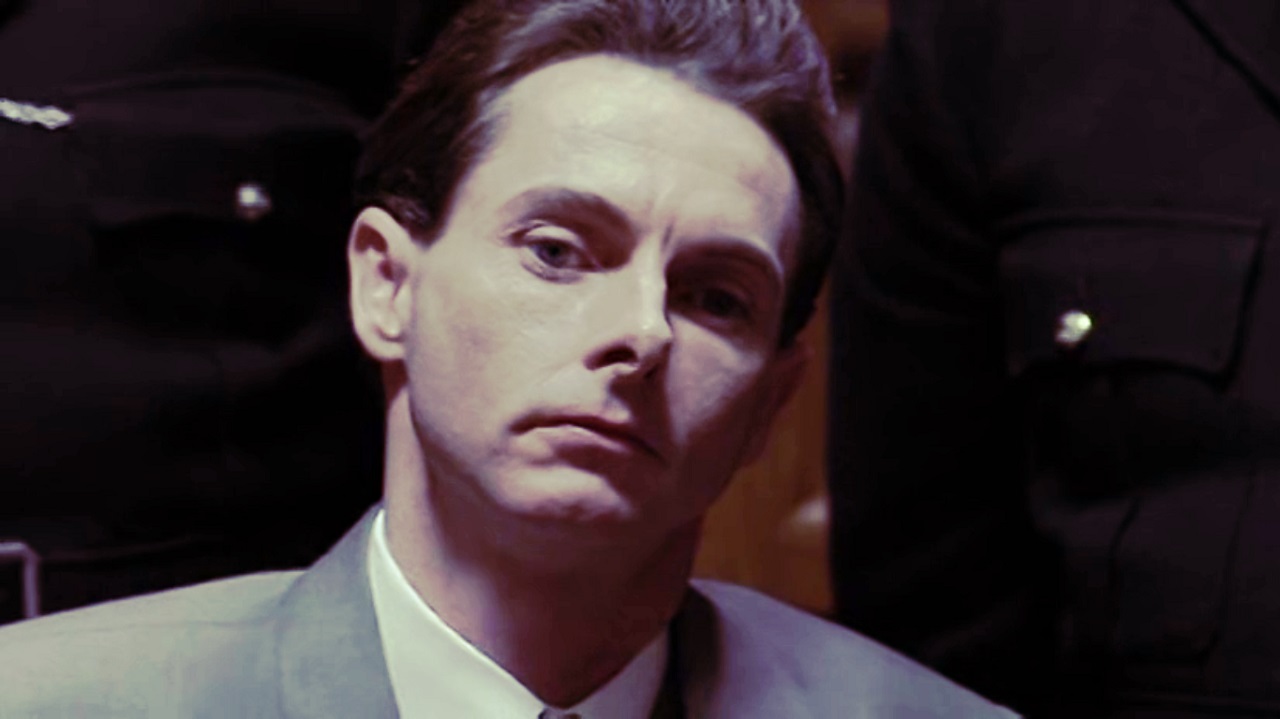
There is no effort made to get inside and dramatise the actual events (which is almost certainly the expectation that any person sitting down to watch the mini-series’ would have) with the only murder depicted being (very briefly) that of the final victim Edward Evans. In fact, all the actual crimes classified as the Moors Murders are over and done with by the point that the mini-series’ timeframe starts. The first half of the mini-series is mundanely dull with nothing other than a few domestics and Sean Harris’s Brady introducing Michael McNulty’s David Smith to his schemes to rob a bank.
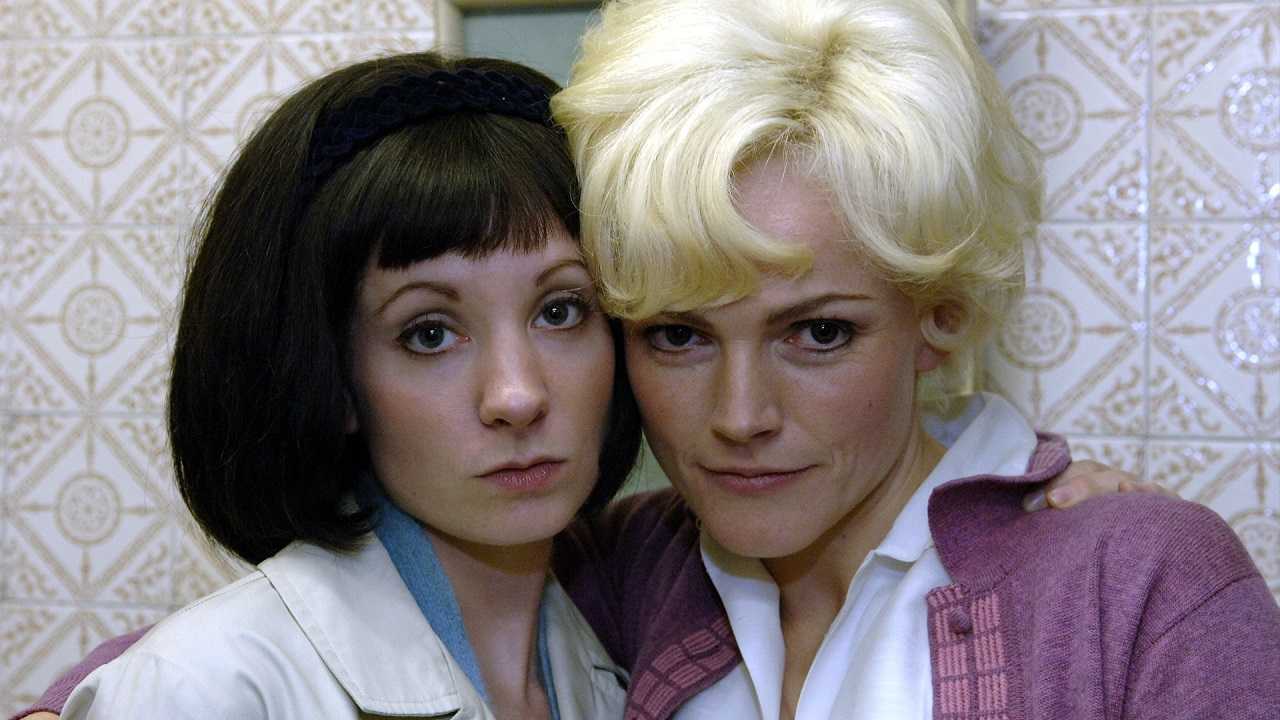
The series top-bills the moderately well-known and rising Joanne Froggatt – who also appeared in three other British true-crime mini-series Danielle Cable: Eyewitness (2003), Murder in the Outback (2007) and Dark Angel (2016) – but the considerable surprise is that she is not cast as the central figure of Myra Hindley but the completely unknown figure of her sister. Aside from that, the two lead actresses appear to have been outfitted with two of the most ugly seeming wigs that the costume department was able to find.
Things perk up somewhat during the second part where we get to police investigation and the attempts made to break Brady and Hindley’s silence in jail, followed by the trial. Certainly, there is no doubt that See No Evil has made an authentic attempt to get all the details of the Moors Murders case down right – as the opening credits note: “Some scenes have been created for the purpose of dramatisation but what follows is based on extensive research.”
The series only very briefly deal with all the drama that occurs after Myra Hindley’s imprisonment – her extensive pleas of innocence, her efforts to obtain parole, her subsequent admission about where one of the bodies was and her conversion to Catholicism, while nothing at all is made of her attempts to escape jail. Although this is presented in a false way where the character of Myra’s brother-in-law David Smith improbably turns from the no-hope plonker he has seen throughout most of the series to a mouthpiece suddenly able to pull apart the logic holes in Hindley’s claims. (The mini-series also tends to whitewash the character of David Smith who in reality had several convictions for violent assault and a reputation as a thug).
There are certainly some pluses to the show. One of these is the presence of Sean Harris as Ian Brady who emerges as a sophisticated fop and plays through an indecipherable accent but charges the show with his presence whenever he is around. Without any doubt, Brady was the dominant figure in the quartet but with the twisted logic that See No Evil seems to operate, he is given the least presence of any of the four central characters. The other one who emerges well is George Costigan, who was considered a British heartthrob back in the 1980s, and stalks about with a fierce intellectual determination as the officer determined to make the case.
Writer Neil McKay has become known for a series true crime thrillers for British television with the likes of This is Personal: The Hunt for the Yorkshire Ripper (2000), In Denial of Murder (2004), Wall of Silence (2004), Appropriate Adult (2011), The Moorside (2017), Four Lives (2022) and The Reckoning (2023), as well as the The Suspicions of Mr Whicher series of tv movies.
Christopher Menaul has been a regular director in British tv since the 1970s, mostly known for the acclaimed British mini-series Prime Suspect (1991) and Killing Jesus (2015). He has occasionally touched on other genre material such as the alternate history film Fatherland (1994), the biopic The Passion of Ayn Rand (1999) and the stalker mini-series Secret Smile (2005).
Trailer here