
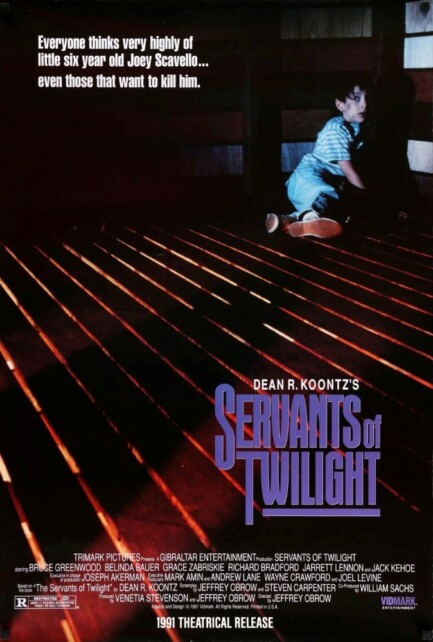
USA. 1991.
Crew
Director – Jeffrey Obrow, Screenplay – Jeffrey Obrow & Stephen Carpenter, Based on the Novel Twilight by Dean R. Koontz, Producers – Jeffrey Obrow & Venetia Stephenson, Photography – Antonio Soriano, Music – Jim Manzie, Special Effects Supervisor – Frank Ceglia, Bat Effects – Michael McCracken, Production Design – Deborah Raymond & Dorian Vernacchio. Production Company – Gibraltar Entertainment/Trimark Pictures.
Cast
Bruce Greenwood (Charlie Harrison), Belinda Bauer (Christine Scavello), Jarrett Lennon (Joey Scavello), Grace Zabriskie (Mother Grave Spivey), Richard Bradford (Henry Rankin), Jack Kehoe (Denton Boothe), Carel Struycken (Kyle Barlow)
Plot
A psychologist talks to Charlie Harrison, a wild-eyed man who has been brought into hospital. Charlie tells his story. As a private investigator, he was hired by solo mother Christine Scavello to protect her and her six year-old son Joey who were being menaced by the fundamentalist Church of the Twilight. Led by Mother Grace Spivey, the Church believed that Joey was the Anti-Christ and were determined to kill him. As Joey began to demonstrate stigmata, Charlie was forced to flee with the two of them. In the course of his flight, Charlie found himself falling for Christine. However, the Church had allies in the most remarkable places.
Servants of Twilight is probably the best of a slew of dreary Dean R. Koontz film adaptations – sitting amongst the likes of Watchers (1988), The Face of Fear (1990), Whispers (1990), Hideaway (1995), Mr. Murder (tv mini-series, 1998) and Sole Survivor (tv mini-series, 2000). That was until the latter half of the 1990s when Koontz adaptations started to get quite good with the arrival of the stunning Koontz tv mini-series Intensity (1997) and the underrated adaptation of Phantoms (1998), as well as the modestly effective tv likes of Black River (2001), Frankenstein (2004) and Odd Thomas (2013).
Servants of Twilight keeps reasonably faithfully to the basics of Dean R. Koontz’s novel Twilight (1984), which he originally published pseudonymously. The film moves well, although there is the clear sense that there is only a constantly moving chase plot that is carrying the film – there is nothing more to the plot other than cultists pursuing detective, mother and child, and always keeping several moves ahead of them. Koontz and the film never expand on the basic premise any more than that.
As with many Dean R. Koontz stories, there is an annoyance to it where Koontz seems to construct his plots in terms of effect rather than clear sense. [PLOT SPOILERS]. One of the big surprises the film pulls is the revelation that the hero’s best friend is a cultist. While effective, the surprise makes little sense – we never get any insight into why such a solid sensible-headed character is drawn to a cult on the lunatic fringe.
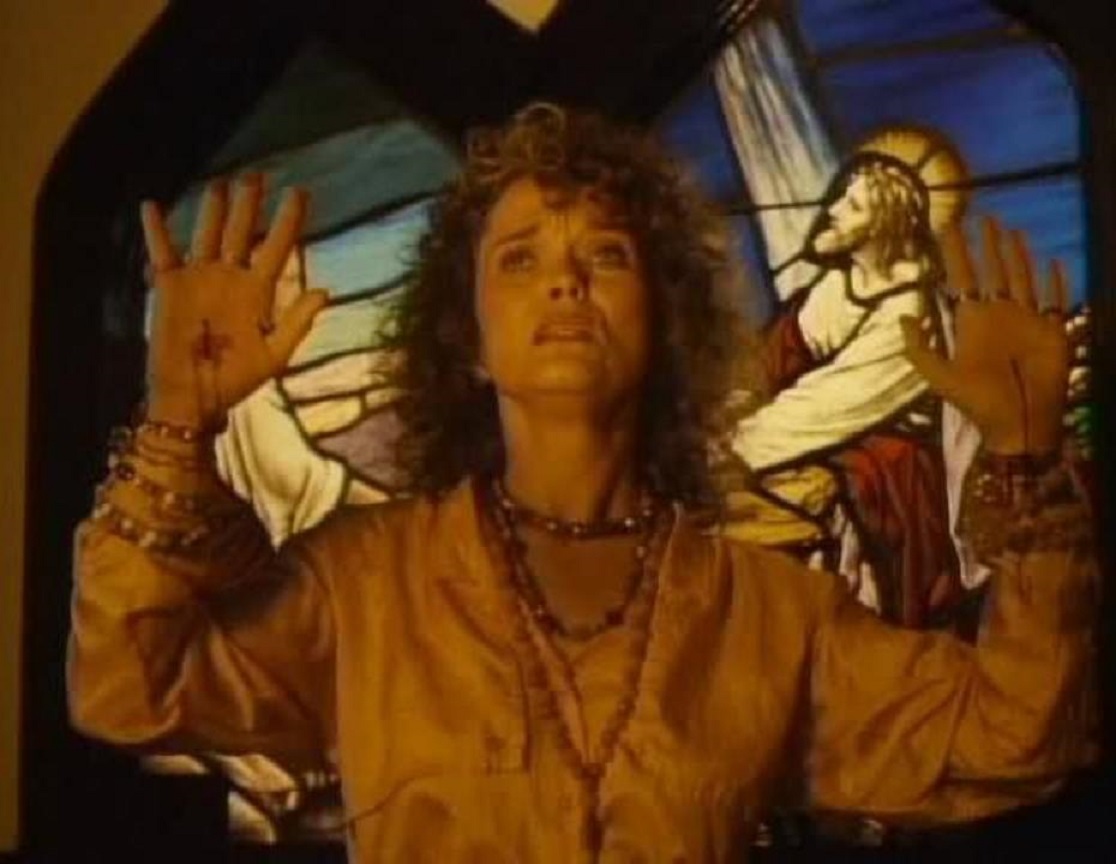
The most annoying surprise that the story pulls [MORE PLOT SPOILERS] is the twist ending that reveals the Church were right about Joey being the Anti-Christ after all. It is an obvious twist in light of the lack of development the rest of the story has. However, in terms of the play of sympathies that run throughout the film, it is an objectionable reversal. Sympathy is built up around Joey as a normal average kid and the cultists as being inhumanely deranged in their single-minded pursuit – it is cynical of a story/film to throw a twist on the entire emotional thrust of the plot by turning around and saying that the people it has portrayed as the lunatic villains of the show were right all along. The equivalent might be if say tv’s The Fugitive (1963-7) were to spend four seasons developing sympathy for its lead character’s innocence and then suddenly pull a twist ending and saying that Richard Kimble was the murderer all along.
Servants of Twilight was also probably the best film of the directing-writing team of director Jeffrey Obrow and his co-writer/sometimes co-director Stephen Carpenter. The two had previously made the low-budget likes of The Dorm That Dripped Blood/Pranks (1982) and The Power (1984) and then the cheesy mad science film The Kindred (1986). The two parted ways after Servants of Twilight. On his own, Jeffrey Obrow went onto make Bram Stoker’s Legend of the Mummy (1997) and They Are Among Us (2004), while Stephen Carpenter made the teen horror Soul Survivors (2001) and went onto create the fairytale tv series Grimm (2011-7).
Trailer here