
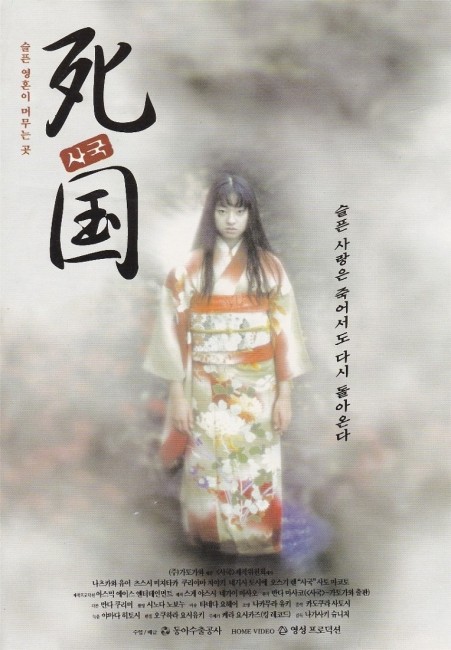
Crew
Director – Shunichi Nagasaki, Screenplay – Kunimi Manda & Takenori Sento, Based on the Novel by Masako Bando, Photography – Niboru Shinoda, Music – Mera, Art Direction – Taneda Yokeni. Production Company – Kadokawa Shone/Shikoku Production/Asmik-Ace.
Cast
Yui Natsukawa (Hinako Myojin), Michitaka Tsutsui (Fumiya), Chiaki Kuriyama (Sayori Hiura), Toshie Negishi (Teruko Hiura)
Plot
Hinako Myojin returns to her childhood village of Yara on the Japanese island of Shikoku after many years. There she learns that her childhood friend Sayori drowned not long after she left. She becomes involved with Fumiya, another childhood friend who always loved Sayori. However, Sayori’s ghost haunts them both. They then learn that Sayori’s mother Teruko, an aging priestess, has spent years conducting a pilgrimage around each of the island’s 88 temples, something that according to folklore, is supposed to keep the spirits of the dead escaping from the underworld. They then discover Sayori’s mother has been travelling around the temples in reverse order, something that will end up releasing the spirits of the dead.
The success of Ring (1998) brought about a new renaissance of Japanese horror. Among the host of Japanese horror films of this period, Shikoku emerges as a nicely old-fashioned ghost story. Certainly, among the new Japanese ghost stories emerging during this era, Shikoku should be noted as one of gentlest and most pleasantly mannered.
Shikoku is a story-driven film, one where the romantic element for once makes up a strong aspect of the story. There is a grandiose idea to the film – that of the island that houses a gateway from which the dead can emerge unless they are kept imprisoned by a series of Shinto rituals paying obeisance in a circuit of each of the island’s 88 temples. (These are ideas in fact taken from the real Shikoku Island’s folklore).
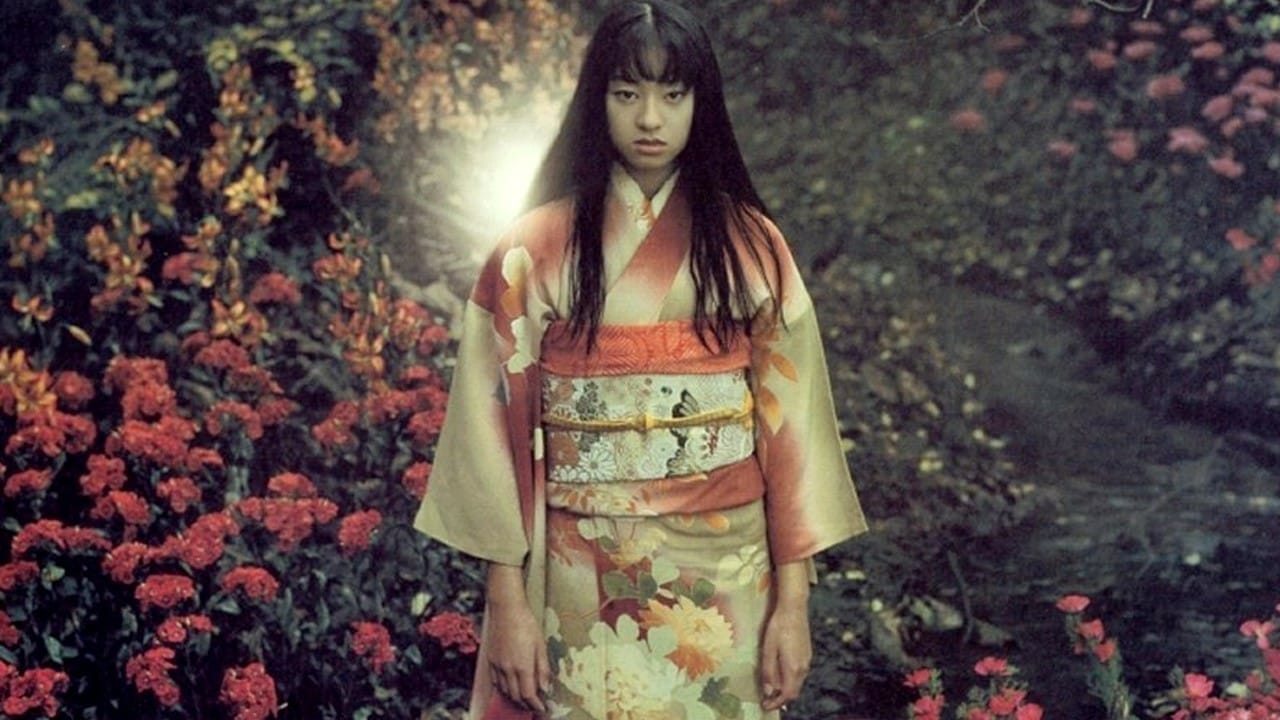
This could well have been the springboard for an epic horror film – about the souls of the dead being unleashed because of one mother’s misguided attempt to raise her daughter from the dead (an idea that we get a glimpse of with the young boy insisting that he can see the ghost of his grandfather). In actuality, the idea emerges much more mundanely – all the gateway to the afterlife is ever used for is to raise a single ghost and, at the climax, despatch her back to the underworld and return things to the status quo.
Nevertheless, the film does contain a number of good scares. There is one great moment where Tsutsui Michitaku sits reading a document and what we think is Natsukawa Yui stands reading over his shoulder. The shot sits focused like that for a few moments – the time it takes us a few moments to realise that it is not Natsukawa Yui reading over his shoulder but the ghost girl. There are some spooky moments at the climax with Kuriyama Chiaki wandering through the house crying “Fumiya, Fumiya” in a mournful voice.
Trailer here