

(Gui Si)
Taiwan. 2006.
Crew
Director/Screenplay – Chao-Pin Su, Producer – Ming Tu, Photography – Arthur Wong Ngok Tai, Music – Peter Kam, Visual Effects Supervisor – Sing-Choong Foo, Visual Effects – Menfond (Supervisors – Eddy Wong & Victor Wong), Makeup Effects – Paul Katte & Nick Nicolaou, Production Design – Yohei Taneda. Production Company – CMC Entertainment/Unit 9 Pictures.
Cast
Chen Chang (Yeh Qi Tung), Yosuke Eguchi (Hashimoto), Karena Lam (Du Wei), Barbie Hsu (Su), Po-Lin Chen (Ren), Chun-Ning Chan (Mei), Kuan-Po Chen (Yao, the Ghost Child), Masane Tsukuyama (Director), Wan Fan (Zheng Chun the Ghost Mother), Kevin S. Smith (James Carmen), Chih-Chin Ma (Tung’s Mother), Wen-Ping Wan (Teacher), Tung-Lin Shih (Drunk Man)
Plot
In Taipei, the Japanese scientist Hashimoto gets in trouble for having forged a high-ranking minister’s signature to commandeer an apartment building. When dragged in over it, Hashimoto demonstrates a working cube of the Menger Sponge that he has discovered, which is capable of defying gravity, and says he can find more if allowed to continue. Granted the freedom to do so, he requests the assistance of police detective Yeh Qi Tung. Tung enters the house and is sprayed with eyedrops of Menger Sponge by Hashimoto’s assistants. These reveal that Hashimoto holds a ghost boy prisoner in a room where he is unable to leave because the Menger Sponge traps his energy. Hashimoto wants Tung to find out who the boy is and so Tung begins an experiment by releasing the boy and following him as he goes through the ritual of his old life. They also discover that whenever someone looks into the boy’s eyes, this triggers his hatred and he kills them. Tung starts to uncover the story of the boy’s murder by his mother and how he gains endless energy because his body was buried inside the torus of a cyclotron. The boy’s mother then dies – because she is connected to the boy by miniscule silk threads, her ghost now comes to kill all involved in the experiment.
Silk is a Taiwanese venture into the popular Asian horror genre that became a boom industry in the 2000s following the success of the Japanese Ring (1998). Silk was the second film directed by Chao-Pin Su. Su has previously directed the non-genre Better Than Sex (2002), a series of vignettes about modern relationships, as well as written a couple of horror films for other directors with one of the segments of Three/Three Extremes II (2002) and the supernatural/serial killer film Double Vision (2002). He would subsequently travel to China to make the Wu Xia Reign of Assassins (2010), as well as wrote the scripts for John Woo’s The Crossing (2014) and sequel.
Silk proves a captivating variant on the Asian horror film. One of the most fascinating parts of the film is when it tries to combine the traditional elements of the Asian horror film with modern science – like the scenes where Chen Chang comes to the apartment building, has the sponge sprayed in his eyes and is suddenly able to see the boy kept imprisoned in the glass-walled apartment.
These lead to some fascinatingly eerie scenes like where Chen Chang suddenly realises that the boy can kill and they race back as Yosuke Eguchi returns to find Barbie Hsu in the room and locks her in, only for the boy to appear out of her pocket, hidden in a piece of newspaper where she was attempting to smuggle him out, and then attacks her, mysteriously winding silk threads towards her and plunging his hand into her throat. The second incredibly spooky moment comes immediately after as they drag Barbie Hsu’s body away and suddenly in the middle of doing so, a version of her abruptly sits upright and we realise that she has just died. It is scenes like these that immediately make one pay attention to Silk as something worth watching.
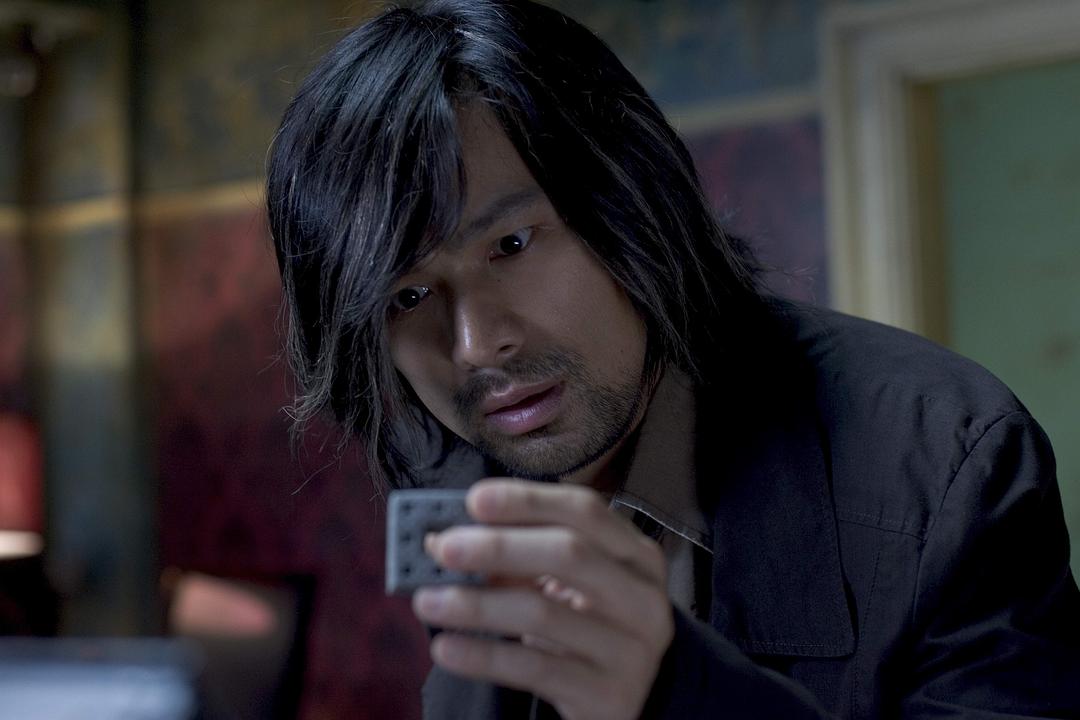
During the middle sections, Silk becomes a fascinating supernatural detective story. There is an intense eeriness to the scenes of Chen Chang following the boy, especially the boy’s attack on the man urinating by a phone booth who accidentally looks at the boy, where everything goes out of control all at once as Chen pulls his gun to try and save the man, only for a nearby cop to pull his gun on Chen and Chen being forced to wound him; or where the boy comes right up to Chen Chang’s face and looks at him and Chang is forced to keep his eyes downcast.
Undeniably, there is something of Ju-on: The Grudge (2003) to the film with the ghost boy and later his mother able to appear out of pockets, under the table in a restaurant, even out of a bowls of noodles but director Chao-Pin Su has a great sense for the eerily otherworldly. It becomes fascinating watching Silk just to see where the film is taking all of these wild ideas.
On the other hand, Silk is two-thirds of a very good film but falls apart during the last third – about the point that the mother’s ghost enters the scene. At this point, everything goes off at a tangent. The professor somehow manages to absorb the boy inside his cube of sponge and then develops a little-explained obsession with dying. After the mother becomes a ghost, we see miniscule silk threads attached to people’s feet and everywhere – although the significance of these is never properly explained. (For that matter, we never find out what the Menger Sponge is meant to do and why its discovery is so important).
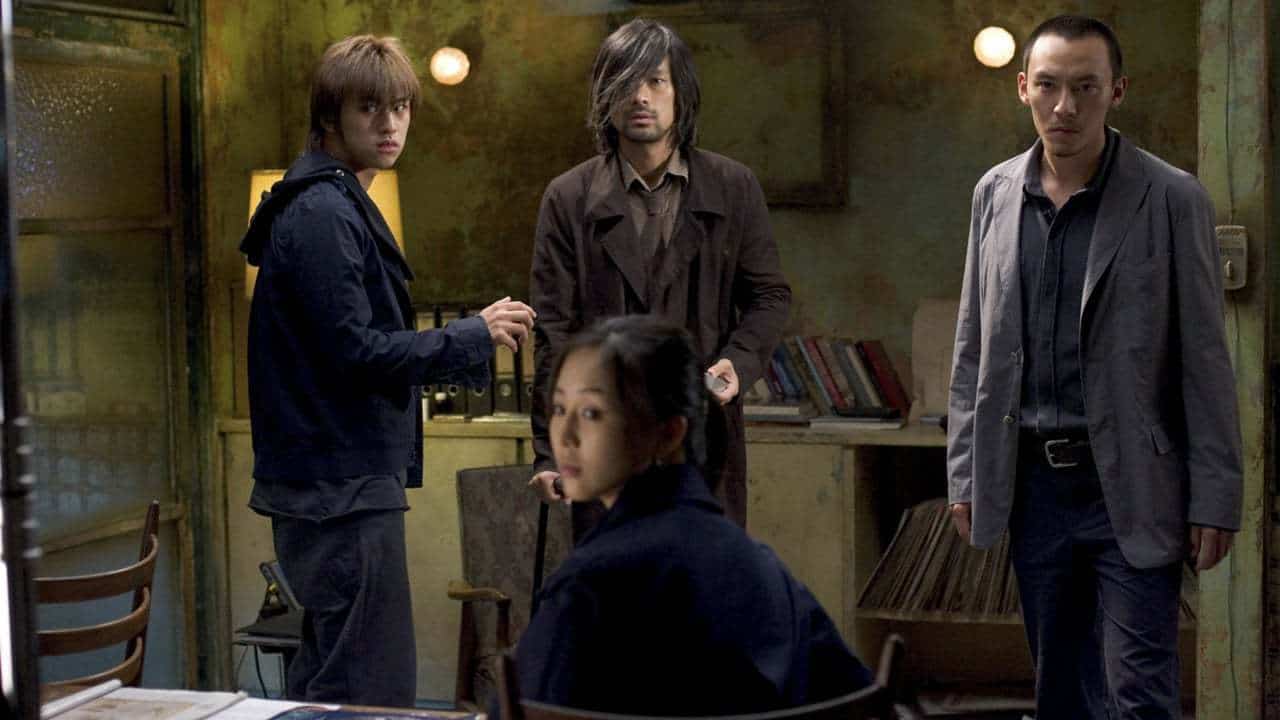
More routinely, the mother simply becomes an avenging ghost and starts killing everyone who has been associated with the experiment. The film starts to lose hold of the fascinating conceptual juggle of ideas it has held up to that point either because Chao-Pin Su didn’t know where to take the story or because juggling all the elements becomes too much. Towards the end, we simply lose track of where the story is going.
Su does leave us with a marvellous coda though [PLOT SPOILERS], one where Chen Chang’s mother appears to undergo her operation, where he takes her home again, only to fall into dismay as she goes over to the sink and starts to cook eggs in exactly the same way she did when she was hospitalised, but then both she and the egg suddenly disintegrates and we realise than Chao-Pin Su has subtly misdirected us M. Night Shyamalan-style to believe that she was still alive and that what we have been seeing is her ghost going through its repetitive moves.
Trailer here