

Crew
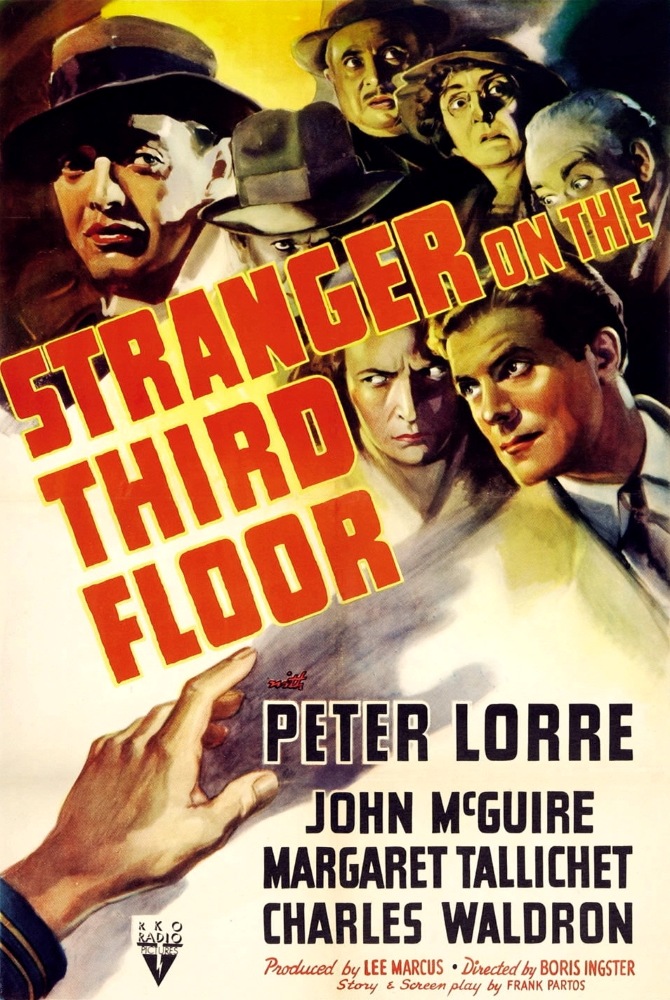
Director – Boris Ingster, Screenplay – Frank Partos, Producer – Lee Marcus, Photography (b&w) – Nicholas Musuraca, Music – Roy Webb, Special Effects – Vernon L. Walker, Art Direction – Van Nest Polglase. Production Company – RKO Radio Pictures.
Cast
John McGuire (Michael Ward), Margaret Tallichet (Jane), Peter Lorre (The Stranger), Elisha Cook Jr (Briggs), Charles Halton (Albert Meng), Ethel Griffies (Mrs Kane), Oscar O’Shea (The Judge)
Plot
Reporter Michael Ward is the key witness in a murder trial. His evidence – that he saw the accused Briggs standing over the body of a man in a diner – is instrumental in having Briggs deemed guilty. Afterwards however, Ward’s fiancee Jane is concerned as to whether Ward was correct in what he saw and Ward becomes haunted by this question. Next Ward’s neighbour is killed the same way as the man in the diner. Ward is arrested after trying to point this out to the police. And so Jane goes out to try and clear Ward by finding the sinister stranger that Ward saw on the stairwell.
Stranger on the Third Floor is a fascinating artifact from the great age of film noir. (In fact, it has been cited as the very first ever film noir). It has a minor reputation, although nothing that prepares one for what an extraordinary film it turns out to be.
The way it starts out, Stranger on the Third Floor seems like it is going to be a B courtroom drama. The heavy-handed symbolism – the cutting away to the blind statue of justice looking over the courtroom – makes it initially seem likely to be a thoroughly pedestrian exercise. It then starts to become rather interesting. Where everything up to that point had seemed straightforward, the film then starts to blur the line of certainty about the hero’s resolute belief that Elisa J. Cook is the killer. The flashbacks and the hero’s voiceovers then start to reveal an increasing sense of pent-up violence upon his part.
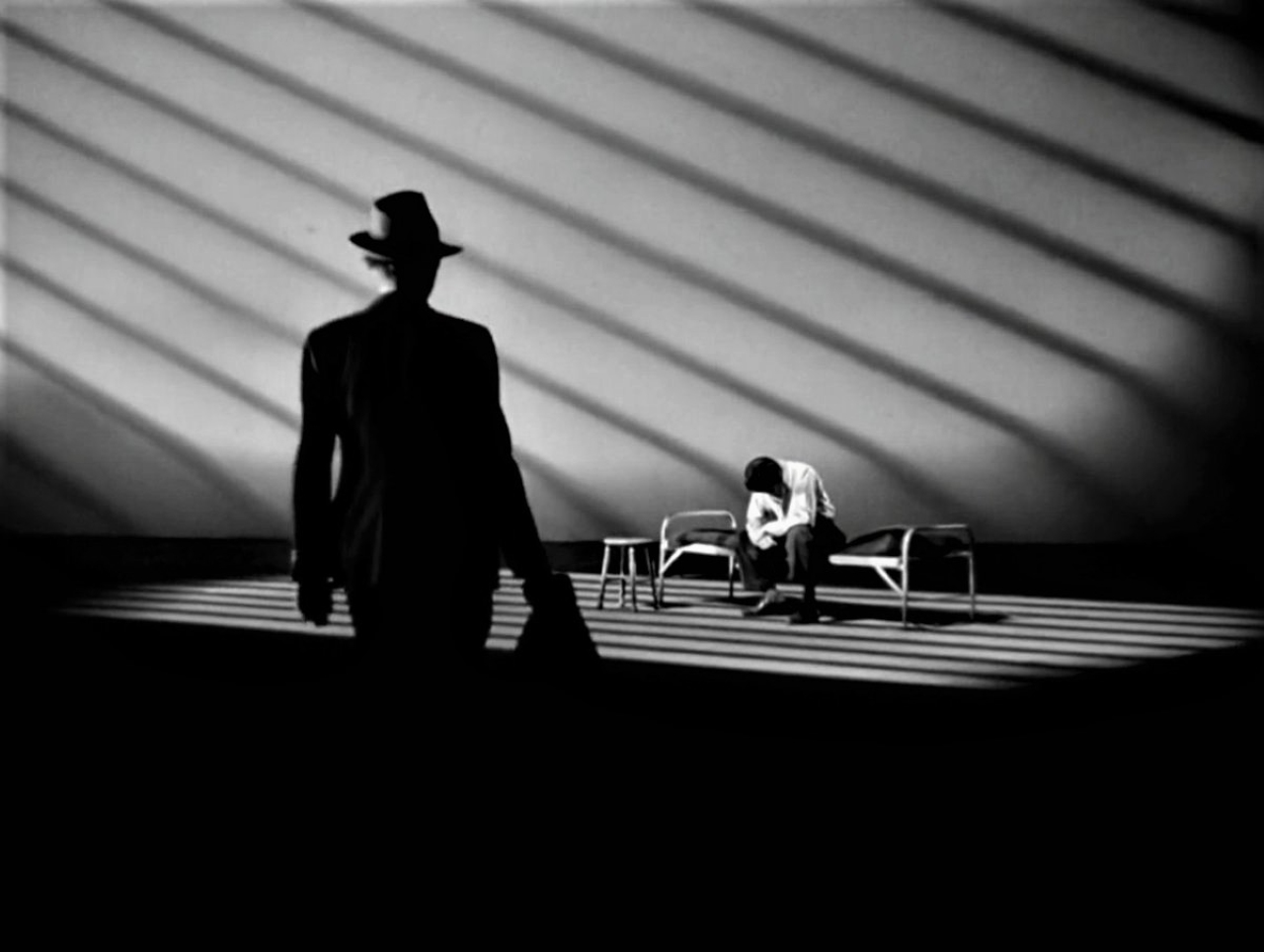
The film is at its most fascinating when it ventures into outright surrealism in a dream sequence where the hero is accused of murder, which comes filled with striking images such as the blind Lady Justice statue sitting at the judge’s bench; newspapers with headlines that only say the single word ‘Murder’; the jury all asleep; and some amazingly stylised shadow lighting schemes, including the giant shadow of an electric chair cast over the room as the hero is dragged away.
It is in the casting of Peter Lorre that the film ventures into outright psycho-thriller territory. Lorre has definitely been cast as a result of his famous part in M (1931). M was a psycho-thriller that came at the end of the great era of German Expressionism. However, Stranger on the Third Floor retreats even further back into Expressionism than M ever did – director Boris Ingster casts Peter Lorre as though he were a frightened rat scuttling about and surrounds him in shadows and stark angles whenever he is about. There is a real creepy weirdness in the scenes where Lorre follows the heroine home. Although here, just when the film has started to build rather interestingly, it abruptly stops and winds things up as though a predetermined length for a supporting feature had been reached.