
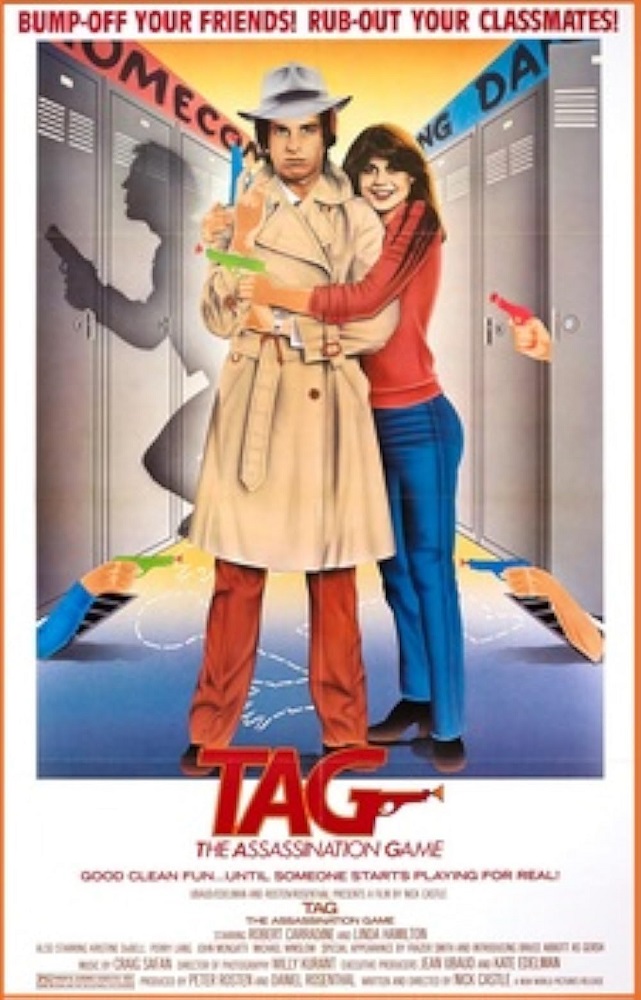
aka Everybody Gets It in the End; Kiss Me, Kill Me
Crew
Director/Screenplay – Nick Castle, Producers – Daniel Rosenthal & Peter Rosten, Photography – Willy Kurant, Music – Craig Safan, Production Design – Peter Politanoff. Production Company – TAG Productions.
Cast
Robert Carradine (Alex Marsh), Linda Hamilton (Susan Swayze), Bruce Abbott (Loren Gersh), Perry Lang (Frank English), Frazer Smith (Nick Carpenter), Kristine De Bell (Nancy McCauley)
Plot
University student Alex Marsh is woken from his sleep when beautiful Susan Swayze bursts into his dorm room. She is trying to avoid her hunter in a game of TAG – a campus game where students hunt and ‘kill’ each other with sucker-tip guns. Alex is drawn to Susan. On the pretext of writing an article about TAG for the campus newspaper, he accompanies Susan during the hunt for her assigned victims. Meanwhile, the long-reigning TAG champion Loren Gersh fumbles his target and is ‘killed’. This causes Gersh to snap and become psychotic. He then takes a gun and starts killing his victims for real.
TAG: The Assassination Game is a relatively obscure film from the early 1980s. It was never widely seen when it came out and has failed to emerge on video or dvd since. TAG comes with an interesting premise. It has been taken from the popular campus game TAG (The Assassination Game) – also known variously on campuses around the world as Assassin, Elimination, Gotcha, KAOS (Killing As Organised Sport) and Paranoia. The basic concept of the game is an elimination round-robin where players are assigned targets to ‘kill’, although the target does not know who is hunting them. The kill must be conducted with the use of toy sucker-tip guns or water pistols, although sometimes more inventive weapons such as fake knives, bombs or attempts to ‘poison’ players is used. The person who makes the successful kill then inherits the victim’s target and the game is won when only one player is left standing.
This is certainly an original premise for a film and gives TAG: The Assassination Game an undeniable novelty value. Ultimately in presenting the game in the context of a psycho film though, one feels that TAG only denigrates its subject matter. The author, having indulged some of his misspent university years playing the game, can attest that the players are not as paranoid, do not appear to be hovering on the verge of psychotic breaks, nor are wholly obsessed by the game to the exclusion of all else as presented in the film – at most you could accuse some of them of an excessive nerdiness.
Essentially the film buys into a public hysteria – the same sort that believes watching horror/violent movies causes people to commit violence or that playing Dungeons and Dragons or reading Harry Potter opens up doorways to the occult and Satanism. It is the ill-conceived prejudice – the belief that anybody engaging in make-believe recreational forms of what would otherwise be socially taboo activities has no ability to differentiate between reality and fantasy and are all susceptible fools on the verge of being swallowed up by the real thing.
TAG: The Assassination Game has gained a small but modest degree of acclaim but I ended up being disappointed by it. The film has a great premise but it seems to miss a good many opportunities to do anything with its idea. Played in a different way, the film could have made great mileage out of the potential confusions between the killings in the game and its psycho’s actions. A better script could have wound a corkscrew of tensions, confusions and reality flips, not to mention derived a good deal of black humour, out of this. Contrarily, this side of things is oddly an aspect that director-writer Nick Castle completely neglects. Remove the handful of scenes where we see people engaged in playing TAG and all we would be left with is a rather ordinary psycho film. There is nothing more sophisticated to the film’s development of its premise than that.
Director/writer Nick Castle was a former associate of John Carpenter – he played Michael Myers in Halloween (1978) and co-wrote Escape from New York (1981). (Carpenter even names a character in The Fog (1980) after Castle, which Castle returns the favour here with a character named Carpenter). On his own, Castle previously wrote the tv evangelist satire Pray-TV (1980) and then made his directorial debut with TAG: The Assassination Game. Subsequent to TAG, Castle enjoyed some success with two genre films, The Last Starfighter (1984) and The Boy Who Could Fly (1986). Subsequently, Castle has specialised in light mainstream films such as Tap (1989), Dennis the Menace (1993), Major Payne (1995), Mr Wrong (1996), the angel fantasy Delivering Milo (2001), the sf/action film Connor’s War (2006), and various tv fare, as well as came up with the story for Steven Spielberg’s Hook (1991).
Despite some occasionally neat set-ups from Nick Castle, TAG: The Assassination Game is predictable. There is never much subtlety or ambiguity to Castle’s direction. There are also some silly pieces of plotting – it is hard to believe that anybody would fall for the gag where Robert Carradine announces over the campus P.A. system that there is a free Grateful Dead concert being held in order to get rid of Linda Hamilton’s hippie pursuer. There are occasional stylish set-ups – Bruce Abbott timing a killing to coincide with a starter gun to disguise the noise of the gunshot; the pan up from Linda Hamilton looking at her target profile to see a psychotic Bruce Abbott standing there; the climactic scenes with Abbott crawling around a dancefloor looking for his gun. On the other hand, there is nothing here that could ever compete with the directorial elan shown by Nick Castle’s mentor John Carpenter in his various films.
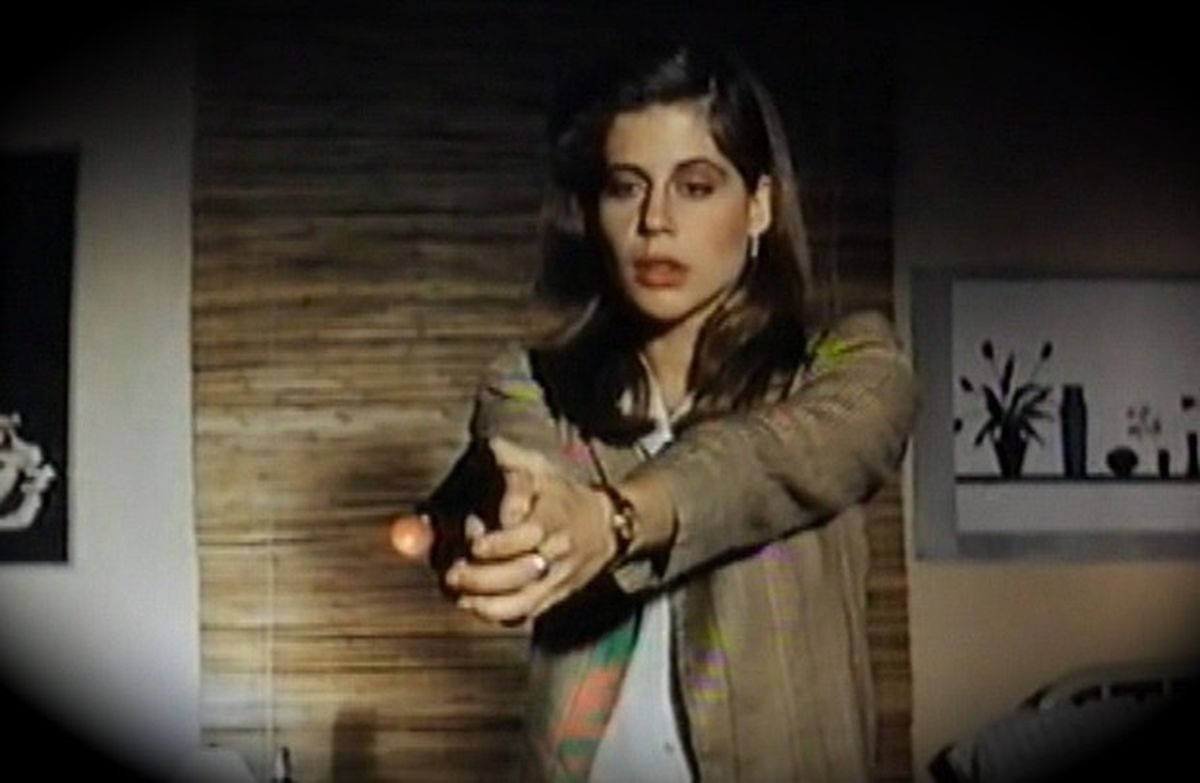
Linda Hamilton appears here in her first screen performance, a couple of years before she broke out as Sarah Connor in The Terminator (1984). Hamilton always excels when she gets to give tough, sexy performances like this and she is the most sophisticated thing the film has on offer. (She and Bruce Abbott met on the set of TAG and married shortly after the film came out). Nick Castle clearly plays to her presence, seductively outlining her in overwrought film noir lighting when she first appears. There are some interesting other fresh faces, including Forrest Whitaker in his first screen role, playing Bruce Abbott’s bodyguard. A low point is the appearance from Michael Winslow of Police Academy (1984) fame as one victim who is a percussive noise performer.
The campus killing game concept also appeared in another film around the same time with Gotcha (1985) starring Anthony Edwards, although that had even more far-fetched plot that propelled Edwards into a spy game in Europe.