
Crew
Director – D.J. Caruso, Screenplay – Joe Bokenkamp, Based on the Novel by Michael Pye, Producers – Mark Canton & Bernie Goldmann, Photography – Amir Mokri, Music – Philip Glass, Visual Effects – Pacific Title and Digital (Supervisor – David Sosalla), Special Effects Supervisor – Louis Craig, Prosthetics – Bruno Gatien, Jonathan Lavallee, Jutras Martin & Adrien Morot, Production Design – Tom Southwell. Production Company – Warner Brothers/Village Roadshow/Mark Canton.
Cast
Angelina Jolie (Agent Illeana Scott), Ethan Hawke (James Costa), Tcheky Karyo (Inspector Leclair), Olivier Martinez (Joseph Paquette), Kiefer Sutherland (Christopher Hart), Jean-Hugues Anglade (William Duval), Gena Rowlands (Mrs Asher), Paul Dano (Young Martin), Justin Chatwin (Matt Soulsby)
Plot
FBI agent and renowned criminal profiler Illeana Scott is called to Montreal by a police friend to help with the investigation of a murder that is suspected to be the activity of a serial killer. Shortly after she arrives, art dealer James Costa is found as a witness near the scene of a fresh victim and is able to help build an identikit picture of the killer. Following the trail, Illeana realises that the killer is Martin Asher. Asher is believed to have died twenty years ago but has in fact killed a series of victims and adopted their identities – that he specialises in ‘taking lives’. They then discover that the killer is targeting Costa, intending to next steal his identity. As they try to protect Costa, Illeana finds that she is becoming attracted to him.
When Taking Lives came out, it was nearly a decade and a half since the enormous success of The Silence of the Lambs (1991) and its creation of a public fascination with serial killers and forensic psychological profiling. There were an enormous number of copies made of The Silence of the Lambs and the serial killer genre became a regular thematic terrain for thrillers. 2004 saw a mini-revival of the serial killer thriller genre on the big screen with Taking Lives, the very similar Twisted (2004), released only three weeks before, which also featured Ashley Judd as a female detective who is targeted by an obsessed killer, and Renny Harlin’s Mindhunters (2004). (Far better were the revivals of the serial killer genre that came from European countries such as Antibodies (2005) from Germany and the tv movies Cold Blood (2005-6) from the UK). (I have a listing of these under Serial Killer Thrillers).
Taking Lives comes from director D.J. Caruso. D.J. Caruso’s previous film, his big screen debut, was The Salton Sea (2002), one of the most underrated and visually striking thrillers of recent years. On the basis of The Salton Sea, D.J. Caruso seemed a director of immense promise and one sat down to watch Taking Lives with a great deal of anticipation. Certainly, the look of Taking Lives is stylish and cool. Not a breathtakingly so as The Salton Sea but the film does move with a composed elegance – from the opening that effectively pillages the fractured credits from the other great serial killer thriller Se7en (1995) to the wonderfully brooding score from Philip Glass.
Only Taking Lives fails to work. Or at least it sits halfway between being effectively cool and stylish and the hackneyed. For the style he demonstrates elsewhere in the film, particularly the chase sequences, D.J. Caruso also throws up a number of jumps that are just schlocky – bodies falling out of ceilings and an especially silly scene where Angelina Jolie lies down on a bed in the killer’s hidey-hole and an arm smashes up from beneath the bed and through the mattress (!!!) to grab her around the neck.
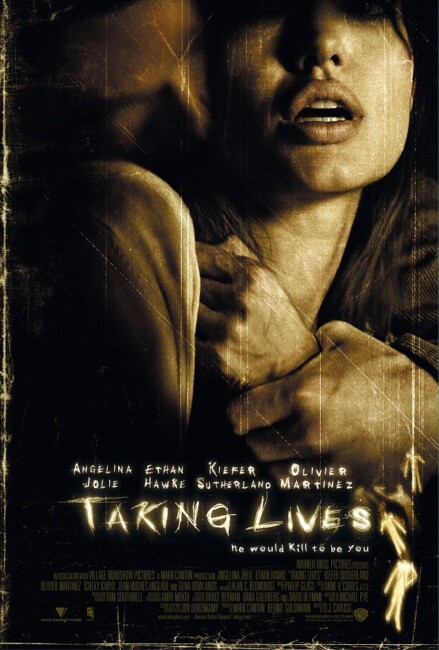
What brings Taking Lives down is a poor script. The big twist is something that one can see coming a good twenty minutes in advance. Neither Caruso nor scriptwriter Joe Bokenkamp achieve it with any subtlety – the sheer lack of time devoted the suspect they want us to believe is the killer vs the amount of time that is devoted to a supporting witness, even the priority of the respective actors names in the credits and poster, tips all of this away. The film’s final twist ending trap is not in the slightest bit convincing – one fails to believe for the slightest moment that any of Angelina Jolie’s fall from grace and move to a caricatured rural farmhouse, literally barefoot and pregnant, is in the slightest bit what it seems.
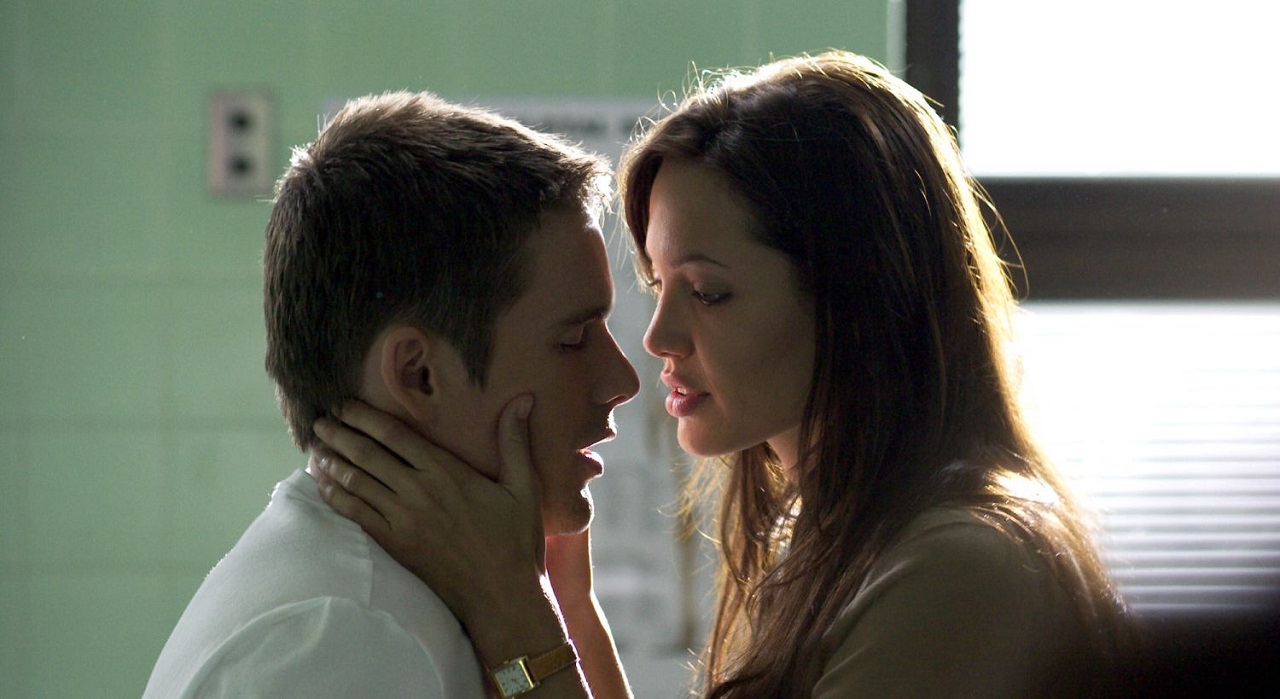
A good part of the problem here is Angelina Jolie herself who fails to invest anything in the film. She remains entirely aloof throughout, merely staring at us with her cat-like eyes. She fails to convince or even project any emotion during the romantic scenes, and her betrayal and fall from grace never involves anything more than a vaguely troubled expression crossing her face.
One commendable aspect about Taking Lives is the Montreal locations. In itself a Montreal location is no big deal – American films and tv series have been popping across the border to shoot in various parts of Canada (and more importantly take advantage of tax breaks and a lower exchange rate) with a great deal of regularity. In the past, American filmmakers, and even Canadian filmmakers in a strange case of identity crisis, have always dressed Canadian locations up and pretended that they were American cities. Indeed, Angelina Jolie’s previous venture into the serial killer thriller genre The Bone Collector (1999) is a perfect example of a Canadian location (also Montreal) being disguised as an American one (New York City).
Taking Lives is one film that reverses this trend and welcomely so – it would have taken no effort whatsoever for the location to have been rewritten as an American city but instead D.J. Caruso and the filmmakers have gone to the extra effort of making it seem authentic, right down to casting French-speaking actors and subtitling the French. Even if in the end they cast French actors – Tcheky Karyo, Olivier Martinez, Jean-Hugues Anglaude – in the parts, rather than native Quebecois actors. (The accent difference is noticeable, I am informed by Quebecois friends). Quite possibly the difference is simply that there are no well-known Quebecois actors on the world stage for the film to cast. (The only names that one can think of are Lothaire Bluteau and Genevieve Bujold – unless you want to count William Shatner). Nevertheless, Taking Lives gets full marks for defying the ridiculous Americano-centric belief that insists that audiences would not possibly sit down to watch anything that takes place in a non-American city.
D.J. Caruso later returned to the serial killer genre with Disturbia (2007), another disappointingly bland film about a teenager discovering that his neighbour is a serial killer, and a further film with LaBoeuf, the techno-thriller Eagle Eye (2008) about a marauding AI, followed by I Am Number Four (2011) about an alien teenager on Earth, the haunted house film The Disappointments Room (2016), xXx: Return of Xander Cage (2017) and the imprisonment thriller Shut In (2022). In these, Caruso’s earlier display of considerable style has been replaced by tired cliches and borrowings from much better films.
(Nominee for Best Musical Score at this site’s Best of 2004 Awards).