
Crew
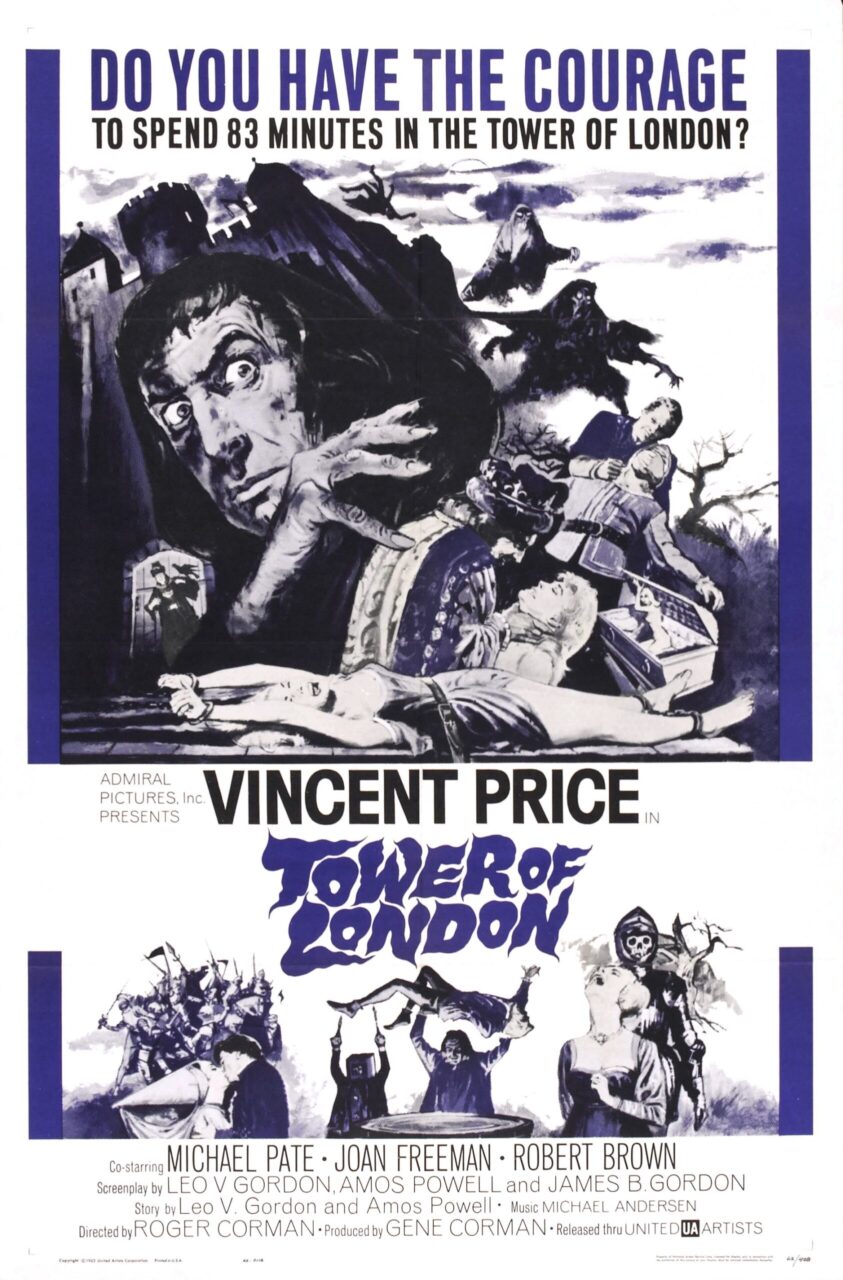
Director – Roger Corman, Screenplay – James B. Gordon, Leo V. Gordon & Amos Powell, Story – Leo V. Gordon & Powell, Producer – Gene Corman, Photography (b&w) – Arch R. Dalzell, Music Supervisor – Michael Andersen, Special Effects Supervisor – Modern Film Effects, Makeup – Ted Coodley, Art Direction – Daniel Haller. Production Company – Admiral Pictures.
Cast
Vincent Price (Richard Plantagenent), Michael Pate (Sir Ratcliffe), Joan Freeman (Lady Margaret), Robert Brown (Sir Justin), Richard Hale (Tyrus), Sandra Knight (Mistress Shaw), Joan Camden (Anne), Justice Watson (King Edward IV), Charles Macaulay (George, Duke of Clarence), Sarah Selby (Queen), Donald Losby (Prince Richard), Eugene Martin (Prince Edward)
Plot
England, 1483. Richard Plantagenet, the brother of the King Edward IV, is shocked when just before he dies Edward appoints his other brother, the ineffectual Clarence, as Protector of his two young sons Edward and Richard, the heirs to the throne. Richard then stabs and drowns Clarence in a barrel of wine and becomes the Protector. He goes on to kill the boys and all those who question or stand in the way to his becoming the king. However, his mind begins to give as he sees the ghosts of those he has killed tormenting him.
Tower of London is a remake of The Tower of London (1939), which was made during the height of Universal starring Basil Rathbone as Richard III and Boris Karloff as the executioner. (In a trivia note, Vincent Price played in both films – in fact, the original Tower of London was only Vincent Price’s third appearance on film where he played the part of Richard’s brother Clarence).
Tower of London was remade by Roger Corman. Corman was then at the height of his critical acclaim with his Edgar Allan Poe films begun with The House of Usher (1960) and he briefly moved away from his home at AIP to make this. The 1939 Tower of London is sometimes cited as a horror film, more so because it has a sinister Boris Karloff lurking as an executioner but bar a couple of murders that are played for lurid effect cannot be regarded as horror. No such doubts trouble Roger Corman.
Indeed, the portrait of Richard III is taken direct from William Shakespeare and his demonising of Richard III in Richard III (1592) rather than any historical textbook. Despite exhaustive analysis of the subject, the only thing that historians agree on is how inconclusive historical documentation is about the real Richard III. The one thing that distinctly emerges is that there is no clear evidence that can conclusively prove that Richard had any hand in the murder of the princes, or indeed any of the other murders usually attributed to him. There is not even any proof that Richard was physically deformed in any way. Rather Richard’s infamy is something that can be more attributed to Henry Tudor, who took the throne as Henry VII after Richard’s death at Bosworth Field in 1485, and made a determined effort to paint Richard and the house of Plantagenent in the vilest light.
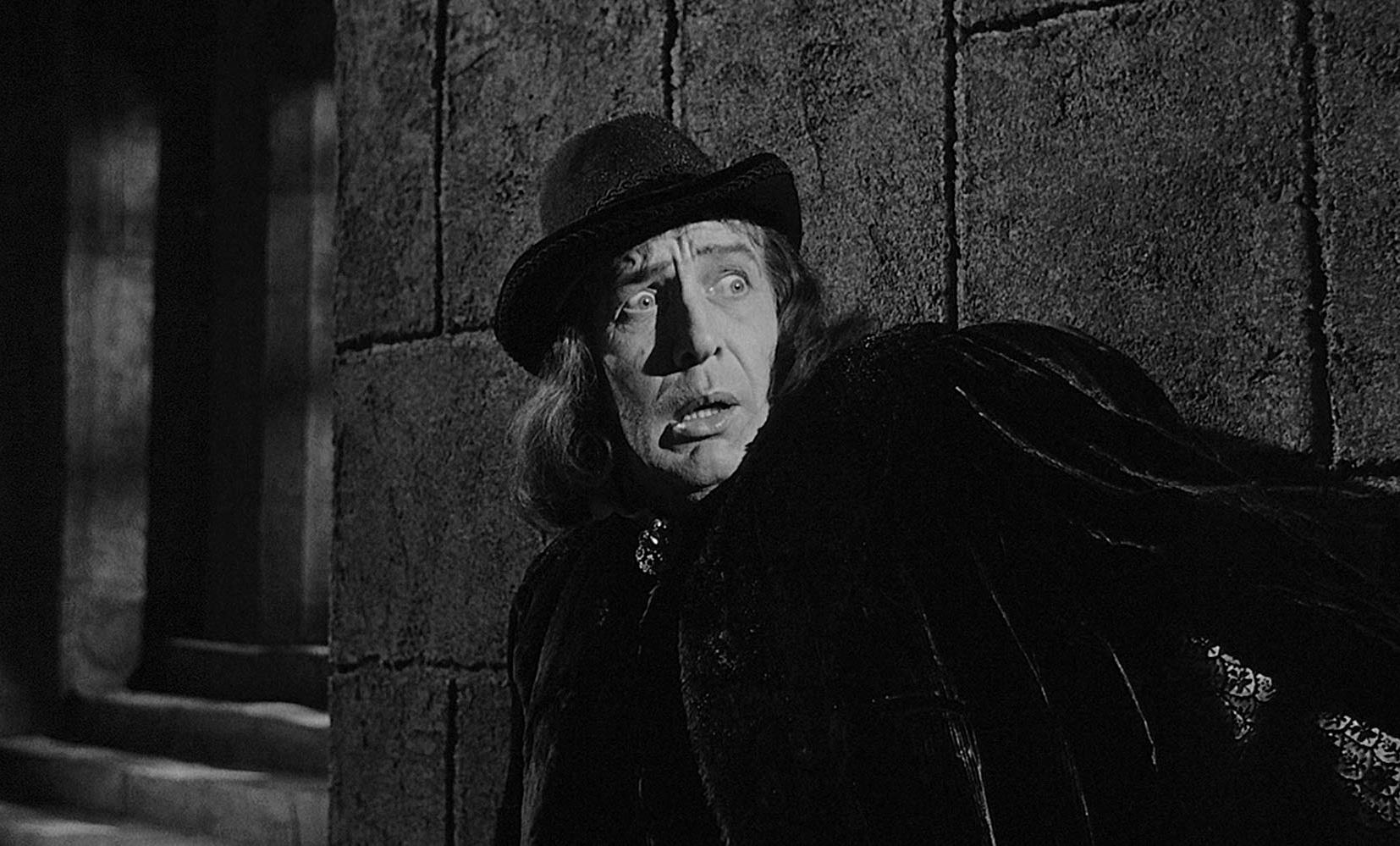
As such, Tower of London 1962 is William Shakespeare’s Richard III mounted as one of Roger Corman’s Edgar Allan Poe films. Vincent Price, who starred in six of the Corman Poe films, plays another of the Poe cycle’s doomed, melancholy heroes. Roger Corman surrounds him with ghosts, magicians with ravens and the like, such that Tower of London becomes a Poe film in all but name. Vincent Price’s meltdown into tortured guilt comes at the beginning rather than toward the end as it might in any other film, which tends to tip the dramatic balance of the story the wrong way. The rest of the time Roger Corman focuses on the Grand Guignol sadism and torture set-pieces – a cage filled with rats placed on a victim’s head, a woman tortured on a rack, Richard drowning his brother in a barrel of wine. As such, Tower of London proves modestly entertaining.
Roger Corman’s other genre films as director are:– Day the World Ended (1955), It Conquered the World (1956), Attack of the Crab Monsters (1957), Not Of This Earth (1957), The Saga of the Viking Women and Their Journey to the Waters of the Great Sea Serpent (1957), The Undead (1957), Teenage Caveman (1958), War of the Satellites (1958), A Bucket of Blood (1959), The Wasp Woman (1959), The House of Usher/The Fall of the House of Usher (1960), Last Woman on Earth (1960), The Little Shop of Horrors (1960), Creature from the Haunted Sea (1961), Pit and the Pendulum (1961), Premature Burial (1962), Tales of Terror (1962), The Haunted Palace (1963), The Raven (1963), The Terror (1963), X – The Man with X-Ray Eyes (1963), The Masque of the Red Death (1964), The Tomb of Ligeia (1964), The Trip (1967), Gas; or It Became Necessary to Destroy the World in Order to Save It (1970) and Frankenstein Unbound (1990). Corman’s World: Exploits of a Hollywood Rebel (2011) is a documentary about Corman’s career.