


Crew
Director – John Stockwell, Screenplay – Michael Arlen Ross, Producers – Marc Butan, Scott Steindorff, John Stockwell & Bo Zenga, Photography – Enrique Chediak, Underwater Photography – Peter Zuccarini, Music – Paul Haslinger, Music Supervisor – David Falzone, Visual Effects – Stargate Visual (Supervisor – Eric Grenaudier), Additional Visual Effects – Custom Film Effects (Supervisor – Mark Dornfeld) & Pacific Title and Art Studio (Supervisor – Rick Sparr), Special Effects Supervisor – Mauricio Bevilacqua, Prosthetic Makeup Effects – MastersFX, Inc. (Supervisor – Todd Masters), Production Design – Marlise Storchi. Production Company – Fox Atomic/2929 Productions/Stone Village Productions/BoZ Productions.
Cast
Josh Duhamel (Alex), Melissa George (Pru), Olivia Wilde (Bea), Desmond Askew (Finn), Beau Garrett (Amy), Max Brown (Liam), Agles Steib (Kiko), Miguel Lunardi (Zamora), Jorge So (Bus Driver)
Plot
A group of tourists from different countries are on a bus through remote Brazil. However, the driver is travelling at a reckless pace and causes the bus to crash over a cliff. All manage to get out safely. They learn that it could be days before a replacement bus comes but then discover a bar on a nearby beach. That night they drink and party, only to wake in the morning and find that their drinks have been spiked and that they have been robbed of everything but the clothes they wear while they were out. They go to the nearby township to find the police. After a fracas with a boy that they find wearing items of their clothing, the locals turn hostile. One local Kiko offers to take them to safety at his uncle’s house and leads them on a trip through the jungle. What they do not know is that Kiko has agreed to deliver them to a blackmarket operation that butchers people in order to harvest their organs.
To put it plainly, Turistas is a blatant attempt to copy Hostel (2005). Where Hostel had a group of innocent backpackers lured to remote Slovakia to be used as the sadistic playthings for paying clients, Turistas has a group of backpackers waylaid in remote Brazil where they are brutally harvested for their organs.
As is fairly much expected for this type of film, director John Stockwell throws up lots of gratuitous sadism – fingers macheted off, a fleeing woman who falls over a cliff and splatters her brains, villain Miguel Lunardi impaling a kebab stick through a lackey’s eye. There is also the sense that Stockwell is only throwing these in because gratuitous sadism was the big selling point about Turistas‘ source of inspiration Hostel. Crucially, there is not the same genuinely disturbing about-to-upchuck effect here that Eli Roth achieved out of the similar scenes in Hostel. (The one exception is a very gory scene where we see Beau Garrett’s stomach being cut up on an operating table – although that was cut from the cinematic release and is only available on the unrated dvd version).
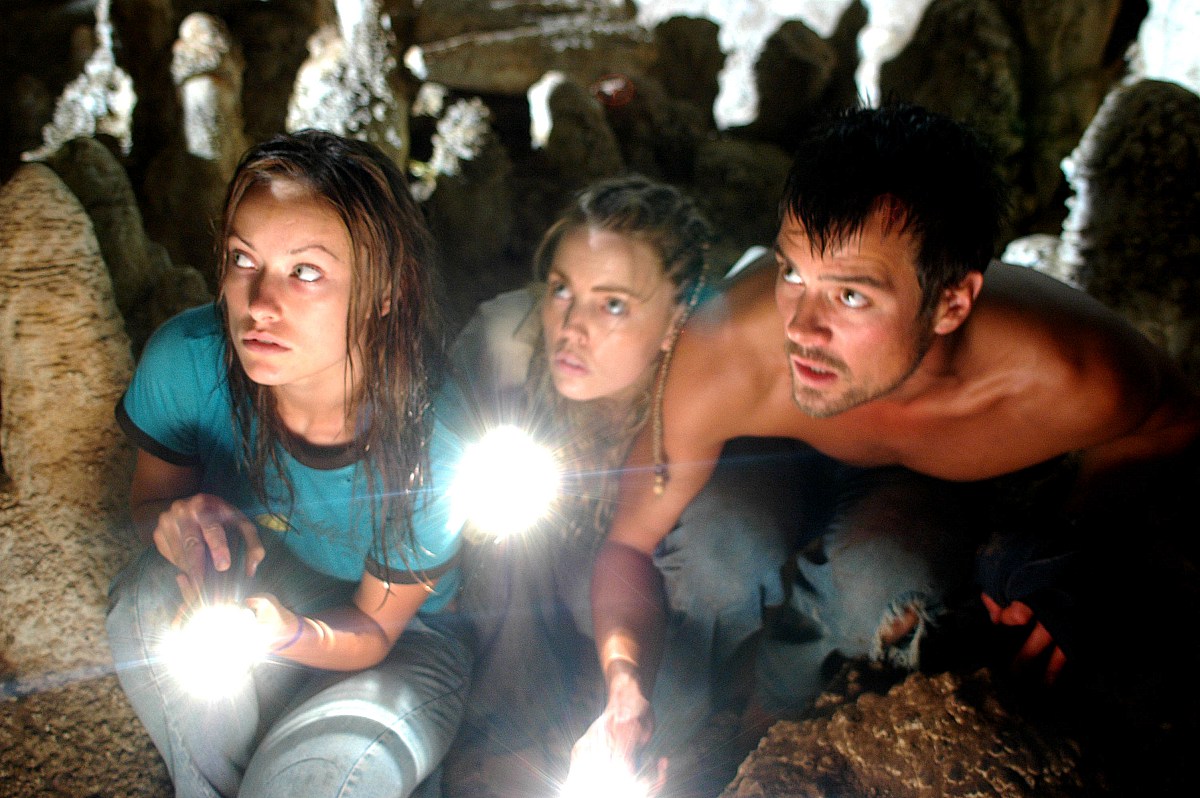
Turistas is surprisingly dull and predictable. The story takes a long time to get to the main action. John Stockwell takes us through the bus trip, the partying at the bar on the beach, the group trying to find their belongings in the nearby township and the long, protracted journey through the jungle (with a side trip to go diving in a cave), all before he arrives at the main thrust of the story. In fact, it is well past the one-hour mark before we get to the main torture and organ harvesting scenes that the film is premised on.
Moreover, when you look at the set-up in terms of reverse logic, the organ harvesting operation fails to make much sense. It is not clear whether the bus crash was an accident or not – one has to take it as being an accident as there seems no indication otherwise. The resulting scheme then seems to be premised on the huge coincidence of tourists having an accident and then just happening by a bar (that is hidden from plain view) on an obscure beach in remote Brazil where they are drugged with spiked drinks, their belongings taken and they left abandoned to find their way to the nearby township where the operation has even arranged for them to get into a fight with locals in order for the operation’s dupe to persuade the tourists to come on a day-long trip through the jungle (without shoes) to where the organ-harvesting takes place. It is a trap that seems improbable to the point of being totally far-fetched. One wonders why the harvesters did not just abduct the group while they were drugged and take them to their place in the jungle without all the other trouble of having to arrange schemes to lead them there by subterfuge.
One suspects that John Stockwell’s main interest was not even in making a horror film. John Stockwell was originally an actor – you can see him as Keith Gordon’s best friend in John Carpenter’s Christine (1983) and other 1980s films like My Science Project (1985), Radioactive Dreams (1986) and Top Gun (1986). Stockwell became director with Under Cover (1987) and attained a name with his third film, the teen drama Crazy/Beautiful (2001) and went onto Blue Crush (2002), Into the Blue (2005), Middle of Nowhere (2008), Cat Run (2011). Dark Tide (2012), In the Blood (2014), Countdown (2016), Kickboxer Vengeance (2016) and the SF film Armed Response (2017).
Almost all of John Stockwell’s films as director are based around an adventure theme – surfer chicks, treasure hunters in the Bahamas – where Stockwell seems to enjoy taking good-looking youthful actors into exotic destinations and in particular going diving. The one notable aspect of these films has been some stunningly photographed and directed diving scenes. Similarly here, John Stockwell throws in a series of diving scenes when the group explores a series of underwater caves, first as an adventure and then in the climactic scenes while pursued by various heavies. The problem is that these diving scenes have no real place in the film – one suspects they are there to serve John Stockwell’s predilections more than anything. When you consider it – a horror/torture film about organ harvesting … with extended rock cave diving scenes, it is an idea that doesn’t seem to compute. Turistas feels like a film that is being torn one way – on one hand a blatant attempt to copy Hostel, on the other hand assigned to a director who seems to want to play it as an adventure film.
There is a point that Turistas almost sits making some biting commentary on the relationship between tourists and locals. The opening credits promisingly contrast various tourist activities with shots of impoverished rural Brazil. Later the stranded tourists run astray when they cockily barge into local situations making cultural and racist assumptions. The lead villain has a speech where he explains what he is doing, plundering tourists because his people cannot afford decent surgery and likens it to the way that tourists exploit his country. Although this is never played with any irony – the film could easily have sat astride a vicious social metaphor about the parasitic relationship between tourists exploiting impoverished third world countries for hedonism and the locals harvesting them for medical necessity. In the finished film, Brazilian poverty and the cultural divide is present no more than to justify the film’s premise – ie. a climate that allows the scripters to offer up a raison d’etre for evildoing. Indeed, the way it is pitched, Turistas instead ends up seeming to justify a colonial attitude towards less than first world countries.
Trailer here