
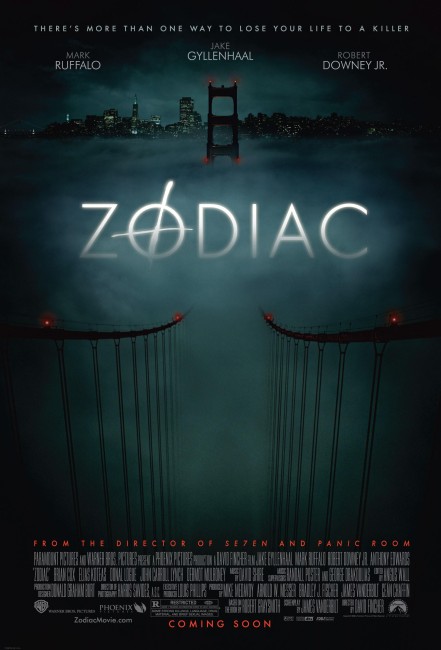
USA. 2007.
Crew
Director – David Fincher, Screenplay – James Vanderbilt, Based on the Books Zodiac and Zodiac Unmasked: The Identity of America’s Most Elusive Serial Killer by Robert Graysmith, Producers – Cean Chaffin, Brad Fischer, Mike Medavoy, Arnold Messer & James Vanderbilt, Photography – Harris Savides, Music – David Shire, Visual Effects – Digital Domain (Supervisor – Eric Barba) & Matte World Digital (Supervisor – Craig Barron), Special Effects Supervisor – Burt Dalton, Production Design – Donald Graham Burt. Production Company – Phoenix Pictures.
Cast
Jake Gyllenhaal (Robert Graysmith), Mark Ruffalo (Inspector David Toschi), Robert Downey Jr (Paul Avery), Anthony Edwards (Bill Armstrong), Chloe Sevigny (Melanie), Elias Koteas (Sergeant Jack Mulanax), Donal Logue (Captain Ken Narlow), John Carroll Lynch (Arthur Leigh Allen), Brian Cox (Melvin Belli), Philip Baker Hall (Sherwood Morrill), Charles Fleischer (Bob Vaughn), Dermot Mulroney (Captain Marty Lee), [uncredited] Ione Skye (Kathleen Johns), Clea DuVall (Linda Ferrin), John Terry (Charles Theiriot), Zach Grenier (Mel Nicolai), James LeGros (Officer George Bawart), Jimmi Simpson (Mike Mageau), John Hemphill (Don Cheney), Ed Setrakian (Al Hyman), Candy Clark (Carol Fisher), Doan Ly (Belli’s Housekeeper)
Plot
Starting in 1969, the San Francisco Chronicle and other local newspapers receive a series of letters in which the author claims responsibility for the killing of several couples around the Vallejo and Napa Valley area. The letters provide details that only the police know and contain a series of cryptic letter substitution puzzles wherein the killer refers to themself as The Zodiac. Over the next few months, the killer moves into the city, claiming the life of a taxi driver. Afterwards, The Zodiac sends pieces of the driver’s bloodied shirt with his letters. As Zodiac Killer fear sweeps the city, police detectives David Toschi and Bill Armstrong follow hundreds of leads. The Zodiac plays games with the police department and media, including asking to speak to high-profile lawyer Melvin Belli in an on-air tv interview, as well as claiming various other crimes as his own. After 1971, the trail goes cold. Chronicle cartoonist Robert Graysmith becomes fascinated with the case and begins investigating his own leads with off-the-record support from Toschi and other police. This leads Graysmith on the trail of a mysterious projectionist and one of the prime suspects that was interviewed by police.
From the mid-1990s onwards, David Fincher has been on the list of directors whose works I am always prepared to watch, no matter what they produce. Fincher began as a music video director and then emerged onto cinema screens with the undeservedly neglected Alien3 (1992). What consolidated David Fincher’s reputation was the serial killer film Se7en (1995), which wound its audience into an ingenious puzzle game before unveiling an unforgettable twist ending. Fincher’s coup-de-grace was Fight Club (1999), which became a cult hit with its provocative bevy of ideas about the reclamation of male identity and its openly anarchist manifesto. In between these, Fincher made a couple of less successful films – the contrived reality bender The Game (1997), the only film in his oeuvre that disappoints, and the underrated thriller Panic Room (2002). Throughout all of these, David Fincher has proven himself an expert stylist who reinvents his visual schema for each film. Fincher subsequently went onto The Curious Case of Benjamin Button (2008) with Brad Pitt aging in reverse, The Social Network (2010) about the establishment of Facebook, the English-language remake of The Girl with the Dragon Tattoo (2011), the thriller Gone Girl (2014); and the true-life Mank (2020) about Hollywood screenwriter Joseph Mankiewicz; as well as producing the tv series Mindhunter (2017-9) about the establishment of the FBI’s Behavioural Science Unit.
Zodiac falls into the fad that has emerged over the recent years for true-life crime films based on the lives of serial killers. So far amid this we have seen the likes of Ed Gein (2000), Dahmer (2002), Nightstalker (2002), Ted Bundy (2002), Gacy (2003), the award-winning Monster (2003), Evilenko (2004), The Hillside Strangler (2004), Starkweather (2004), Karla (2006), Lonely Hearts (2006), Ed Gein: The Butcher of Plainfield (2007), The Alphabet Killer (2008), B.T.K. (2008), Drifter: Henry Lee Lucas (2009) and Freeway Killer (2010). Zodiac is the only among these that has come with the backing of a major studio, while all the others are independent productions. There is also a notable difference between Zodiac and these others true-life serial killer films – out of all these films, the Zodiac Killer case is the only one that remains unsolved. Thus, unlike these other films, which act as portraits/docu-dramas of a serial killer’s state of mind and actions, Zodiac is a puzzle film centred around trying to work out the identity of The Zodiac.
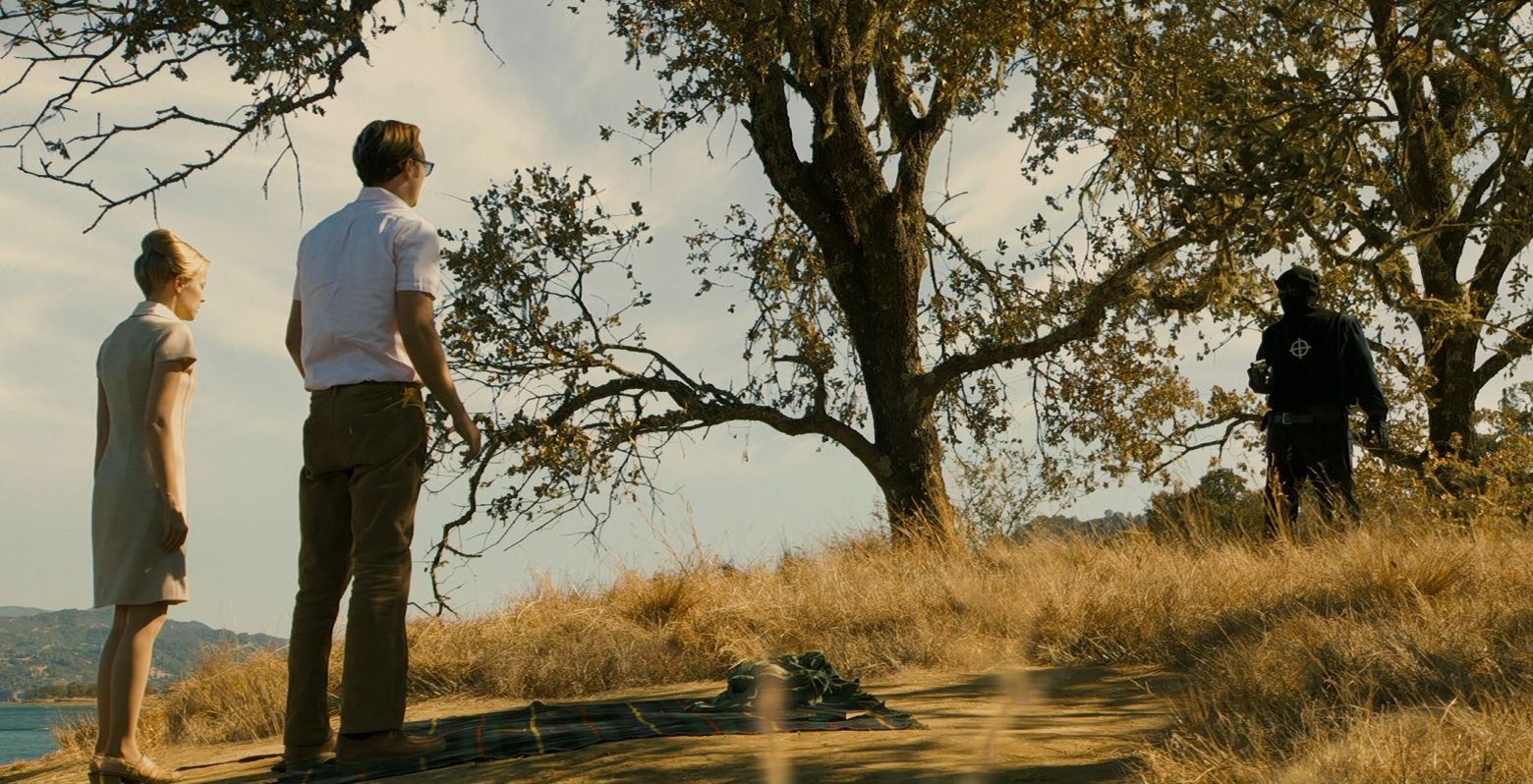
The Zodiac Killer either shot or stabbed at least seven people in four different attacks between 1968 and 1969 in the general San Francisco and NorCal area. Three of the attacks were couples and in two of these cases the men survived. The Zodiac also claimed a number of other crimes as his own – including the Cheri Jo Bates murder in Riverside in 1966 and the highway abduction of Kathleen Johns in 1970, which are both depicted in the film. What The Zodiac is most famous for is less the murders than the series of cryptic and rambling, sometimes deliberately misspelt, letters he sent to various newspapers, in particular to The San Francisco Chronicle. There have been numerous Zodiac letters sent between 1969 and the present, although many of these were fakes and the exact number of letters that came from the killer is not known for certain.
The Zodiac Killer case has been of considerable fascination to filmmakers before. The most notable example was Dirty Harry (1971), which came out during the period when the case was active, and features Clint Eastwood up against a killer known as Scorpio who notedly takes his name from a zodiacal sign, who taunts the police with letters and at one point abducts a busload of children (as The Zodiac threatened to do). Around the same time, there was also the cheaply exploitative The Zodiac Killer (1971), but this was only a poorly made psycho film of no other relevance, and the interesting The Zebra Killer (1974) loosely based on the Zodiac case. There was even a pornographic film exploiting the hysteria with Zodiac Killer/Zodiac Rapist (1972). Others later efforts include the cable tv movie The Limbic Region (1996) starring Edward James Olmos as the David Toschi equivalent, which was also drawn from Robert Graysmith’s speculations and suggested a pseudonymously named Arthur Leigh Allen as the Zodiac; and The Zodiac (2005), an independent film that closely follows the facts of the case. There was also Ulli Lommel’s ultra-low budget Zodiac Killer (2005) but this was not about The Zodiac but someone in the present-day who starts up their own series of Zodiac-inspired killings (and implausibly reveals that the real killings were conducted by a secret society). Awakening the Zodiac (2017) showed The Zodiac still alive in the present, while the ghost of The Zodiac turned up in the Devil’s Night episode of American Horror Story: Hotel (2015).
Zodiac is taken from the investigation conducted by San Francisco Chronicle cartoonist Robert Graysmith, who is played in the film by Jake Gyllenhaal. Robert Graysmith wrote two books about the case, Zodiac (1986) and Zodiac Unmasked: The Identity of America’s Most Elusive Serial Killer (2002), in which he honed in on Arthur Leigh Allen as chief suspect. (Although, in the first of these, Graysmith was forced to call Allen by a pseudonym to avoid libel but was able to name names in the second book following Allen’s death in 1992). Graysmith went onto write various other true life crime books including The Murder of Bob Crane (1993) about the unsolved death of tv star Bob Crane, which became the basis of Paul Schrader’s film Auto Focus (2002); Unabomber: A Desire to Kill (1998); The Bell Tower: The Case of Jack the Ripper Solved … in San Francisco (1999), which purports to offer a solution to the Jack the Ripper killings (and improbably names the Ripper as a priest in turn of the century San Francisco); and Amerithrax: The Hunt for the Anthrax Killer (2006) and The Laughing Gorilla: The True Story of the Hunt for One of America’s First Serial Killers (2013).
Robert Graysmith has been accused of having stretched the truth, fabricated evidence and distorted witness statements in order to make his case for Arthur Leigh Allen as The Zodiac. Both www.zodiackiller.com and www.zodiackillerfacts.com, for instance, are scathing about Graysmith’s research. The latter site makes a detailed critique of Robert Graysmith’s arguments, which makes for fascinating reading. Among the accusations they make:- that Graysmith fabricated a number of the claims about Darlene Ferrin knowing a man named Lee who stalked her and that no painting party was ever held; that Graysmith has constructed bizarre theories to explain away how there is no match between Allen’s handwriting and the Zodiac letters; that he has fabricated claims about Allen’s family believing he was a likely suspect. The site also appears to place some doubt on the substance of the call to Melvin Belli’s maid on Allen’s birthday. Personally, one does not know enough about the Zodiac case to be able to dispute such claims – certainly, some of the derogation of Robert Graysmith’s name on these sites goes way beyond fair disputation of the evidence and into personal abuse.
On the other hand, there do seem on the face of it to be a number of strong pieces of evidence that support Arthur Leigh Allen as being the Zodiac – the police interview where he volunteered suspicious information; a number of the coincidences between crucial dates and the areas that Allen was in at the time; Michael Mageau’s eyewitness identification of Allen; Allen’s background in the military and interest in ciphers; and the police’s dedicated belief in Allen as prime suspect.
Equally so, there are other aspects that cast considerable doubt on Allen – the lack of DNA match between any of the Zodiac letter envelopes and Allen; the lack of handwriting match between Allen and the Zodiac; and the lack of any incriminating evidence that was uncovered during the various police search warrants executed on Allen’s addresses. There have been a number of other Zodiac suspects, including the enigmatic projectionist Rick Marshall who is seen being investigated by Graysmith in the film; Unabomber Ted Kaczynski who lived in San Francisco around the time of the killings (although no evidence has been unearthed to ever tie Kaczynski to the Zodiac killings other than coincidence of time periods); and members of the Manson Family.
David Fincher is by his own confession a long-time amateur Zodiac Killer enthusiast – you can see Fincher’s fascination for serial killer puzzles in Se7en. Fincher first became fascinated with the Zodiac killings as a seven-year-old growing up in Marin County when his schoolbus was accompanied by police cars after the Zodiac’s threats to kill a busload of school children. Fincher first optioned Robert Graysmith’s book when he was nineteen.
On screen, Fincher has made scrupulous effort to replicate the case (and Robert Graysmith’s investigation) in every detail. This fanaticism went so far as Fincher shooting in a number of the locations where the killings took place and building a detailed recreation of the corner of Washington and Cherry Streets where taxi driver Paul Stine was shot (using sets and CGI inserts when the production was unable to film in the real location). Fincher’s search for authenticity sometimes borders on the fanatical – from reports of his exacting attempts to match the piece of cloth that the fragments of Paul Stine’s shirt came from or his shooting scenes in the actual apartment where Robert Graysmith lived. Handwriting experts were hired to doubly ascertain any connections between Arthur Leigh Allen’s and the Zodiac’s handwriting and the end credits come with acknowledgement to a host of private investigators that were hired to research the facts. Fincher also had Robert Graysmith and Bryan Hartnell, one of the surviving attack victims, as on-set advisors during filming.
I am not informed enough to say to what extent Robert Graysmith’s investigation is valid or constructs spurious arguments but the enormous degree of authenticity with which David Fincher puts it together on screen makes for a highly absorbing film. The film becomes particularly riveting from the moment that the police investigation is considered cold and when Graysmith’s personal quest takes over. The puzzle and connections that the film takes us through, before leading us to the argument in favour of Arthur Leigh Allen as the Zodiac Killer that Graysmith/Gyllenhaal makes in the last scene with Toschi/Mark Ruffalo is positively ingenious. Though this is a non-fiction investigation, the revelation the film arrives at is as intense and absorbing as any fictional thriller.
David Fincher crafts a number of scenes that have a genuinely creepy fascination. Particularly good is the scene where Jake Gyllenhall goes to the home of Charles Fleischer’s Bob Vaughn and where, in discussing the authorship of the handwriting on the poster, Gyllenhaal casually mentions how it is the best match of the Zodiac Killer’s penmanship yet, before Fleischer mentions that it wasn’t Marshall but him that wrote the posters. It is a scene where the mood of the film suddenly changes in a second as we realise that Jake Gyllenhaal might be sitting in the presence of the killer. The subsequent scene where we venture down to the basement and Jake Gyllenhaal hears footsteps upstairs, despite Charles Fleischer having said there was no-one else in the house, amplifies this creepiness to something genuinely unnerving. (Disappointingly, the film fails to explore the Rick Marshall avenues any further after this point – one would have thought that if the real Robert Graysmith felt he had come so close to someone who could be the killer, he would not have run away but doggedly pursued Vaughn, especially if he knew where Vaughn lived).
The other unearthly scene is one where an uncredited Ione Skye plays Kathleen Johns whose wheel is sabotaged on the highway and she is given a ride by a sinister man who suddenly turns and announces with cold chill: “Before I kill you, I’m going to throw your baby out the window.”
One also liked Zodiac for the various pieces of geek trivia that it manages to sneak in. Like when Melvin Belli appears on the air and the interviewer casually mentions how he liked Belli “in his appearance on Star Trek (1966-9)” – the real-life Belli appeared as a sinister angel in the episode And the Children Shall Lead (1968). Or the staging of a meeting between Graysmith and Toschi at a screening of Dirty Harry, which was after all a film that took its inspiration from the Zodiac Killings, whereupon the script has Toschi criticizing the lack of due process used by his fictional on-screen counterpart.
Although, the one point the film makes an error is in reference to Richard Connell’s The Most Dangerous Game (1924), which is a short story, not a novel as the film keeps insisting several times – the text is freely available online and one is surprised that the filmmakers never bothered checking out or reading this. [The story has been filmed several times in different variations, most notably as The Most Dangerous Game (1932)].
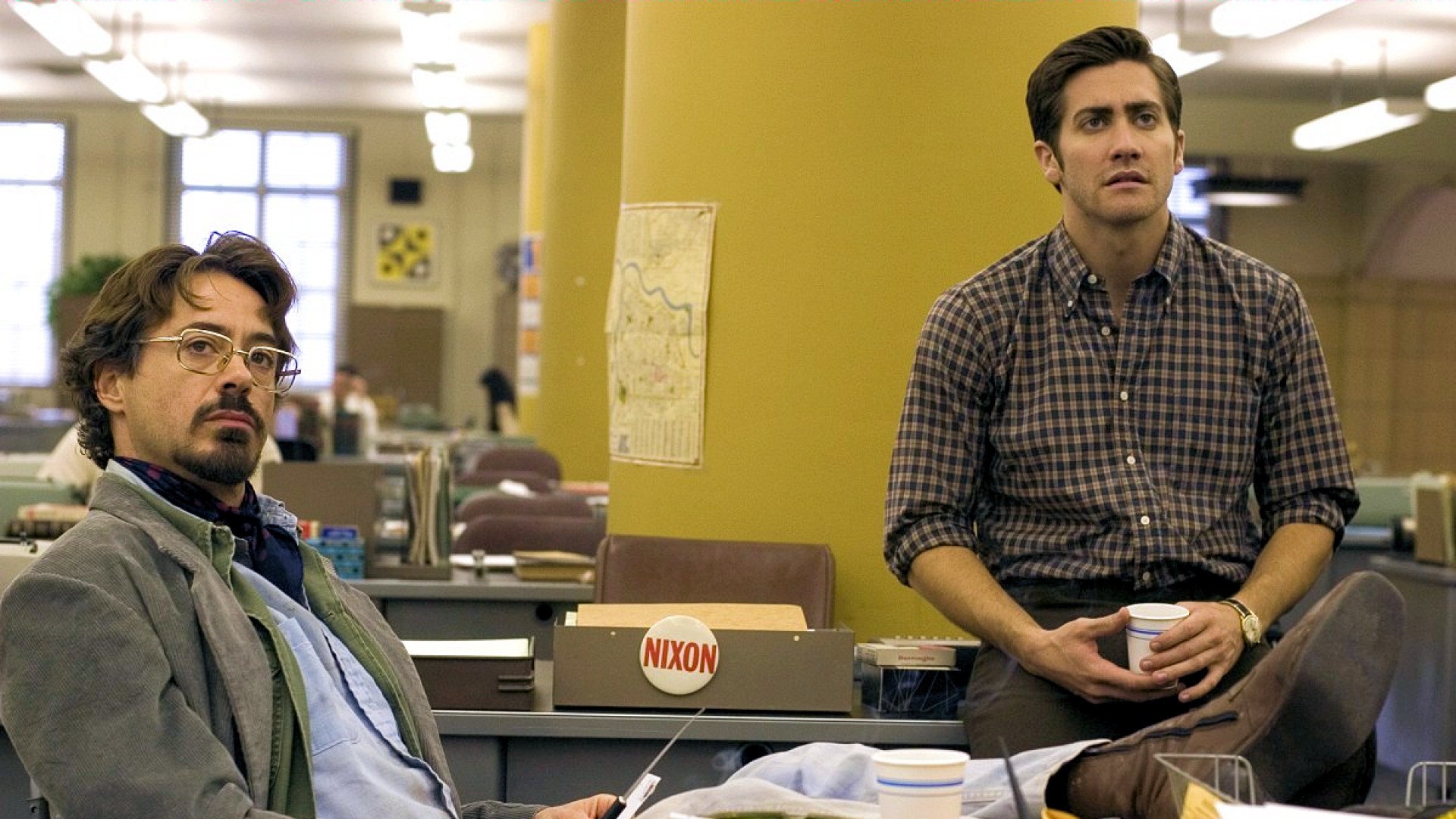
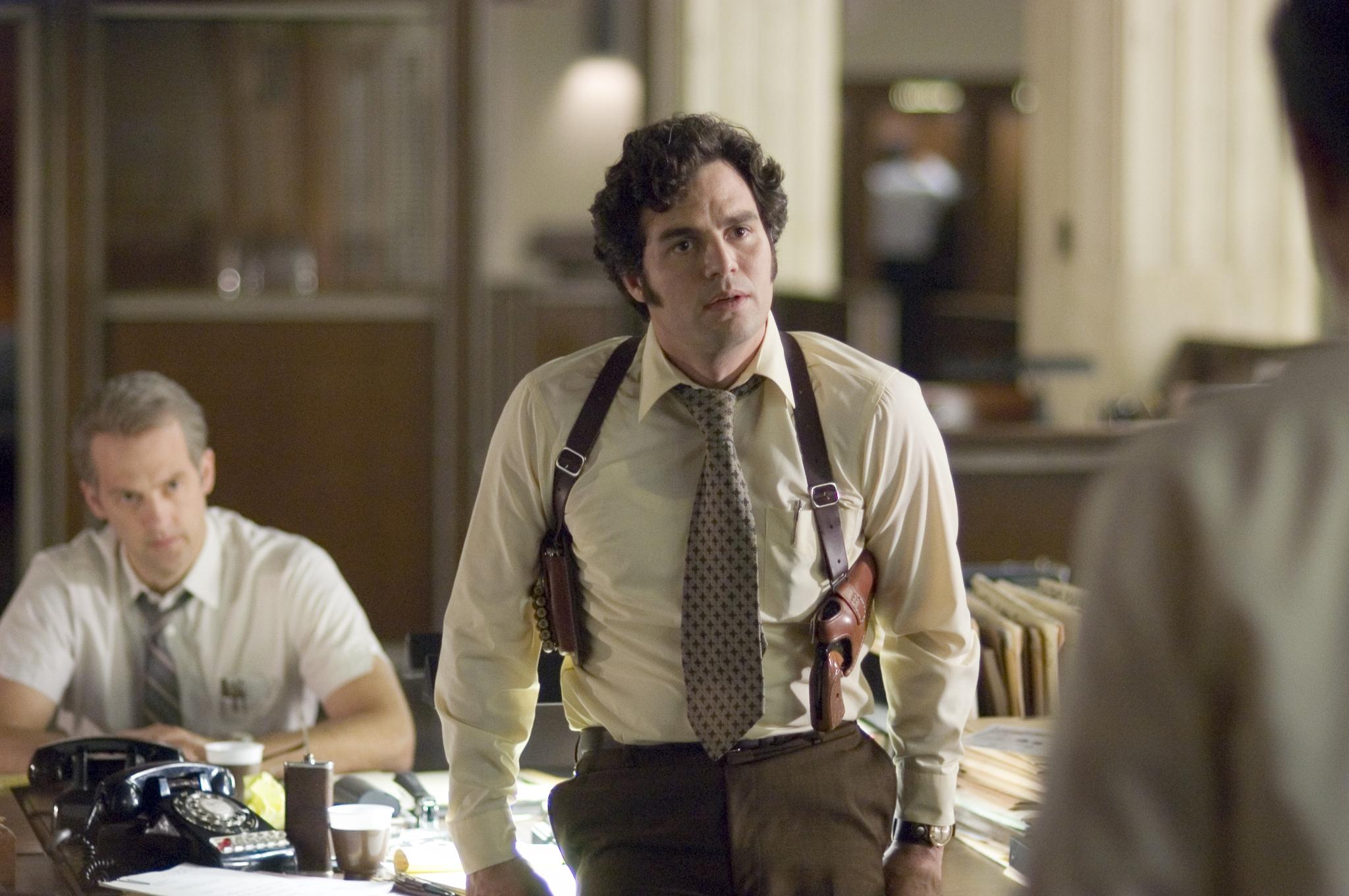
As Robert Graysmith, Jake Gyllenhaal does his earnest nice guy routine to the point of gloopiness – you are not entirely sure to what extent this is David Fincher trying to portray Graysmith as earnestly straight-arrow or not but the effect is to make Graysmith come across as blandly nerdy. Even Chloe Sevigny playing Graysmith’s wife emerges with more personality during her handful of appearances. Nevertheless, as we follow Graysmith’s dogged investigation, Gyllenhaal cannot help but sway our sympathy. Among the triptych of male leads, the fine and underrated Mark Ruffalo seems perfectly cast in his role as Inspector Toschi, while the show is largely stolen by Robert Downey Jr who plays the boozy reporter role up for all that he can.
(Winner in this site’s Top 10 Films of 2007 list. Winner for Best Adapted Screenplay and Best Supporting Actor (Mark Ruffalo), Nominee for Best Director (David Fincher) and Best Supporting Actor (Robert Downey Jr) at this site’s Best of 2007 Awards).
Trailer here