

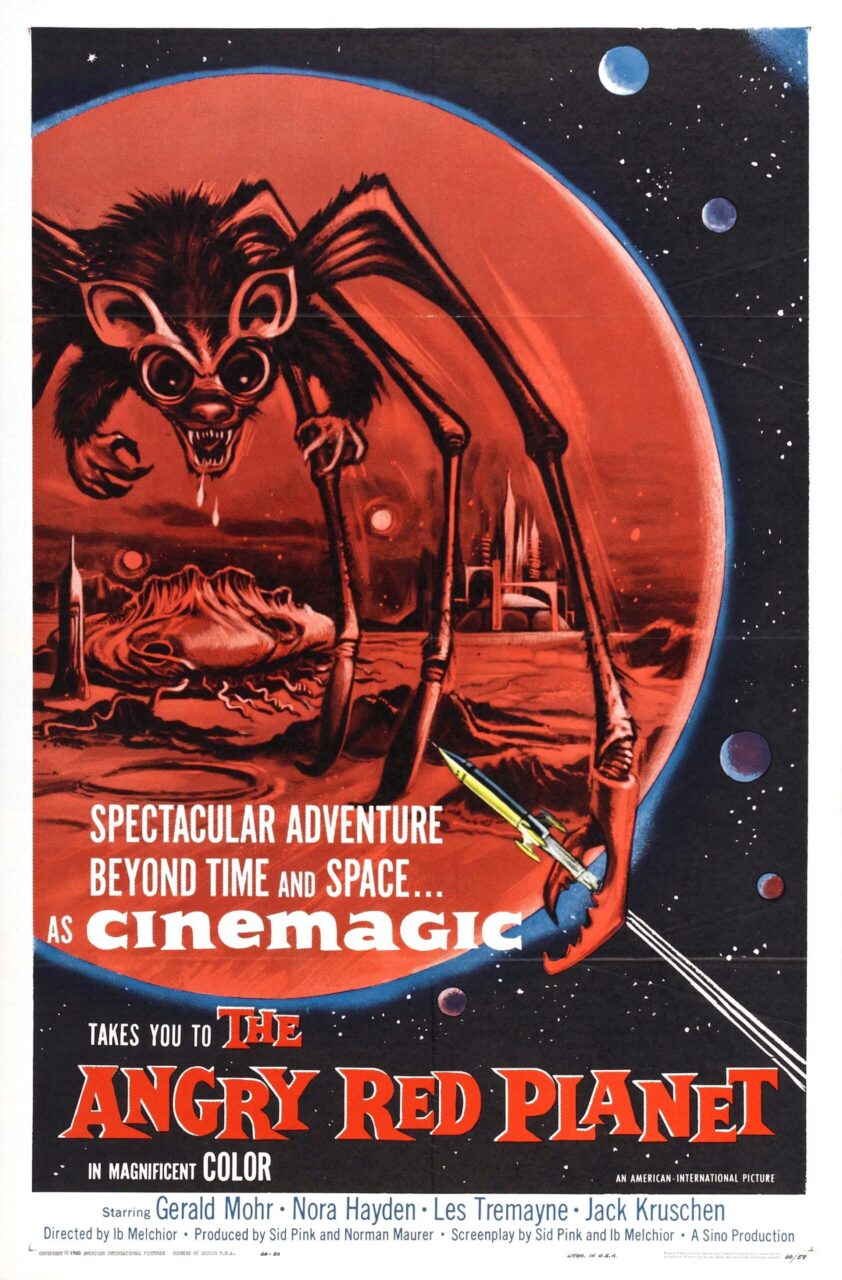
USA. 1959.
Crew
Director – Ib Melchior, Screenplay – Ib Melchior & Sid Pink, Story – Sid Pink, Producers – Sid Pink & Norman Maurer, Photography – Stanley Cortez, Music – Paul Dunlap, Special Effects – Herman Townsley. Production Company – Sino Productions.
Cast
Nora Hayden (Dr Iris Ryan), Gerald Mohr (Colonel Tim O’Bannion), Les Tremayne (Professor Theodore Gettell), Jack Kruschen (Chief Warrant Officer Sam Jacobs), Paul Hahn (Major-General George Traeger), Tom Daly (Dr Frank Gordon)
Plot
The X1, the first manned expedition to Mars, returns to Earth after 61 days radio silence. Aboard the ship, the ground crew find one survivor who is infected by an alien organism and the unaffected Dr Iris Ryan who has no memory of what happened. Gradually doctors managed to obtain the full story from her. She tells how the expedition landed on Mars and encountered various strange lifeforms, before being threatened by Martian natives.
The study of 1950s science-fiction is absolutely fascinating. For America, the post-War era contained an amazing sense of optimism, that the universe could be conquered by human hand. This was explicitly stated by Destination Moon (1950), which started the 1950s science-fiction boom off. However, almost immediately afterwards, this optimism folded inward amid fears of the Bomb, Communism and the sense of a nameless threat that could shatter the fragility of ordinary American life.
Almost as soon as Destination Moon came out, visions of travel to other planets collapsed into a self-absorbed stare into the abyss. Overwhelmingly, all ventures out into the universe encountered either a mirror of atomic devastation – Rocketship X-M (1950), This Island Earth (1955); or a universe that was too much for humanity to handle – Conquest of Space (1955); worlds where civilisation would be destroyed by its own hubris – Forbidden Planet (1956); or quite simply faced out-and-out hostility as in It! The Terror from Beyond Space (1958) and The Angry Red Planet here.

The Angry Red Planet comes with all the fear-laden rhetoric of the era. “I know this is funny for a scientist, but maybe there are some things better left unknown,” says Nora Hayden early in the piece. The end of the film offers a vision of the universe from which humanity must retreat due to the potential for devastation it has unleashed: “Your culture has not progressed beyond devastation, war and violence against yourselves and others. Do as you will to your own kind but remember this warning: Do not return to Mars,” the Martians announce in ringingly portentous tones as the film closes.
The film is routinely directed. All the Martian scenes were advertised as being in a ‘revolutionary’ process called Cinemagic, which only consisted of an orange filter placed over the lens. The alien plants and Martian city are only drawings, although the Bat-Rat-Spider creature is modestly effective. The two leads, Gerald Mohr and Nora Hayden, are stodgy and dull. Despite the promise of a journey to the exotic realm of Mars, not much happens throughout.
The producing, directing and writing team of Ib Melchior and Sidney Pink, combined on a number of other science-fiction films both in the USA and Sweden, including Reptilicus (1961) and Journey to the Seventh Planet (1962). On his own, Ib Melchior wrote and directed The Time Travelers (1964) and wrote Robinson Crusoe on Mars (1964), Planet of the Vampires (1965) and Death Race 2000 (1975).
Trailer here