
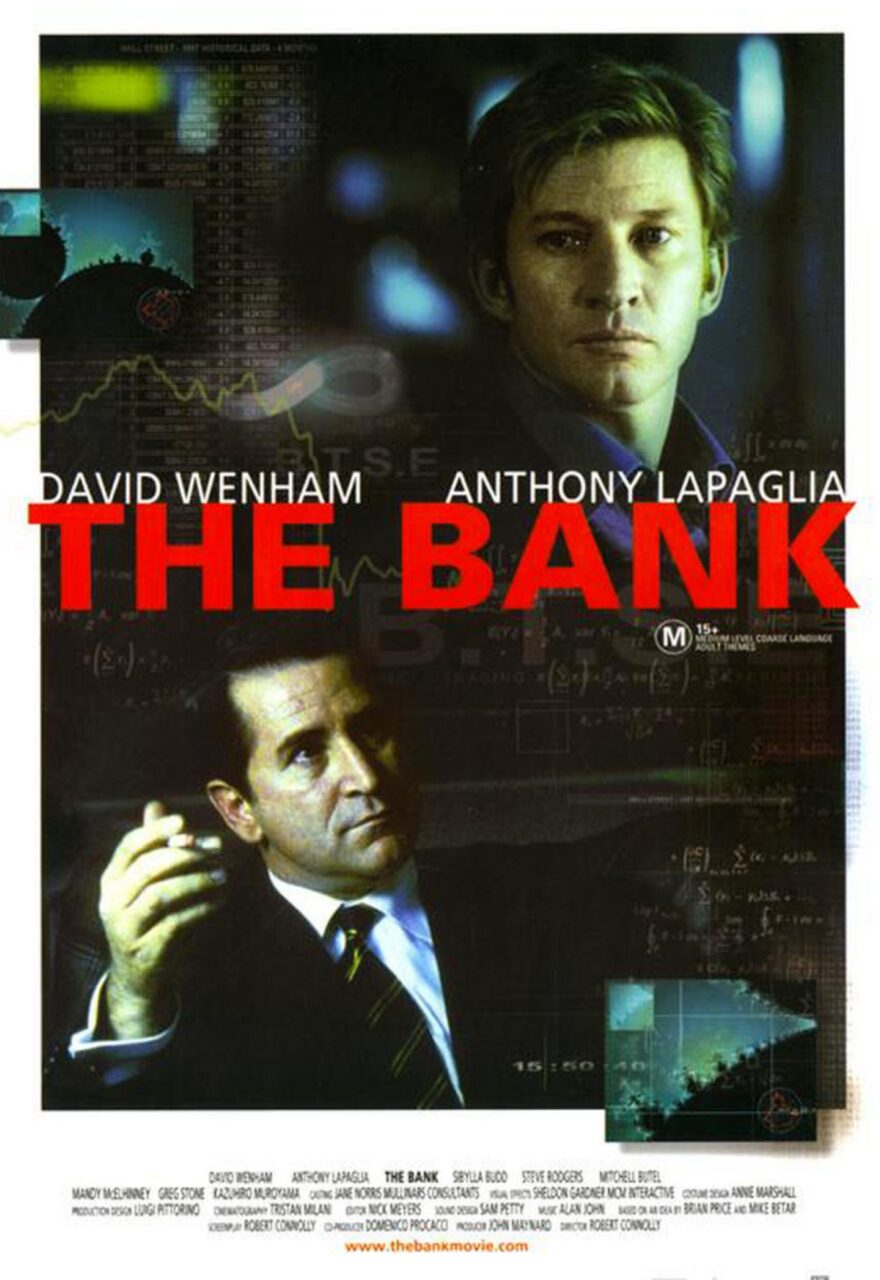
Australia. 2001.
Crew
Director/Screenplay – Robert Connolly, Based on an Idea by Mike Betar & Brian Price, Producer – John Maynard, Photography – Tristan Milani, Music – Alan John, Visual Effects – MCM Interactive (Supervisor – Sheldon Gardner), Special Effects Supervisor – Clint Ingram, Production Design – Luigi Pittorino. Production Company – Footprint Films/Arenafilm/Axiom Films.
Cast
David Wenham (Jim Doyle), Anthony LaPaglia (Simon O’Reily), Sibylla Budd (Monica Roberts), Steve Rodgers (Wayne Davis), Greg Stone (Vincent), Mandy McElhinny (Diane Davis), Mitchell Butel (Steven O’Connor), Kazuhiro Muroyama (Toshio), Stephen Leeder (Billy)
Plot
Simon O’Reily, the ruthless CEO of Melbourne’s Centrabank, is under pressure from his board of directors to turn a profit. He hires Jim Doyle, a mathematician who believes that he has found a means of predicting the stockmarket. As Simon pressures him to perfect his methods, Jim begins to see Simon’s increasing ruthlessness first hand and experiences doubts about what he is doing. At the same time, Simon must deal with the Davis family whose son was killed by a debt collector and are now seeking revenge against Centrabank by suing the bank for failing to properly disclose the liabilities of the business loan they took. As Jim perfects his methods, predictions then show that the stockmarket is about to crash disastrously and he offers Simon one chance to risk all and make a killing.
Although it was being called a thriller in its promotion – and eventually does settle down into a thriller-styled ending – The Bank is less of a thriller than it is a series of cool, biting observations on the increasing amorality of banking institutions. One of the bylines the film advertised itself with is the phrase “At the end of the day, it’s really quite simple. I just hate banks…” – a subversive outcry the film was clearly inviting its audience to join.
The Bank was one of several releases that came out in 2001 that took up the rather uncinematic idea of mathematics – others included the thoroughly overrated, Oscar-winning A Beautiful Mind (2001) and Enigma (2000) about WWII codebreakers. The Bank takes up the science-fictional notion of developing a system that can mathematically predict stockmarkets – which makes it strongly reminiscent of Pi (1998). Of course, the notion of anybody devising a formula to exactly predict the nature of the stockmarket is science fiction in the purest sense – the Heisenberg Uncertainty Principle would surely render any attempt to predict the stockmarket (an inherently unpredictable and chaotic system) useless. Nevertheless the film bolsters its idea with an impressive series of references to chaos theory, Mandelbrot and some cool, beautiful computer representations of fractals and at least wields enough doubletalk to give the impression it knows what it is talking about.
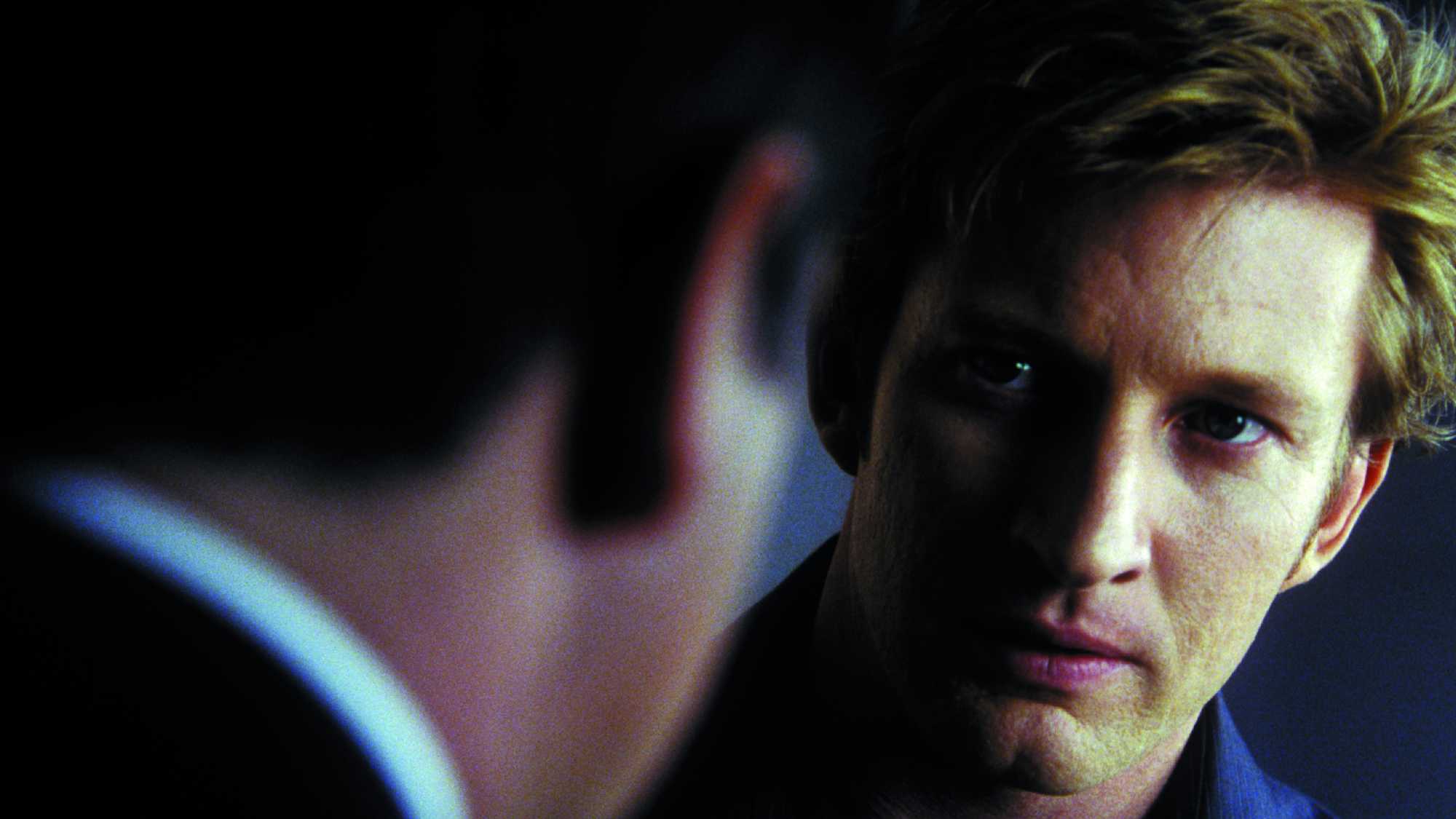
Unlike Pi though, The Bank is not concerned for the quest for the meaning of life through mathematics, rather it aims closer in the direction of Oliver Stone’s Wall Street (1987), offering a scathingly charged indictment of the financial industry. At the centre of the show is Anthony LaPaglia, whom director/writer Robert Connolly turns into this film’s equivalent of Michael Douglas’s Gordon Gecko. LaPaglia sits in the midst of the film like a coiled cobra waiting to attack. Connolly arms him with a memorably quotable series of one-liners – “You are going to work so much better with my boot against the back of your neck. It’s an undervalued management technique” and “I’m like God – only with better suits.” It is a performance that becomes compulsively charged through the sheer predatory bullishness the film invests him with.
LaPaglia is never more in control of the film than the scene where he manages to reduce the life aspiration of a man pointing a gun at him to absolutely nothing using only the power of his voice. It surprises some people to discover that LaPaglia is actually an Australian by birth rather than an American. In 2001, he returned to his homeland to deliver two of his best performances – here and in Lantana (2001). Up against LaPaglia is David Wenham who delivers a fine performance of affectedly uncertain body languages while allowing an impassively calm and opaque facial surface to reflect a variety of internal conflicts.
Where the film becomes less interesting is when it lets its scintillatingly on-target bites into banking practice dissemble down into a thriller. Not that there isn’t anything wrong with that, it is just that the thriller aspect is a little ordinary and conducted without much in the way of sharp twists, except at the end. There is no grinding tension to it there way there should be in a good thriller. There is also a B plot running up against the main one of a family trying to sue the bank for murdering their son (it is never too clear exactly what did happen), which does come preciously close to creating sentimentalised victims, but does dovetail nicely with the main plot in the latter half with a (slightly contrived) Faustian deal and a nicely sardonic end comeuppance for Anthony LaPaglia.
(Nominee for Best Original Screenplay and Best Actor (Anthony LaPaglia) at this site’s Best of 2001 Awards).
Trailer here