


USA. 2009.
Crew
Director – Andrew Allan, Screenplay/Producers – Andrew Allan & Andy Lalino, Photography – Wes Pratt, CGI Effects – Leo Frangos & Ronnie Williams, Makeup Effects – Mark Argenola & Marcus Koch, Production Design – Vanessa Allan. Production Company – Film Ranch.
Cast
Chris Jackson (Tristan Davis), Somali Rose (Laney Bates), Rod Grant (Dr Karas), Christopher Sarlls (Zane Booker), Krista Grotte (Flora ‘Heaven’ Walker), Nimai Manrique (Alex), Jesse McLane (Ivan), Clay Maples (Chief Hargin), Jillian Kinaman (Evelyn Graham), Mark Fisher (Everett Graham), Joel D. Wynkoop (Norm Simpkins)
Plot
18 year-old Tristan Davis runs away from home, no longer wanting to live with his stepfather who whores his mother out for gangbangs with his friends and beats Tristan. Settling down to sleep on the street, he meets Laney who shows him the place where she stays, filled with former runaways who have turned their lives around. Tristan meets the head of the facility Dr Karas who introduces him to the trepanning operation (a hole drilled through the skull) that opens up vast untapped mental potential inside each person. Tristan agrees to undergo the operation and is welcomed into the group. He soon discovers that there are periods when those among the group, including himself, go blank and wake up remembering nothing. Following one of these blank spells, he abruptly finds himself in the midst of a street fight, during which his trepan wound is reopened and he is horrified to discover a control chip has been implanted in his head. Realising that Dr Karas is using these chips to control them, he and Laney go on the run, attempting to get the truth about Dr Karas’s mind control experiments out to the public. Instead they find that everywhere they turn they are faced by people who have been implanted with mind control chips.
Brainjacked is a low-budget self-financed effort from a group of ingenue filmmakers from St Petersburg, Florida.
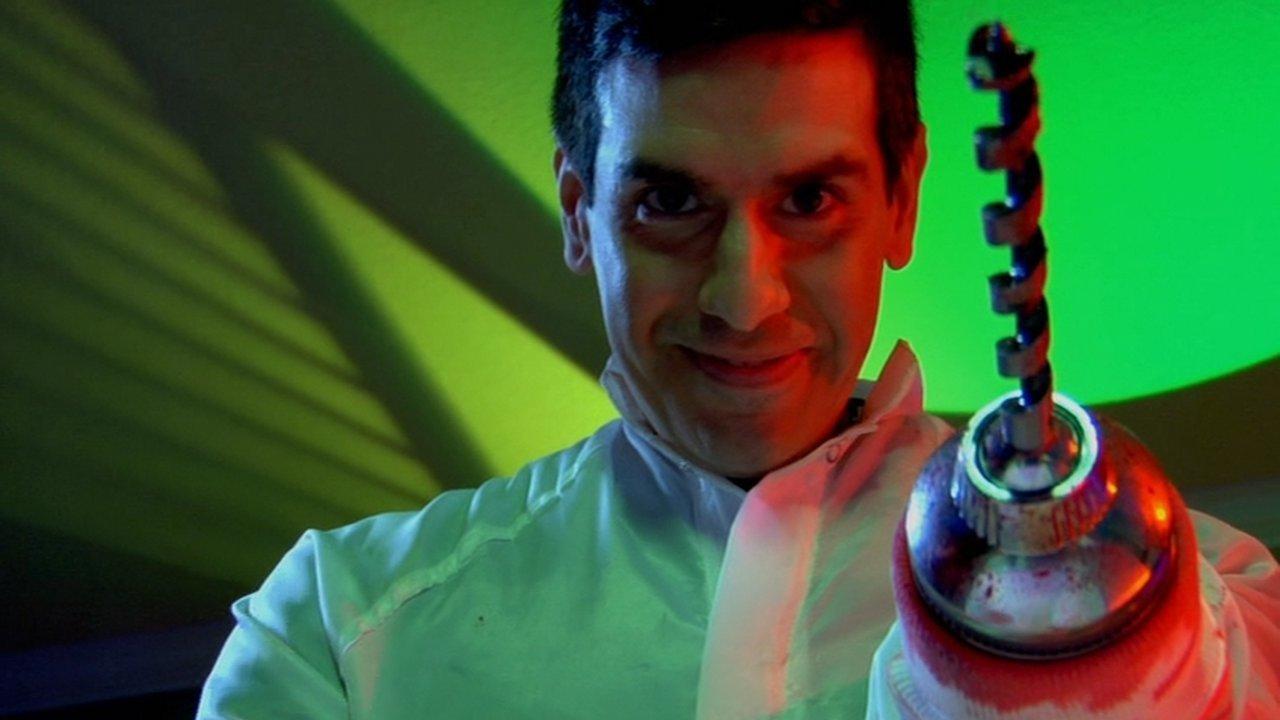
Brainjacked takes up the subject of mind control. Unlike other films on the subject, Brainjacked places its treatment of the premise down around the level of a low-budget budget horror film with much emphasis on blood and splatter. For a time, this seems potentially interesting as approaches go. There is a scene where hero Chris Jackson is introduced to the doctor (Rod Grant) who talks in charismatic and calm tones about the trepanning process, before putting somebody in the chair, producing a drillbit prosthesis on the end of his hand and then boring into the head of the person before him, all the while talking about the advantages the process offers. At this point, the film suddenly seems to hold a good deal of deranged psychotronic promise.
On the other hand, compare Brainjacked to some of the classic works on mind control such as The Manchurian Candidate (1962), The Mind Benders (1962) and Cypher (2002) and the way it plays out by contrast is utterly banal. What is crucially lacking in comparison to any of these others is the sense of paranoia, the slow erosion of identity and assumptions the protagonist about the world. Instead, Brainjacked creates a paranoid conspiracy that seems to lack any basic credibility – one deranged scientist has created a network that reels in wayward youths, drills holes in their skulls and secretly implants mind control chips that turns them into zombies (controlled by what is referred to as an orb but is anything but orb-like).
Somehow this conspiracy of rehabilitated teenagers has spread to take over key positions throughout the city and almost everybody the protagonist encounters. It is impossible to believe that a single doctor and youth rehabilitation program could have such a widespread an influence, let alone nobody have noticed that people are suddenly blanking out on a regular basis. Or even that an x-ray/neurological exam would not reveal the implants inside the brain. The brain operations seem to be conducted without any apparent consultation of medical procedure on the part of the filmmakers, let alone the slightest degree of basic medical hygiene, including scenes where the chips are removed from inside people’s brains with bare fingers.
I thought that Brainjacked had initial possibilities. However, as a conspiracy/mind control film, it is conducted with a remarkable lack of skill or subtlety. Rather than a subtle inner psychology story, it is about people running around, various cheap gore effects and no more than that – at one point, the film even bizarrely seems to be turning into a zombie film.
One of the more annoying aspect is director Andrew Allan shooting most of the film using garish lighting schemes, lighting everywhere from apartment interiors, the facility and alleyways in bold green, red or blue saturations. These become exceedingly absurd, as though the film takes place in an alternate world where people have, for no apparent reason, positioned spotlights for the specific purpose of turning walls in the facility or the street into vast surfaces of primary colour. It seems either a case of amateurs having gotten carried away with the possibilities that coloured lights can offer or are attempting to light the film in order to disguise budgetary shortcomings.
The performances swing between the passable and the amateurish – the worst comes from Christopher Sarlls as the rogue rehabilitatee where Sarlls plays everything through an incredibly fake breathless hoarse voice.
Trailer here