
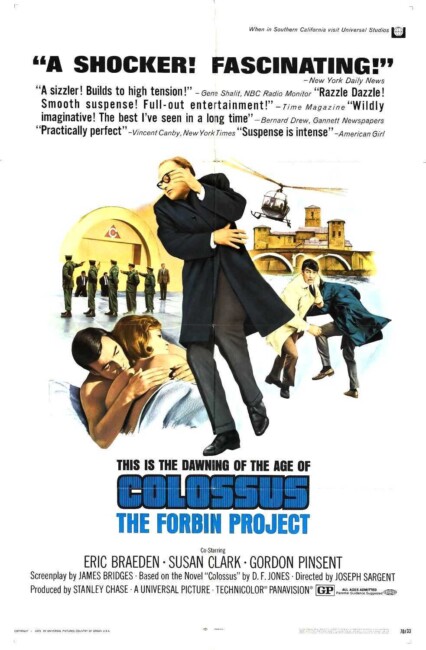
USA. 1969.
Crew
Director – Joseph Sargent, Screenplay – James Bridges, Based on the Novel Colossus by D.F. Jones, Producer – Stanley Chase, Photography – Gene Polito, Music – Michel Colombier, Photographic Effects – Albert Whitlock, Special Effects – Whitey McMahon, Production Design – Alexander Golitzen & John J. Lloyd. Production Company – Universal.
Cast
Eric Braeden (Dr Charles Forbin), Susan Clark (Cleo Markham), Gordon Pinsent (The President), William Schallert (CIA Director Grauber)
Plot
Dr Charles Forbin activates his creation, the super-computer Colossus, which has been designed to take control of all US military installations. Once activated, Colossus is sealed into an impenetrable bunker. Moments later, the Russians announce the existence of an identical super-computer Guardian. Colossus demands a line of communication with Guardian and it is granted but the level of discussion between the two computers soon goes beyond anything understood by human minds. When the President orders their link terminated, the two computers fire nuclear missiles. They then use their combined threat to impose a new order on mankind for its own good.
Colossus: The Forbin Project is a quiet but highly effective little film. It was poorly distributed in its time and never found the audience it should have. The film was made right after 2001: A Space Odyssey (1968) and, although based on a 1966 novel by D.F. Jones, it could almost be a feature-length extension of the scenes aboard The Discovery in 2001 with HAL 9000 conspiring against the humans. It was one among a spate of 1970s films that took up the theme of machines and our technological systems having become so perfected that they end up deciding they can run things better than we do. See also the likes of The Andromeda Strain (1971), THX 1138 (1971) and Westworld (1973).
The 1960s was probably the only point that a film like this could have ever been made. It is hard to think that such an incredulous premise would ever succeed in the 1990s and beyond where the computer has become seamlessly integrated into the everyday world. For a start, not only does Forbin build a system that seemingly has no off switch, but he seals it off inside an impenetrable bunker … and without it appears ever having turned it on before or done any tests on it. Moreover, what seems almost impossible to believe, the military seem perfectly happy to turn over the running of the entirety of the US military complex to this untested machine. Not too surprisingly, the machine starts exhibiting errors within moments of operation … yet the creator of this system has no means of being able to do anything about it, not even unplugging the power cables that feed the machine. In a modern version, Forbin would be regarded as the villain and lionised for his incompetence for designing such a system, however here he remains the hero of the show.
Nevertheless, on its own terms, Colossus: The Forbin Project is one of the most unassuming and perfect of all lesser-budgeted science-fiction films. It was directed by Joseph Sargent, a former director on tv series such as The Man from U.N.C.L.E. (1964-7), Star Trek (1966-9) and The Invaders (1967-8). The script is a marvel of economy and Sargent directs with a tight precision where nothing is out of place.
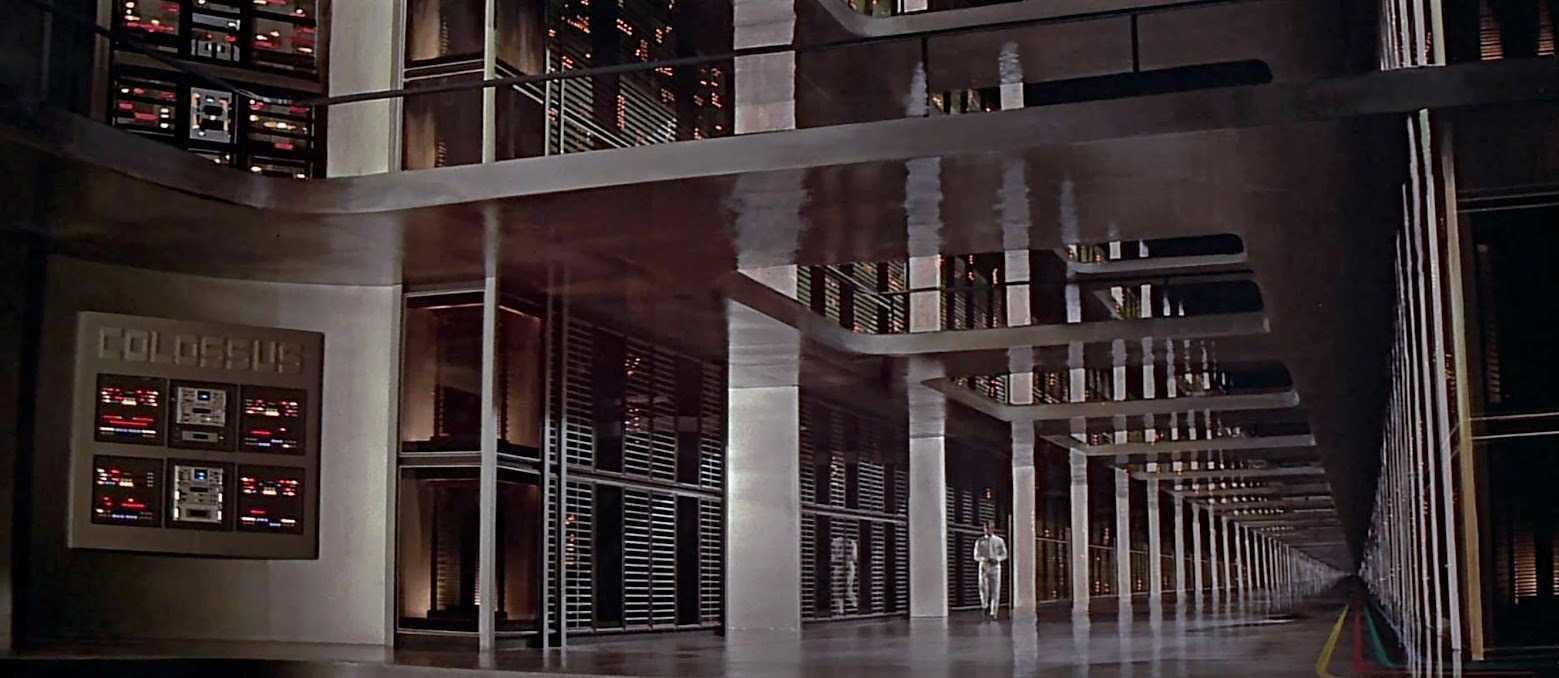
The interplays between computer and creator are wonderful. In what must be the most ingenious tying in of a love interest in a science-fiction film, Eric Braeden’s Forbin explains to Colossus the need to have his mistress Susan Clark every night of the week for his mental health (he in fact using her to relay messages to the CIA); to which the computer’s sarcastic reply is “I asked need, not want.” (This scene has been cut from the butchered print that screens on The Sci-Fi Channel). The ending has the machine triumphant, announcing to Forbin, “In time you will come to regard me with not only awe and respect but love.” Eric Braeden is great in the part, as is Susan Clark who balances Braeden with spry, charming wit.
D.F. Jones wrote two Colossus sequels The Fall of Colossus (1974) and Colossus and the Crab (1977), although neither of these have been filmed.
Joseph Sargent was a veteran director of films and tv. His most famous film is probably the original version of the thriller The Taking of Pelham One Two Three (1974). He made a surprising number of works that fall within genre guidelines including One Spy Too Many (1966) and The Spy in the Green Hat (1967), both films patched together from episodes of The Man from U.N.C.L.E.; the pilot for the tv series The Immortal (1969), with Christopher George as a man whose blood contains a universal panacea and the secret of immortality; The Man (1972) about the first Black President of the US; the tv movie The Night That Panicked America (1975) about the panic that ensued over the true life Orson Welles War of the Worlds radio broadcast; Goldengirl (1979) about an attempt to genetically engineer an Olympic super-athlete; the tv movie Tomorrow’s Children (1982) about test-tube babies; the horror anthology Nightmares (1983); the mini-series Space (1985), a fictionalisation of the Space Program; and the notorious Jaws: The Revenge (1987).
Trailer here